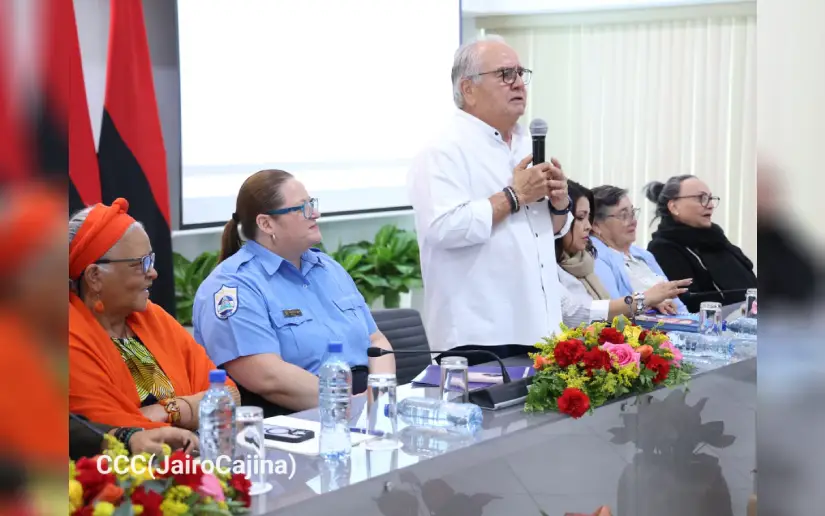
Exposición del Doctor Gustavo Porras Presidente de la Asamblea Nacional
sobre la Propuesta de Reforma
a la Constitución Política
ante el Ministerio del Interior
Viernes 31 de Julio de 2026
En principio, darles la bienvenida a todos los Compañeros del Ministerio del Interior y darle la bienvenida a la Compañera María Amelia Coronel Kinloch, Ministra del Interior. Al Comisionado General Luis Cañas Novoa, Viceministro del Interior; a la Compañera Carla Salinas García, Viceministra del Interior.
También saludamos a los hermanos Comisionados Generales que están al frente de las direcciones: el Comisionado General Ramón Landero Pichardo, Director General de Bomberos; el Comisionado General Julio Orozco, Director General del Sistema Penitenciario; y el Comisionado General Juan Emilio Rivas Benítez, Director General de Migración y Extranjería.
De la misma forma, les damos la bienvenida y, para nosotros, es grato tenerlos a todos ustedes, funcionarios y funcionarias de las Direcciones Generales y del nivel central del Ministerio del Interior.
Antes de comenzar, yo quiero presentarles a los Compañeros que estamos trabajando en la Reforma Electoral, Reforma Constitucional que, claro, tiene que ver con las elecciones. Reforma Constitucional orientada por el Comandante Daniel y la Compañera Rosario. Es decir, la Comisión Especial Constitucional está formada por los Miembros de la Junta Directiva, por los tres Jefes de Bancada, de las bancadas que existen en la Asamblea Nacional, y por dos Miembros presidentes de las comisiones más importantes de la Asamblea Nacional.
Les voy a presentar a la Compañera Doctora Arling Alonso, que es la Primer Vicepresidenta. La Compañera, muy amada por nosotros, Heroína Amada Pineda, Amadita, realmente muy respetada, una mujer histórica; ustedes conocen a Amadita. Es la Segunda Vicepresidenta de la Asamblea. Y a la amiga María Haydee Osuna, que es la Presidenta del Partido Liberal Constitucionalista y Miembro, la Tercera Vicepresidenta de la Asamblea, que ha estado siempre unida, con una posición admirable en términos de patriotismo, junto con todos los Compañeros que están con nosotros.
De la misma forma, les quiero presentar a la Compañera Loria Dixon, ella es la Primer Secretaria; al Doctor Wilfredo Navarro, que es el Segundo Secretario y al amigo Alejandro Mejía Ferretti, que es el Tercer Secretario de la Asamblea. Esos son los Miembros de la Junta Directiva de la Asamblea.
También en la Comisión Especial Constitucional están los tres Jefes de Bancada. Está el Compañero Edwin Castro; probablemente lo conocen ustedes, es el Jefe de la Bancada del Frente Sandinista. Tenemos al amigo Lester Flores, que es el Jefe de la Bancada del PLC.
Y tenemos al amigo Mario Asensio, que es el Jefe de la Bancada BID. La Bancada BID es la Bancada Independiente Democrática que junta varios Partidos, entre ellos el PLI, el ALN y otros Partidos. Él es el responsable de la bancada. Tenemos a los hermanos que son presidentes de dos comisiones muy importantes. La comisión que se llama Producción, Economía y Presupuesto, que conocemos como Comisión Económica, cuyo Presidente es el Doctor Wálmaro Gutiérrez, que está aquí con nosotros. Y la Doctora Auxiliadora Martínez, que es la Presidenta de la Comisión de Justicia.
Nosotros doce, conformamos la Comisión Especial Constitucional. Nosotros tenemos la responsabilidad de cumplir las órdenes de nuestra Jefatura. Y también aquí, entre hermanos, nosotros tenemos clara nuestra Jefatura Suprema, la Jefatura Suprema de todo, la Presidencia: El Copresidente Comandante Daniel Ortega y la Copresidenta Compañera Rosario Murillo. Esas orientaciones y esas órdenes, como ustedes saben, han sido emitidas y esto ha venido orientándose, pero fueron emitidas públicamente el 19 de Julio.
El 19 de Julio, el Comandante Ortega dijo: "Aquí no volverán a haber elecciones que permitan que los enemigos del Pueblo se tomen el Gobierno y se tomen el poder, porque no podemos permitir que echen atrás lo que tanto ha costado y los avances que vamos teniendo". Y dijo también: “Vamos a trabajar con la Asamblea Nacional, otras Instituciones y otras Organizaciones para reformar las Leyes, de tal forma que garanticemos que no podrán, no podrán, no podrán”. Más o menos, esas fueron, casi textuales, las palabras del Comandante Daniel.
Esas órdenes nosotros las asumimos y comenzamos a trabajar, siempre bajo la orientación de la Presidencia, de la Copresidenta y del Copresidente, y comenzamos a proponer conceptos. Pero queremos hacer, en estos 30 minutos, a partir de ahorita, más o menos, una historia del trabajo o, más bien, un relato de los procesos que hemos venido desarrollando.
¿Y por dónde comenzamos nosotros? Comenzamos por la historia de Nicaragua. Cuando a nosotros nos preguntaron qué pensábamos del discurso del Comandante Daniel, nuestra reacción inmediata fue: es un resumen de la historia de Nicaragua. Es decir, nosotros no podemos volver a los tiempos en que nos imponían una Democracia que no es nuestra Democracia. Para nosotros, la Democracia son las elecciones, pero no solo son las elecciones. Es decir, esa es una parte, pero absolutamente ínfima, de nuestro concepto de Democracia.
Nuestra Democracia es la Democracia del derecho de todos. La Democracia de la práctica de género, del 50 y 50. Es la Democracia de que todos tengamos las mismas oportunidades y, además, de que el Estado tenga la responsabilidad de facilitárselas a todos. Esa es nuestra Democracia.
Nuestra Democracia va dirigida a profundizar el poder del Pueblo y por eso, nuestra Democracia viene desarrollando un concepto que es el sello de la estructura social que estamos organizando, que se llama el Pueblo Presidente. Porque el Pueblo Presidente es, en otras palabras, el Pueblo Jefe, y eso significa que nosotros tenemos que hacer cualquier cosa en función de los intereses del Pueblo. Esa es la Democracia que estamos construyendo.
Es la Democracia de desarrollar económicamente el país, de conseguir recursos, pero dirigir todos esos recursos para satisfacer los intereses del Pueblo. Entonces, poco a poco, venimos trabajando en eso con la orientación del Comandante Daniel y la Compañera Rosario. Vamos trabajando y, por eso, en vez de las grandes construcciones privadas, lo que van surgiendo son los grandes hospitales públicos para todos los nicaragüenses.
El HEODRA, el León, el Vélez aquí, el Coro de Ángeles, en Estelí; el Hospital Héroes de la Segovia, el Hospital de Bilwi, el hospital que vamos a construir en Bluefields, el hospital que vamos a construir aquí, en la zona oriental, el Hospital Lesbia Carrasquilla, las centenares de sillas de hemodiálisis; es decir, todo hay que írselo entregando a quien es el Jefe, el Pueblo de Nicaragua. Nuestro concepto de Democracia va más allá de las votaciones.
Cualquier acción que vaya en contra de ese derecho del Pueblo es una acción antidemocrática. Porque la parte de las elecciones, como parte de todo nuestro sistema, tiene que ser absolutamente cuidada en función de los intereses del Pueblo. Es decir, un Proceso o un desarrollo electoral, o un Proceso electoral, no pueden entorpecer ni destruir lo que venimos construyendo. Entonces, eso lo vamos avanzando.
¿Y por qué todo esto, Compañeros? Si ustedes ven, ahí hay tres ideas que son las que están guiando este Proceso: Estabilidad, Seguridad y Paz. Pero esas tres ideas no están puestas ahí simplemente como elementos al aire.
Esas ideas están puestas ahí como elementos necesarios, fundamentales e indispensables para el objetivo común de todos los nicaragüenses. El objetivo común, que lo ha definido perfectamente el Comandante Daniel y la Compañera Rosario y que lo vamos construyendo con esto de lo que hemos hablado nosotros, es el objetivo de derrotar la pobreza. Al fin y al cabo, el verdadero enemigo de todos los nicaragüenses, de toditos, sean sandinistas o no sean sandinistas, seamos pobres, medios o ricos, es la pobreza.
Mientras haya pobreza, nosotros no podemos descansar, porque ese es el objetivo fundamental definido por el Comandante Daniel, la Compañera Rosario y asimilado por toda la organización, por el Frente Sandinista, por todos los Partidos que nos acompañan en este esfuerzo y por todas las Instituciones del Estado. Tenemos que derrotar la pobreza y, para derrotarla, necesitamos Estabilidad, sin duda. Necesitamos Seguridad, sin duda. Y necesitamos Paz, que ustedes nos garantizan en este sentido.
En este recorrido que hemos hecho, comenzamos a ver la historia de nuestro país. Decíamos: ¿por qué el Comandante hizo ese énfasis en que debemos garantizar ese muro de contención, ese bloque a los sectores golpistas y, sobre todo, a los que vienen financiados por las fuerzas extranjeras?
Y la historia de nuestro país es esta: Desde principios del siglo pasado, más bien desde mediados del siglo antepasado, nosotros hemos tenido la muestra de la intervención extranjera. Ya no me voy a remontar al colonialismo español, que todos conocimos y del que nos libramos en 1821.
Me estoy remontando a 1856, cuando vino un yanqui filibustero y dijo: “Yo soy Presidente de Nicaragua”. Armó una faramalla y se erigió Presidente. Hubo tres o cuatro vende patrias, de los que hay siempre, que firmaron, y William Walker fue Presidente de Nicaragua. Pero los nicaragüenses no aguantamos esas cosas y lo desalojamos, pero eso significó guerras, significó división del país.
Hasta que hubo una Revolución Liberal, y la Revolución Liberal acabó como parte de toda esa estructuración social que existía. Entonces apareció el liberalismo como fuerza revolucionaria. Y Zelaya, que es Héroe Nacional, estuvo al frente de esa revolución. Darío, nuestro gran Poeta Universal, Revolucionario Antiimperialista, incluso fue Ministro de Zelaya.
Es decir, esa era una revolución, pero naturalmente, la fuerza enemiga, la fuerza que está al acecho para dominar, vino, presionó a Zelaya, puso cañoneras y apareció aquello que es lo que recordamos nosotros, lo que nos queda en la cabeza: la nota Knox, mediante la cual el Departamento de Estado y los gobiernos de los yanquis sacan a Zelaya.
Y ahí se erige la figura de un Héroe Nacional, el General Benjamín Zeledón y esa figura, ese Héroe Nacional, dio origen a un proceso, porque Sandino, siendo muchacho, vio cómo lo arrastraban por las calles de Catarina y dio origen a un espíritu de lucha que se transformó en el espíritu de lucha que tiene Nicaragua, en el sello, junto con Darío y Sandino, del ser nicaragüense.
Y comenzó la lucha. Pero, en medio de eso, los enemigos, los vende patrias, llamaron a la intervención y apareció la intervención. Y aquí ven que, en 1928, 1930 y 1932, hubo elecciones organizadas y dirigidas por las tropas de ocupación, aquí lo podemos ver.
En 1928 llegaron los marines. Imagínense cómo, después de lo ocurrido en 1927 con el Pacto Nacional, existía el compromiso de los yanquis de colocar al vende patria Moncada. Entonces, los yanquis, en 1928, introdujeron marines para controlar los cantones electorales y, entre otras cosas, nombraron como Presidente del Consejo Nacional de Elecciones al Brigadier General Frank Ross McCoy, a ese nivel llegaba la intervención.
Entonces, vinieron y dijeron: “Sí, van a haber elecciones. Como necesitamos garantizar que salga Moncada, vamos a nombrar, por decirlo así, al Presidente del Consejo Supremo Electoral, al General McCoy”. Es más, estas elecciones estaban montadas sobre una Ley que se había aprobado en 1923. Una Ley Electoral de 1923 que, si ustedes la buscan en los buscadores, la van a encontrar como la Ley Dodds.
Por la firma o la creación de un académico yanqui de apellido Dodds, a quien el Gobierno yanqui envió para que fuera el Asesor del Presidente de Nicaragua y elaborara la Ley electoral. Es decir, era una Ley hecha por los Yanquis, con la orientación de que el Congreso de ese tiempo la aprobara por instrucciones del Gobierno yanqui. Y están los telegramas expresos y todos los documentos originales. Y, para ejecutar y hacer realidad eso, nombraron como presidente del Consejo Nacional Electoral a un General yanqui.
Pero, además, no solo eso; en los registros históricos aparece que cada mesa estaba presidida por marines yanquis. Y esa era la aparente Democracia, la falsa Democracia, que era la intervención yanqui y el dominio yanqui disfrazados de Democracia. Entonces, eso nos dio la pauta para tener una argumentación sólida. No podemos volver a eso; no es posible, no nos calza, eso no nos puede calzar.
Pero ¿cuál era la idea? Antes de eso, deja la papeleta. ¿Cuál era la idea? La ley Dodds lo que hizo fue crear una copia, más o menos, del modelo yanqui que estableció el bipartidismo, lo que todos conocimos como las paralelas históricas: liberales y conservadores. Entonces, se produjo la creación del bipartidismo.
Aquí está: En 1923 se promulgó la ley electoral conocida como Ley Dodds. En esta Ley se estableció el Consejo Nacional de Elecciones, que trató de institucionalizar el bipartidismo, aquí están el conservador y el liberal. Por el Partido Conservador estaba Adolfo Díaz y, por el Partido Liberal, Juan Bautista Sacasa. Este es el vende patria que mandó a traer a los yanquis y este es el de la última cena con el General Sandino, entonces, esas eran las realidades. Esta es la Ley Electoral de Abril de 1923.
Esta es la Ley Electoral Dodds. Pero solo para llamar la atención, para que tengamos una idea de cuál era la población electoral y quiénes votaban. Nosotros ahora decimos que votan todos los que son mayores de 16 años y que tienen su cédula. Ahí, ¿quiénes votaban? En vez de decir que todos los nicaragüenses tienen derecho a votar, a elegir y a ser electos, aquí, más bien, desde el inicio, se establecía una disposición restrictiva: “Ningún ciudadano tendrá derecho de votar si no reúne las condiciones y calificaciones requeridas por la Constitución”.
Ese es un hecho, es un axioma general. Nosotros lo podemos poner en cualquiera. Ahora, el problema es el siguiente: ¿cuáles son las condiciones? “El derecho del sufragio pertenece solamente a los varones nicaragüenses de 25 o más años de edad”. Claro, me pueden decir: “Sí, pero eso fue hace 100 años”; pero ese era el espíritu.
Ahora, eso va calculando. Es decir, si yo tengo una población de 100 y, por ponerlo tana catana: 50 son mujeres, ya solo me queda una población votante de 50. Pero, además, dice que deben tener 21 años o más de edad. Eso me reduce la población votante, probablemente, a unas 20 personas, porque, en ese tiempo, la estructura demográfica indicaba que la enorme mayoría de los nicaragüenses éramos menores de 20 años.
Pero, además, podían votar los de 18 años o más si eran casados o sabían leer y escribir. Imagínense el nivel de alfabetismo que existía en aquel tiempo y, cuando se decía que eran casados, se hacía referencia al matrimonio por la iglesia. Fue la Revolución Liberal la que habló del matrimonio civil y de los registros, entiendo que así fue, antes era la Iglesia.
Por eso, todavía en nuestros tiempos, cuando se obtenían partidas de nacimiento, se pedía la fe de bautismo; es decir, se preguntaba si la persona había sido bautizada o no, porque, si no había sido bautizada, prácticamente no existía. Ese era el poder que existía. Ese era el poder que trastocó la Revolución Liberal. Ese era el poder que quisieron restaurar todos esos sectores que llevan el apellido Chamorro y otros personajes. Y ese es el poder por el que apostaban los yanquis, o por el que apuestan. Pero, bueno, esta es la historia.
Después de eso, aquí hay un dato importante. No se quedaron así y, sobre esa Ley, montaron una reforma, un decreto. Un decreto, una reforma que llamaron la Ley McCoy, en honor a quien iba a ser el Jefe y me estoy deteniendo con ustedes en toda esta historia porque es importante. Ustedes son una fuerza vital para la defensa, para el sentimiento antiimperialista de nuestro país y para la Seguridad de nuestro país.
Miren a qué nivel estaba esto: Poder Ejecutivo, Cartera de Gobernación y Policía. Esto era como el Ministerio del Interior de ese tiempo; así se llamaba: Cartera de Gobernación y Policía.
Y dice:
“En vista de que la Corte Suprema de Justicia, por acuerdo de 17 del corriente mes, ha nombrado, en sustitución del señor Doctor don Joaquín Gómez, que elevó su renuncia, al señor General Frank Ross McCoy, Presidente del Consejo Nacional de Elecciones, y que este alto funcionario, en ese carácter y por haber sido designado por el señor Presidente de los Estados Unidos, debe dirigir el acto electoral de 1928 de autoridades supremas, conforme a lo convenido para poner término a la guerra civil que asolaba a Nicaragua”.
Esa era la introducción de esa Ley. Después de eso venía ya la Ley, el considerando y los demás elementos. Entonces, este es el antecedente, esto es lo que no va a volver. Esto es lo que estamos destruyendo día a día, año con año y eso es lo que estamos destruyendo ahorita. Por eso surge la alharaca de que se va a hacer todo a su modo. No, esta es una Reforma de los nicaragüenses para los nicaragüenses, para organizar las elecciones en Nicaragua, donde votan los nicaragüenses y no las fuerzas extranjeras.
Ahora, aquí hay dos elementos, o tres, que tal vez, en la parte histórica, tenemos que recordar. Uno de ellos, que no se nos puede olvidar, es que en 1990, en las elecciones de ese año, nos pusieron una pistola en la cabeza. Nosotros respetamos el voto del Pueblo, organizamos unas elecciones absolutamente limpias, pero los yanquis nos pusieron una pistola en la cabeza.
Eso no fue una elección libre. Le dijeron al Pueblo nicaragüense: “Si votan por los sandinistas, la guerra va a seguir”. Y el Pueblo es inteligente. ¿Quién quiere la guerra? y también fue inteligente, como parte del Pueblo, el Frente Sandinista, el Comandante Daniel, la Compañera Rosario y nuestros mandos. En ese momento dijeron: “Sí, entregamos”. Y recuerden que el Comandante Daniel dijo: “Vamos a volver por la vía de los votos”, que fue lo que hicimos, vamos a regresar al Gobierno por la vía de los votos.
Eso es lo que nosotros no podemos permitir que vuelva a repetirse. ¿Y cómo hicieron eso? Crearon un muñeco, lo pusieron de blanco y crearon una ilusión; pero, además, te ponían el muñeco de blanco y te apuntaban a la cabeza. Entonces, nosotros no podemos permitir eso ahora.
Recuerden también, los que tienen más de 40 años, o tal vez puedan recordarlo, que aquí hubo un embajador gringo, de apellido Garza, que andaba entregando paquetes de comida junto con el candidato opositor o, más bien, con el candidato de ellos al lado, porque éramos nosotros los que estábamos en la oposición. Andaban entregando paquetes de comida. ¿Esas son elecciones libres? ¿Esa es la Democracia? No. La Democracia son las elecciones que vamos a organizar nosotros para los nicaragüenses.
Entonces, este objetivo, porque este es el Artículo 1 de la Constitución y ese es el objetivo que nosotros tenemos que profundizar, argumentar y no olvidar:
La Independencia, la Soberanía y la Autodeterminación Nacional, la Seguridad y la Paz son Derechos irrenunciables del Pueblo y fundamentos de la nación nicaragüense. Toda injerencia extranjera en los asuntos internos de Nicaragua o cualquier intento de menoscabar esos Derechos, atenta contra la vida del Pueblo. Es deber de todos los y las nicaragüenses preservar y defender esos Derechos. Por consiguiente, todos aquellos o aquellas que atenten contra esos Sagrados Derechos del Pueblo nicaragüense serán considerados Traidores a la Patria.
Ese es el Artículo 1. Es completo, es perfecto, es exacto; pero hay que interiorizarlo y hay que operativizar su ejecución. Entonces, nosotros tenemos que operativizar la ejecución de esto en el marco jurídico y legal de los Procesos electorales.
Para esto, nosotros hemos desarrollado seis conceptos. Para decírselo a ustedes, eso significa que vamos a reformar catorce artículos de la Constitución actual, pero en una Ley de Reforma en la que habrá seis artículos, porque la propuesta que tenemos, y sobre la que queremos escuchar la opinión de ustedes, es que cada Artículo exprese uno de los conceptos que vamos a reformar.
El primer concepto es: "No podrán". Nosotros tenemos que organizar un Artículo de Reforma Constitucional bajo este concepto: "No podrán". El Artículo 47 de la Constitución dice que: “Las y los ciudadanos tienen derecho a elegir y ser electos y a optar a cargos públicos, salvo las limitaciones contempladas en esta Constitución Política”.
Entonces, “No podrán ser candidatos a cargos de elección popular ni podrán ejercer cargos públicos por designación de la Presidencia o por elección de la Asamblea Nacional los golpistas”. No sé si alguien va a estar de acuerdo con que un golpista pueda ser candidato a algo.
Tampoco podrán hacerlo “Los que incurran o hayan incurrido en actos que menoscaben la Independencia, la Soberanía y la Autodeterminación de Nicaragua”. Es decir, aquellos que violen el Artículo 1 de la Constitución. Los Traidores a la Patria y no solo los que actualmente lo sean, sino también quienes puedan llegar a aparecer, porque acuérdense de que eso es el resultado de un Proceso judicial: te acusan de un delito y, si se determina que eres culpable de traición a la Patria, sos un traidor a la Patria.
Ahora, el traidor a la Patria pierde la nacionalidad. De todos modos, no puede ejercer esos Derechos. Tampoco podrán hacerlo “Quienes violenten o hayan violentado los Principios Fundamentales contemplados en la Constitución Política”. Ese es el primer concepto: “No podrán”, eso lo vamos a organizar en un Artículo.
Ahora, quisimos poner íntegramente este párrafo de lo que proponemos que será el texto escrito, porque no basta con decir: “Aquellos que menoscaben o atenten contra la Independencia, la Soberanía y la Autodeterminación”. Y, para que quede claro: “Aquellos que inciten o promuevan la injerencia extranjera, pidan intervención militar, se organicen con financiamiento proveniente del extranjero, propongan, gestionen o respalden bloqueos económicos, comerciales o financieros y sanciones contra el Estado de Nicaragua, sus Instituciones y sus ciudadanos”. Para que quede clarito qué es o quiénes son los que no podrán.
El segundo concepto es la “Estabilidad”. En este concepto nosotros decimos que necesitamos, como ya lo vimos, Estabilidad para luchar contra la pobreza; Estabilidad que, junto con la Seguridad y la Paz, nos garantice esa lucha contra la pobreza. Entonces, en este concepto de Estabilidad, hemos revisado y existen diversos períodos en el mundo. Hay países que tienen períodos de cuatro años; otros, de cinco; otros, de seis.
Recientemente, hubo un país que pasó de cinco a seis años. Hace poco, nosotros mismos habíamos pasado de cinco a seis años. Entonces, en esa discusión, lo que nos parece un período aceptable para desarrollar proyectos de mediano plazo o incluso de largo plazo, en esta lucha contra la pobreza, es el de siete años.
Entonces, ahí la redacción es la siguiente: “El período establecido en la Constitución Política de la República de Nicaragua para los cargos de elección popular y para los de elección o ratificación por la Asamblea Nacional es de siete años”. Ese es el planteamiento.
Entonces, el otro concepto es “Cohesión y Seguridad”. Ser coherentes o estar cohesionados, porque no solo se trata de la parte de las elecciones populares, los cargos de elección popular o los cargos designados, sino también lo que tiene que ver con el Ejército y la Policía.
Entonces, en este concepto se deja claro, mediante un Artículo, que este es el tercer concepto: “Los períodos de nombramiento del Comandante en Jefe de las Fuerzas Militares del Ejército de Nicaragua y de los Jefes de las Fuerzas Policiales de Nicaragua serán de siete años”. ¿Para qué? Para que sea concordante con todo lo demás.
Entonces, por eso le pusimos Cohesión y Seguridad. ¿Por qué? Porque son las fuerzas que, junto con el Pueblo, acuérdense de que nuestro concepto es el de Pueblo Presidente que constituye la fuerza vital para poder construir lo que estamos construyendo y es el Pueblo la fuerza principal. Todos nosotros somos mecanismos, instrumentos y auxiliares de la fuerza del Pueblo, entonces, son siete años.
Después viene el tema de las Atribuciones del Consejo Supremo Electoral. Yo estaba pensando que, a lo mejor, podemos valorar en la reunión que tengamos si se puede cambiar por un concepto más nuestro, por ejemplo, “Nuestra Democracia”. Porque este es el instrumento de la parte democrática electoral.
Se trata de las atribuciones del Consejo Supremo Electoral. Como ustedes vieron en el Artículo 1, o en el primer concepto, y en los otros conceptos, ya estamos hablando de que los cargos serán cada siete años, es decir, del período de los cargos. Tenemos que dejar claro que las elecciones deberán realizarse cada siete años y tenemos que dejar claro que el instrumento del Estado que dirige y organiza las elecciones, que es el Consejo Supremo Electoral, debe tener la facultad de convocarlas cada siete años.
Y eso es lo que tratamos de establecer aquí:
Organizar y dirigir las Elecciones Generales, Municipales y Regionales cada siete años, en el año electoral que corresponda.
¿Por qué? Porque se mantienen las elecciones nacionales, al año siguiente las municipales y, posteriormente, las regionales. Este es el numeral 1 del Artículo 152.
Y se agregan estos dos elementos al numeral 12 del Artículo 152: “No otorgar personalidad jurídica a Partidos Políticos constituidos con financiamiento extranjero o cuando algunos de sus directivos hayan violentado los Principios Fundamentales de esta Constitución Política”. Y, “Cancelar la Personalidad Jurídica del Partido cuando este, sus directivos o sus candidatos reciban financiamiento extranjero o hayan violado dichos principios".
Si por un lado decimos que pierden los Derechos Políticos, por otro decimos que el Consejo Supremo Electoral debe garantizar eso, tanto para los candidatos como para los Partidos.
Y, en el numeral 14:
“Verificar e imponer las sanciones correspondientes a todo candidato o candidata, funcionario o funcionaria del Órgano Electoral e integrante de la Junta Directiva de los Partidos Políticos que incurra o haya incurrido en actos que menoscaben la Independencia, la Soberanía y la Autodeterminación de Nicaragua.
Y ahí volvemos a poner el párrafo que les leí, donde se menciona a los que llamen a la intervención militar y a los que promuevan la injerencia extranjera, porque eso hay que repetírselo, para que quede claro. Ese es el concepto del “no podrán”, que nos transmitió el Comandante Ortega: no habrá elecciones para que ellos vuelvan. Entonces, sí va a haber elecciones, pero vamos a garantizar que los demonios estos, no vuelvan.
El traspaso de Gobierno, constitucionalmente, estaba establecido para el 10 de Enero y estábamos cometiendo una enorme injusticia. El 18 de Enero es el nacimiento de Rubén Darío. Entonces, vamos a proponer la modificación de los Artículos 123 y 130 de la Constitución, para que estemos claros de que la fecha de toma de posesión del Copresidente y la Copresidenta de la República será el 18 de Enero, en Homenaje a nuestro Héroe Nacional y Poeta Universal, Rubén Darío.
Y, claro, como la Asamblea Nacional se instala un día antes, es necesario modificar el Artículo 130, para que establezca que el 17 de Enero es cuando toman posesión los Diputados y Diputadas y se instala la Asamblea Nacional, que es la que realiza la toma de posesión al día siguiente. Entonces, a este concepto le pusimos “PAX”, que es el poema de Rubén Darío, muy bello y que hay que leer.
Y, finalmente, este es el último. Son seis conceptos; por eso los nombramos, para que no se nos olviden, son relativamente fáciles. Primero, “No podrán”; después, la “Estabilidad”; luego, la “Cohesión y Seguridad”; posteriormente, lo relacionado con el “Consejo Supremo Electoral”, es decir, la garantía de la Democracia; después, “PAX”; y, por último, la “Coherencia”.
Este es el último: “Coherencia”: Muchos, cuando comenzamos a trabajar en ello, y lo vivimos en la experiencia del año pasado, preguntaban: "Bueno, ¿y qué va a pasar con los que están actualmente en sus cargos, con los que han sido resultado de un Proceso electoral anterior o con los que han sido designados o nombrados antes?". Porque esto se incorpora a la Constitución a partir de hoy. Entonces, ¿qué va a pasar? Que no quede duda y que todo el mundo esté claro. Por eso le llamamos “Coherencia”, porque el cambio también debe ser coherente con la realidad. Entonces, son tres numerales, bajo este concepto.
Por mandato y estricta observancia de la Supremacía constitucional:
Los períodos de las autoridades electas por el voto popular en las últimas elecciones generales, municipales y regionales vigentes quedan ampliados a siete años.
Entonces, queda ese mandato. Este es una especie de transitorio dentro de la Ley de Reforma Constitucional.
Se amplía a siete años el período de los cargos designados por la Presidencia de la República o por elección o ratificación de la Asamblea Nacional.
En toda la legislación nacional en la que se estipule o regule un período de funciones, se entenderá reformado de pleno derecho y se establecerá que el período es de siete años.
Con eso le damos Coherencia a todo. Aquí aparecen los cargos, los colocamos aquí porque son bastantes, pero solo para tener una idea ¿Cuáles son esos cargos?
El Comandante en Jefe de las Fuerzas Militares y de las Fuerzas Policiales; los Jefes; los Magistrados y Magistradas de la Corte Suprema; los Magistrados y Magistradas del Consejo; el Procurador o la Procuradora General de Justicia; los Miembros del Consejo Superior de la Contraloría General de la República; la Presidenta o el Presidente del Banco Central; los Miembros del Consejo Monetario Financiero; el Superintendente y el Vice-superintendente de Bancos; el Presidente o los Miembros del Consejo Directivo del Banco de Fomento a la Producción; los Miembros del Consejo Directivo de la Comisión Nacional de Microfinanzas; los Miembros del Tribunal Aduanero Tributario Administrativo; los Miembros del Consejo Nacional de Administración y Carrera Judicial; el Consejo Directivo del INE; el Director o Director Ejecutivo de la Autoridad Nacional del Agua; y los Miembros de la Comisión de Apelación del Servicio Civil.
Esos son los cargos a los que se hace referencia, solo para que tengamos una idea. Con esto creemos que vamos a hacer, y con el apoyo y las ideas de ustedes, una Ley de Reforma Constitucional que responda al mandato del Comandante Daniel y de la Compañera Rosario y, por encima de todo, a las necesidades del Pueblo y al camino que hemos emprendido en la lucha contra la pobreza.
Asimismo, esperamos que, de una vez por todas, toda Nicaragua participe, porque vamos a realizar un Proceso de Consulta muy amplio y un amplio Proceso de divulgación, y vamos a seguir trabajando. Nosotros esperamos que, en cada uno de los casos y con cada una de las personas con las que vamos trabajando, se transforme también un abanderado, un defensor y un divulgador de estas necesidades.
Es decir, ahora hay que comentarlo: nosotros no podemos permitir que vuelva a venir un yanqui a decirnos cómo deben hacerse las cosas. No van a poder, porque eso no nos calza; pero, además, hay que dejarlo establecido constitucionalmente. Acuérdense de que la Constitución es la base, el fundamento; por eso se le llama Ley fundamental, es lo que le da la vida jurídica al País y a la Nación. Lo que está ahí debemos defenderlo con la vida misma, eso lo sabemos y eso es lo que tenemos que hacer.
Bueno, yo dejo el mando aquí a la Compañera.
---------------------------------------------------------------------------------------------------
Presentation by Dr. Gustavo Porras
President of the National Assembly
on the Proposal to Amend the Political Constitution
before the Ministry of the Interior
Friday, July 31st 2026
To begin with, welcome to all the Compañeras and Compañeros of the Ministry of the Interior and welcome to Compañera María Amelia Coronel Kinloch, Minister of the Interior. To Commissioner General Luis Cañas Novoa, Deputy Minister of the Interior; to Compañera Carla Salinas García, Deputy Minister of the Interior.
We also greet our brothers the Commissioners General who are at the head of the different directorates: Commissioner General Ramón Landero Pichardo, Director General of the Fire Service; Commissioner General Julio Orozco, Director General of the Penitentiary System; and Commissioner General Juan Emilio Rivas Benítez, Director General of Migration and Foreign Citizens.
Similarly, we welcome you all and, for us, it is a pleasure to have all of you, officials of the General Directorates and the central leadership of the Ministry of the Interior.
Before starting, I want to introduce to you the Compañeras and Compañeros with whom we are working on Electoral Reform, the Constitutional Reform which, of course, has to do with elections. a Constitutional Reform ordered by Comandante Daniel and Compañera Rosario. That is to say, the Special Constitutional Commission is formed by the Members of the National Asembly’s Executive Board, by the three heads of the political groupings, the groupings that exist in the National Assembly, and by the presidents of the two most important commissions of the National Assembly.
I'm going to introduce you to my colleague Dr. Arling Alonso, who is the National Assembly’s First Vice President. Also the Compañera, much loved by us, the Heroine Amada Pineda, Amadita, very much respected, a historic woman; you know Amadita. She is the second Vice-President of the Assembly. And to my friend Maria Haydee Osuna, who is the president of the Liberal Constitutionalist Party and a Member, the Third Vice President of the Assembly, who has always been united with an admirable position in terms of patriotism, along with all the Compañeras and Compañeros who are with us.
Similarly, I would like to introduce you to the Compañera Loria Dixon, she is the First Secretary; to Doctor Wilfredo Navarro, who is the Second Secretary and to our friend Alejandro Mejía Ferretti, who is the Third Secretary of the National Assembly. Those are the Members of the Executive Board of the Assembly.
Also in the Special Constitutional Commission are the three heads of the political groupings. There is Compañero Edwin Castro; you probably know him, he is the head of the Sandinista Front grouping. We have our friend Lester Flores, who is the head of the PLC grouping.
And we have our friend Mario Asensio, who is the head of the BID grouping. The BID grouping is the Democratic Independent grouping that brings together several political parties, including the PLI, the ALN and other parties. He is responsible for that grouping. We have our brother and our sister who are presidents of two very important commissions. The commission that is called Production, Economy and Budget, which we know as the Economic Commission, whose president is Dr. Wálmaro Gutiérrez, who is here with us. And Dr. Auxiliadora Martínez, who is the president of the Justice Commission.
The twelve of us form the Special Constitutional Commission. We have the responsibility to carry out the orders of our superiors. And also here, in this fraternal setting, we have our Supreme Leadership clear, the Supreme Leadership of us all, the Presidency: Co-President Comandante Daniel Ortega and Co-President Compañera Rosario Murillo. Their guidelines and orders, as you know, have been issued and this process has been following that guidance, but this was issued publicly on July 19th.
On July 19th Comandante Ortega said: There will never again be elections here that allow the enemies of the People to take over the government and take power, because we cannot allow them to roll back what has cost so much and the advances that we have made. And he also said: We are going to work with the National Assembly, other Institutions and other Organizations to reform the Laws, in such a way that we guarantee that they will not prevail, they will not be able to, they will not be able to. More or less, that was, almost verbatim, what Comandante Daniel said.
We took on these orders and set to work, always under the guidance of the Presidency, the Co-Presidents, and began to propose concepts. But we want to make, in these 30 minutes, from now on, more or less a history of the work or, rather, an account of the processes that we have been developing.
So where do we start? Let's start with the history of Nicaragua.
When we were asked what we thought of Comandante Daniel's speech, our immediate reaction was to say it is a summary of the history of Nicaragua. That is to say, we cannot return to the times when they imposed on us a democracy that is not our democracy. For us, democracy is elections, but it's not just elections. That is to say, that is just one part, absolutely insignificant, for our concept of democracy.
Our democracy is the democracy of everyone's rights. The democracy of gender equity, 50-50. It is the democracy where we all have the same opportunities and, in addition, that the State has the responsibility to provide those opportunities to everyone. That is our democracy.
Our Democracy is aimed at deepening the power of the People and that is why our Democracy has been developing a concept which is the hallmark of the social structure we are organizing, which is called the People President. Because the People President are, in other words, the People-in-Chief, and that means that we have to do everything based on the interests of the People. This is the democracy we are building.
It is the democracy of developing the country economically, of securing resources, but directing all those resources to satisfy the interests of the People. So, little by little, we have been working on this model with the guidance of Comandante Daniel and Compañera Rosario. We are working and, therefore, instead of large private buildings, what are appearing are large public hospitals for all Nicaraguans.
The HEODRA in León, the Vélez Paíz here, the Choir of Angels, in Estelí; the Heroes of the Segovias Hospital, the Bilwi Hospital, the hospital that we are building in Bluefields, the hospital that we are going to build here, in the eastern part of Managua, the Lesbia Carrasquilla Hospital, the hundreds of hemodialysis units; that is, everything must be handed over to the one in charge which is the People of Nicaragua. So our concept of democracy goes far beyond voting.
Any action that goes against the rights of the People is an undemocratic action. Because the role of elections, as one component of our whole system, has to be dealt with based absolutely on the interests of the People. In other words, an electoral process or its development, or a voting process, cannot be allowed to hinder or destroy what we have been building. So, we're moving forward with that.
And why all of this, compañeras and compañeros? As you can see, there are three ideas guiding this Process: Stability, Security and Peace. But those three ideas are not put there simply as elements plucked out of the air.
These ideas are placed there as necessary, fundamental and indispensable elements for the common goal of all Nicaraguans. The common goal, which has been perfectly defined by Comandante Daniel and Compañera Rosario and which we are building with what we have just talked about, is the goal of defeating poverty. After all, the real enemy of all Nicaraguans, of everyone, whether they are Sandinistas or not, whether we are poor, doing ok or wealthy, is Poverty.
As long as there is Poverty, we cannot rest, because that is the fundamental objective defined by Comandante Daniel, Compañera Rosario and assimilated by the entire organization, by the Sandinista Front, by all the political parties accompanying us in this effort and by all the State Institutions. We have to defeat poverty and, to defeat it, we need stability, without a doubt. We need security, categorically. And we need Peace, which you all guarantee for us in this regard.
In this journey that we have made, we began to see the history of our country. We were saying to ourselves: why did the Comandante put such emphasis that we must guarantee that containment wall, that barrier to the coup promoters and, above all, to those financed by foreign forces?
And the history of our country is this: Since the beginning of the last century, rather since the middle of the century before, we have had the demonstration of foreign intervention. I am no longer going to go back to Spanish colonialism, which we all know about and got rid of in 1821.
I'm going back to 1856, when a Yankee filibuster came and declared, “I'm the President of Nicaragua." He set up a charade and became President. There were three or four sell-outs, of which there are always some, who signed and made William Walker President of Nicaragua. But we Nicaraguans did not put up with such a thing and we expelled him, but that meant war, it meant division of the country.
Until there was a Liberal Revolution, but the Liberal Revolution ended up becoming a part of all the social structures that existed then. Later, Liberalism appeared as a revolutionary force. And Zelaya, who is a National Hero, was at the forefront of that Revolution. Darío, our great universal poet and anti-imperialist revolutionary, was even a Minister for Zelaya.
That is to say, that was indeed a revolution, but naturally, the enemy forces, the forces lurking, waiting to dominate, came, put pressure on Zelaya, sent their gunboats and there appeared as we remember, what we recall as the Knox note, via which the State Department and the Yankee government removed Zelaya.
And there stands the figure of a National Hero, General Benjamín Zeledón, and that figure, that National Hero, gave rise to a process, because Sandino, as a boy, saw how Benjamín Zeledón was dragged through the streets of Catarina and that gave rise to a fighting spirit that became the fighting spirit of Nicaragua, the hallmark, along with Darío and Sandino, of being Nicaraguan.
And the struggle began. But, in the midst of it all, the enemies, the sell-outs, called for intervention and intervention appeared. And here you can see how, in 1928, 1930 and 1932, elections were organized and directed by the occupation troops, here we can see it.
In 1928 the Marines appeared. Imagine how, after what happened in 1927 with the National Pact, that was a commitment by the Yankees to elevate the sell-out Moncada. So then, the Yankees, in 1928, introduced marines to control the electoral districts and, among other things, appointed Brigadier General Frank Ross McCoy as President of the National Elections Council, the intervention reached right up to that level.
So, they came along and said, "Yes, there are going to be elections. Since we need to guarantee that Moncada wins, we are going to appoint, so to speak, the president of the Supreme Electoral Council, General McCoy.” Moreover, these elections were based on a law that had been passed in 1923. An Electoral Law from 1923 that, if you look for it in the search engines, you will find it is known as Dodds’ Law.
Thanks to it being signed or created by a Yankee academic called Dodds, whom the Yankee government sent to be the adviser to the President of Nicaragua and to produce the electoral Law. That is to say, it was a law made by the Yankees, with the order that the Congress of that time should approve it on instructions from the Yankee Government. And on that there are the express telegrams and all the original documents. So, to execute and make that all a reality, they appointed a Yankee General as president of the National Electoral Council.
But, besides, not only that; in the historical records it appears that each voting urn was presided over by Yankee Marines. And that was the apparent Democracy, the false Democracy, which was after all Yankee intervention and Yankee domination disguised as Democracy. So, the Presidency gave us the guideline so as to have a solid argument. We can't go back to that; it's not possible, it doesn't sit well with us, it doesn't suit us.
But what was the idea? Before that, or any vote cast. What was the idea? What the Dodds Act did was to create a copy, more or less, of the Yankee model that established bipartisanship, which we all know from its historical parallels: the Liberals and Conservatives. It was then that the creation of bipartisanship occurred.
Here it is: In 1923 the electoral law known as the Dodds Act was enacted. In this Law the National Elections Council was established, which tried to institutionalize a bipartisan system, here the Conservative and the Liberal. For the Conservative Party there was Adolfo Díaz and, for the Liberal Party, Juan Bautista Sacasa. The former is the sell out who was sent to invite in the Yankees and the latter is the one who held the last dinner with General Sandino, so, that was the reality. Here’s the Electoral Law of April 1923.
This is the Dodds Election Act. But just to draw your attention, so that we have an idea of what the electoral population was and who was able to vote. We now say that everyone who is over the age of 16 and has their ballot paper votes. Back then, who was voting? Instead of saying that all Nicaraguans have the right to vote, to elect and to be elected, rather, here, from the beginning, a restrictive provision was established: “No citizen will have the right to vote if he does not meet the conditions and qualifications required by the Constitution.”
That's a fact, it's a general axiom. We can apply it to anyone. Now, the problem is this: what are those conditions? "The right to vote belongs only to Nicaraguan men 25 years of age or older.” Of course, you can say to me, “Yes, but that was 100 years ago”; but that was the spirit.
Now, let's do a calculation. That is to say, if I have a population of 100 and, to put it bluntly: 50 are women, I only have a voting population of 50 left. But, in addition, it says that they must be 21 years of age or older. That reduces the voting population, probably, to about 20% of people, because, at that time, the demographic structure indicated that the vast majority of Nicaraguans were under the age of 20.
But, in addition, those aged 18 or over could vote if they were married or could read and write. Imagine the level of literacy that existed at that time and, when it was said that they were married, the marriage referred to marriage by the church. It was the Liberal Revolution that talked about civil marriage and registrations, I understand that before it was like that, marriage had to be in Church.
That is why, even in our times, when birth certificates were processed, the faith of baptism was requested; that is, it was asked whether the person had been baptized or not, because, if he had not been baptized, he practically did not exist. That was the power that existed in those days. That was the power that the Liberal Revolution disrupted. That was the power that all those sectors with the surname Chamorro and other characters back then wanted to restore. And that's the power the Yankees were betting on, or are still betting on. But, well, there's the story.
After that, here is an important fact. They did not leave things that way and, on top of that Law, they mounted a reform via a decree. A decree, a reform that they called the McCoy Law, in honor of the person who was going to be put in charge and I'm dwelling on this whole story with you because it's important. You are a vital force for the defense, for the anti-imperialist sentiment of our country and for the security of our country.
Look at what level this was taking place at: Executive Power, Government portfolios and Police. This was like the Ministry of the Interior of that time; that's what it was called: the Ministry of the Interior and the Police. And it says: "In view of the fact that the Supreme Court of Justice, by agreement of the 17th of this month, has appointed, in place of Señor Doctor Don Joaquín Gómez, who submitted his resignation, Mr. General Frank Ross McCoy, becomes president of the National Elections Council, and this high official, in that capacity and because he was appointed by the President of the United States, must direct the 1928 electoral process for supreme authorities, as agreed in order to put an end to the civil war ravaging Nicaragua.”
That was how that law was introduced. After that came the Law’s adoption and the other elements. So, this is the antecedent, this is what is not going to come back. This is what we are destroying day by day, year by year and this is what we are destroying right now. That is why the false claim is made that everything is going to be done willy nilly. No, this is a reform by Nicaraguans for Nicaraguans, to organize elections in Nicaragua, where Nicaraguans vote and not foreign forces.
Now, here are two elements, or three, that perhaps, in the historical part, we need to remember. One of them, which we cannot forget, is that in 1990, in the elections of that year, they put a gun to our head. We respected the people's vote, we organized an absolutely clean election, but the Yankees still put a gun to our head.
That election was not a free choice. They told the Nicaraguan people: "If you vote for the Sandinistas, the war will continue." And the people are smart. Who wants war? and also, as part of the people, the Sandinista Front, Comandante Daniel, Compañera Rosario and our Comandantes were intelligent. At that point they said, "Yes, we’ll hand over power." And remember that Comandante Daniel said, "We are going to return by way of votes,” which is what we did, we returned to government by way of votes.
That is a process we cannot allow to happen again. And how did they achieve that? They created a doll, dressed her in white and created an illusion; but, in addition, they put the doll in white and pointed a gun at our head. So, we can't allow that again now.
Remember also, those who are over 40 years old, or maybe you can remember, that there was a gringo ambassador here, surnamed Garza, who went around delivering food packages together with the opposition candidate or, rather, with their candidate next to him, because at the time it was we who were in the opposition. They were delivering food packages. Can these be free elections? Is that democracy? No. Democracy is the elections that we are going to organize for Nicaraguans.
So, this objective, because this is Article 1 of the Constitution and that is the objective we have to deepen, argue for and never forget:
Independence, Sovereignty and National Self-Determination, Security and Peace are inalienable Rights of the People and foundations of the Nicaraguan nation. Any foreign interference in the internal affairs of Nicaragua or any attempt to undermine those Rights threatens the life of the People. It is the duty of all Nicaraguans to preserve and defend these rights. Consequently, all those who violate these Sacred Rights of the Nicaraguan People will be considered traitors to the Nation.
That is Article 1. It is complete, it is perfect, it is exact; but it must be internalized and its execution must be put into practice. So, we have to put the execution of all this into practice in the legal and juridical framework of the electoral processes.
For this, we have developed six concepts. Just so you know, this means that we are going to reform fourteen articles of the current Constitution, but in a Reform Law in which there will be six articles, because the proposal we have, and on which we want to hear your opinion, is that each Article expresses one of the concepts that we are going to reform.
The first concept is: "They will not prevail". We have to organize a Constitutional Reform Article under this concept: "They will not prevail". Article 47 of the Constitution states that: "Citizens have the right to elect and be elected and to run for public office, except for the limitations provided for in this Political Constitution.”
Therefore, Coup promoters may not be candidates for popularly elected positions, nor may they hold public offices by appointment of the Presidency or by election of the National Assembly. I doubt whether anyone is going to agree that a coup leader can be allowed to be a candidate for something.
Nor will “those who have committed or are carrying out acts that undermine the Independence, Sovereignty and Self-determination of Nicaragua” be able to do so. That is, those who violate Article 1 of the Constitution. Traitors to the Nation and not only those who are currently traitors, but also those who may do so, because remember that this is the result of due judicial Process: you are accused of a crime and, if it is determined that you are guilty of treason, you are a traitor to the Nation.
Now, a traitor to the Nation loses their nationality. You cannot exercise those Rights at all. Nor may “Those who violate or have violated the fundamental principles contemplated in the Political Constitution”. That's the first concept: "They won't prevail”, and we're going to organize that in an Article.
Now, we wanted to put this paragraph of what we propose to be the written text in its entirety, because it is not enough to say: "Those who undermine or threaten Independence, Sovereignty and Self-Determination." And too, just to be clear: “Those who incite or promote foreign interference, call for military intervention, organize with financing from abroad, propose, manage or support economic, commercial or financial blockades and sanctions against the State of Nicaragua, its institutions and its citizens.” To make clear what it is to be a traitor and who are the people who will not prevail.
The second concept is Stability. In this concept we say that we need, as we have already seen, Stability to fight poverty; stability that, together with Security and Peace, guarantees the fight against poverty. So, in relation to this concept of Stability, we have reviewed it and there are various electoral periods in the world. There are countries that have periods of four years; others, of five; others, of six.
Recently, there was a country that changed from five to six years. Recently, we had changed from five to six years ourselves. So, in that discussion, what seems to us an acceptable period to develop medium-term and even long-term projects, in this fight against poverty, is seven years.
So, there the wording is the following: “The period established in the Political Constitution of the Republic of Nicaragua for popularly elected positions and for those elected or ratified by the National Assembly is seven years." That's the approach we’re taking.
So then, another concept is "Cohesion and Security". To be coherent or to be cohesive, because it is not just about the popular elections, the popularly elected positions or the appointed positions, but also what has to do with the Army and the Police.
So, in this concept it is made clear, through an Article, that this is the third concept: “The periods of appointment of the Commander-in-Chief of the Military Forces of the Nicaraguan Army and of the Chiefs of the Nicaraguan Police Forces will be seven years.” Why? To make it consistent with everything else.
So, that's why we put Cohesion and Security into it. Why? Because these are the forces which, together with the People, remember that our concept is that of the People President which constitutes the vital force to be able to build what we are building and it is the People who are that main force. All of us are mechanisms, instruments and auxiliaries of the People's power, so the period is seven years.
Then comes the issue of the powers of the Supreme Electoral Council. I was thinking that, maybe, we can assess at the meeting we have if it can be changed for another of our concepts, for example, “Our Democracy”. Because this is the instrument of the democratic electoral function.
This has to do with the powers of the Supreme Electoral Council. As you saw in Article 1, or in the first concept, and in the other concepts, we are already talking about the official posts being every seven years, in other words, the period of the official posts. We have to make it clear that elections should be held every seven years and we have to make it clear that the instrument of the State that directs and organizes the elections, which is the Supreme Electoral Council, should have the power to convene them every seven years.
And that's what we're trying to establish here:
To organize and direct the General, Municipal and Regional Elections every seven years, in the corresponding election year.
Why? Because the national elections are held, the following year the municipal ones and, subsequently, the regional ones. This is paragraph 1 of Article 152.
And these other two elements are added to paragraph 12 of Article 152: "Not to grant legal personality to political parties constituted with foreign financing or when some of their directors have violated the fundamental principles of this Political Constitution.” And, "To cancel the legal personality of the political party when it, its directors or its candidates receive foreign funding or have violated the fundamental principles."
If on the one hand we say that those people lose their political rights, on the other hand we say that the Supreme Electoral Council must guarantee that, both for candidates and for Parties.
And, in number 14:
To verify and impose the corresponding sanctions on any candidate, official of the Electoral Body and member of the Executive Board of political parties who commits or has committed acts that undermine the Independence, Sovereignty and Self-determination of Nicaragua.
And there we put back the paragraph that I read to you, where those who call for military intervention and those who promote foreign interference are mentioned, because that must be repeated for them, so that it is clear. That is the concept of “They will not prevail”, which Comandante Ortega transmitted to us: there will be no elections allowing them to return. So, yes, there will be elections, but we are going to guarantee that these demons do not return.
The transfer of government, constitutionally, was set for January 10th and we were committing a huge injustice. January 18th is the birth of Ruben Dario. So, we are going to propose the amendment of Articles 123 and 130 of the Constitution, so we can be clear that the inauguration date of the Co-Presidency of the Republic will be January 18th in tribute to our National Hero and Universal Poet, Rubén Darío.
And, of course, since the National Assembly is installed a day earlier, it is necessary to modify Article 130, so that it establishes that January 17th is when the Deputies take office and the National Assembly is installed, which is the one that inaugurates the following day. So, we put “PAX” to this concept, which is the poem by Rubén Darío, a very beautiful one that should be read.
And finally, this is the last one. There are six concepts; that's why we named them, so that we don't forget, they are relatively easy. First, “They will not prevail”; then, “Stability”; then, “Cohesion and Security”; then, what is related to the “Supreme Electoral Council”, that is, the guarantee of Democracy; then, “PAX”; and, finally, “Coherence”.
This is the last one: ”Coherence": Many people asked, when we started working on it, and we lived it in the experience of last year: "Well, and what is going to happen with those who are currently in their positions, with those who have resulted from a previous electoral process or with those who have been elected or appointed before?". Because at the moment this is incorporated into the Constitution as of now. So, what's going to happen?
Let there be no doubt and let everyone be clear. That's why we call it “Coherence”, because the change must also be consistent with reality. So, there are three numerals, under this concept.
By mandate and strict observance of the Constitutional Supremacy:
The terms of the authorities elected by popular vote in the last general, municipal and regional elections in force are extended to seven years.
So, that mandate remains. This is a kind of transitional measure within the Constitutional Reform Law.
The term of office of the positions appointed by the President of the Republic or by election or ratification of the National Assembly is extended to seven years.
In all national legislation stipulating or regulating a term of office, it shall be understood to have been fully reformed and it shall be established that the term of office is for seven years.
With that we give coherence to everything. The official posts appear here, we put them here because there are quite a few, but just to get an idea what those posts are:
The Commander-in-Chief of the Military and Police Forces; the Chiefs; the Magistrates of the Supreme Court; the Magistrates of the Supreme Electoral Council; the Attorney General of Justice; the Members of the Superior Council of the Office of the Comptroller General of the Republic; the President of the Central Bank; the Members of the Financial Monetary Council; the Superintendent and the Vice-superintendent of Banks; the President or the Members of the Executive Board of the Production Development Bank; the Members of the Board of Directors of the National Microfinance Commission; the Members of the Administrative Tax Customs Tribunal; the Members of the National Council of Administration and Judicial Career; the Board of Directors of the INE; the Director or Executive Director of the National Water Authority; and the Members of the Civil Service Appeal Commission.
Those are the official posts referred to, just to give us an idea. With this we believe we are going to make, and with your support and ideas, a Constitutional Reform Law that responds to the mandate of Comandante Daniel and Compañera Rosario and, above all, to the needs of the People and to the path we have taken in the fight against poverty.
We also hope that, once and for all, all of Nicaragua will participate, because we are going to carry out a very broad Consultation Process and a broad dissemination Process, and we are going to continue working. We hope that, in each of the cases and each of the people with whom we are working will also be transformed into a standard-bearer, a defender and a disseminator of the need for these reforms.
That is to say, now we have to put it plainly: we cannot allow a Yankee to come and tell us how things should be done again. They're not going to be able to, because that doesn't suit us; but, furthermore, we have to leave it constitutionally established. Remember that the Constitution is the basis, the foundation; that is why it is called the Fundamental Law, it is what gives legal life to the Country and the Nation. What is there we must defend with life itself, we know that and that is what we have to do.
Well, now I pass the floor to the Compañera.