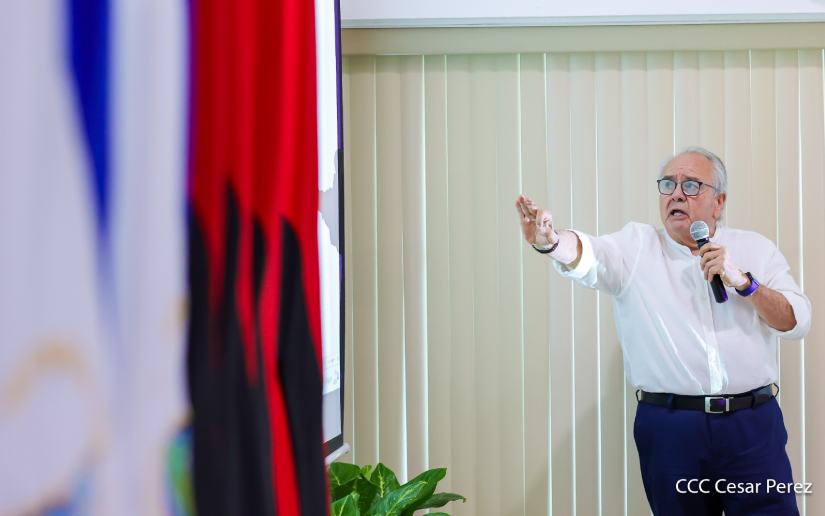
Exposición del Doctor Gustavo Porras
Presidente de la Asamblea Nacional
ante las Fuerzas Policiales, durante
el Proceso de Consulta a la Reforma
a la Constitución Política
Jueves 30 de Julio de 2026
En primer lugar, quiero presentarles a los Compañeros. Bueno, sean bienvenidos todos; después vamos a expresar el saludo, pero quiero presentarles a los Compañeros que conforman la Comisión Especial Constitucional. Son los hermanos de la Junta Directiva que estamos aquí presentes, estamos la Compañera Loria Dixon, el Doctor Wilfredo Navarro, el Compañero amigo Alejandro Mejía Ferretti, nuestra Heroína, Compañera Amadita Pineda, y nuestra amiga María Haydee Ozuna.
También son Miembros de esta Comisión Especial el Presidente de la Comisión Económica de la Asamblea, el Compañero Wálmaro Gutiérrez; la Compañera Auxiliadora Martínez, que es la Presidenta de la Comisión de Justicia; y tenemos a Mario Asensio, que es el representante, el Jefe de la Bancada BID, que es la Bancada Independiente Democrática; el amigo Lester Flores, que es el Jefe de la Bancada del PLC; y nuestro hermano Edwin Castro, que es el Jefe de la Bancada del Frente Sandinista.
Nosotros queremos darles la bienvenida a todos y expresar nuestro saludo al Primer Comisionado Francisco Javier Díaz Madriz, que es Cojefe de las Fuerzas Policiales, el Primer Comisionado General, y al hermano General Victoriano Ruiz, Jefe de las Fuerzas Policiales, el Primer Comisionado y Comisionado General.
Tenemos también con nosotros, para que todos sepamos, al Comisionado General Fernando Javier Ocón, Subdirector General de las Fuerzas Policiales. Tenemos al Comisionado General Aldo Martín Sáenz Ulloa, Subdirector General de las Fuerzas Policiales; al Comisionado General Mauricio Lenin Sosa Robelo, Inspector General de las Fuerzas Policiales; y a Oficiales Superiores y Subalternos de las Fuerzas Policiales, sean bienvenidos.
Sin más preámbulos, vamos a iniciar esta presentación, esta explicación y Consulta. Nosotros, después del Discurso del Comandante Ortega, y desde antes, por orientaciones de él, hemos venido trabajando en una Reforma Constitucional para ir adecuando el orden constitucional relacionado con las elecciones, con los períodos, etcétera, y la orden la recibimos el 19 de julio.
Creo que todos tuvimos claro que el 19 de julio el Comandante dijo claramente: “Aquí no van a volver a haber elecciones; no habrán elecciones que permitan que los enemigos del Pueblo, que los golpistas, retornen al gobierno y se hagan del poder para echar atrás las conquistas del Pueblo”. Esa fue la orientación clarísima. Y dijo: “Vamos a trabajar con la Asamblea Nacional una serie de leyes para garantizar que eso se dé”. Y ese fue el mandato, un mandato que, al fin, resume una necesidad nacida del Proceso histórico nicaragüense.
Es decir, cuando me preguntan a mí qué pienso del discurso del Comamdante, digo que es un discurso que resume la historia del Pueblo de Nicaragua y que hace una síntesis de lo que debemos hacer y de cómo debemos avanzar los nicaragüenses, esa es la idea.
Entonces, con ese mandato, que es: “No van a haber elecciones que permitan que los enemigos del Pueblo vuelvan al poder”. No dijo que no van a haber elecciones del todo, dijo que no van a haber elecciones que permitan que esos demonios vuelvan. Y eso es lo que tenemos que garantizar, que las elecciones que hagamos no permitan que los demonios vuelvan a hacerse del instrumento del gobierno, del poder, y echen para atrás las conquistas del Pueblo.
Hay alguna parte del Discurso en la que el Comandante dice: “¿Para qué quieren volver? Para hacer negocios con la Educación”. Lo mencionó, y yo me imagino a cualquiera de esos demonios de vuelta privatizando esos bellísimos hospitales que, poco a poco, hemos venido construyendo, ese iba a ser el objetivo. Eso no puede ser, nadie puede tener la idea de un regreso, de un retorno a esos momentos.
Entonces, nos dimos a la tarea de preparar, bajo las orientaciones del Comandante Daniel y de la Compañera Rosario, las bases de esta Reforma. Y, al fin y al cabo, coincidimos en siete conceptos sobre los que debemos actuar para cambiar y poner en práctica lo que nos ordenó, porque recuerden que nos ordenó poner un muro, un bloque, para que los golpistas no puedan regresar.
Y entonces, poner ese bloque, ese muro, organizar todo para lograr Estabilidad, Seguridad y Paz, que son tres palabras necesarias para combatir la pobreza, que es el centro, el objetivo último de todos nosotros, de todos los nicaragüenses, sandinistas o no sandinistas. El objetivo que nos une es combatir la pobreza. Y, para combatir la pobreza, nosotros necesitamos Estabilidad, Seguridad y Paz.
Esos tres elementos fueron los que nos guiaron en la elaboración de este concepto, más el no volver a repetir la historia. ¿Tenés alguna proyección de la historia? Como para recordar, de pronto, esto lo hemos encontrado ahora que hemos estado en este proceso. Estas son unas láminas que en un momento presentó el Consejo Supremo Electoral, nuestro Consejo Supremo Electoral. Pero voy a leer, ahí está la foto de los yanquis con Moncada.
“En enero de 1928 llegan marines norte-americanos, controlan los cantones electorales y, entre otras cosas, nombran como Presidente del Consejo Nacional de Elecciones al Brigadier General Frank Ross McCoy, llegando a la presidencia del país”, que era el objetivo que tenían que garantizar, llegando a la presidencia del país el General Moncada con un gobierno absolutamente pronorteamericano.
Entonces uno dice: estamos hablando de 1928, cuando vino una intervención yanqui y se apoderaron del Órgano Electoral; es decir, el brigadier yanqui era el Presidente y el objetivo era poner a Moncada. Entonces uno dice: ¡qué barbaridad! No, se habían hecho cosas peores. Recuerden que, casi 70 años antes, un poco más de 70 años antes, en 1856, William Walker se erigió Presidente de este país. Es lo más ignominioso que puede haber desde una visión de Soberanía.
La destruyó totalmente y él se nombró Presidente e inmediatamente reactivó la esclavitud y ese era su planteamiento. Pero uno dice: ¿y cómo es esto?, ellos hicieron sus leyes. Entonces hay una reseña que, en 1923, es decir, cinco años antes de que se dieran las elecciones, se promulgó la Ley Electoral conocida como Ley Dodds.
Y hay tantas cosas, porque aquí revisé los archivos de la Asamblea y ahí está la Ley Dodds. Ahí está la Ley Electoral de 1923, conocida como Ley Dodds. En esa ley se estableció el Consejo Nacional de Elecciones, que trató de institucionalizar el bipartidismo de los yanquis, lo vino a institucionalizar. Y entre 1928 y 1978 solo participaron el Partido Liberal y el Partido Conservador, que era el bipartidismo instaurado por los yanquis, quienes tenían que garantizarlo desde 1928. Y aquí le ponen una imagen histórica del rescate de una papeleta oficial de ese tiempo.
El Partido Conservador, cuyo candidato era Adolfo Díaz, y el Partido Liberal Nacionalista, cuyo candidato era Juan Bautista Sacasa. Como diríamos nosotros, a los dos, y con miedo, la crucita totalmente; para donde votaras, ya sabías que estabas votando por los gringos, por la intervención, como lo demostró la historia.
Entonces, esta es la realidad que teníamos, Compañeros. Pero cuando uno se va 100 años antes, en ese tiempo, en 1923, a mí me impresionó, no lo tenemos, lo vamos a poner, el Artículo 2, de la Ley Dodds. Es brutal, pero creo que la tengo aquí. Voy a tratar de leerlo íntegramente, porque me parece que es para que veamos todo lo que tenemos que avanzar.
El Artículo 1 de la Ley Dodds, dice: “Ningún ciudadano tendrá derecho a votar si no reúne las condiciones o calificaciones requeridas por la Constitución y por la presente ley electoral”. Esto es universal, nada más que todo ciudadano tiene derecho a votar, a elegir y a ser electo, siempre y cuando cumpla con los requisitos.
Pero el Artículo 2 es absolutamente, digamos, descriptivo de lo que pasaba en ese momento, dice: “El derecho del sufragio pertenece solo a los varones nicaragüenses”. Desde ahí, yo estoy apartando a la mitad de la población. “De 21 años o más”. La población nicaragüense, hasta hace poco, ahora no, porque hemos cambiado los patrones demográficos, pero hasta hace poco, cuando digo hace poco, hablo de hace unos 15 o 20 años, estaba constituida en un 60% por menores de 16 años.
Y aquí estamos haciendo una reducción de la población votante a un poquito de gente. Ciudadanos, varones nicaragüenses de 21 años o más de edad. “También podrán votar los de 18 o más años de edad si son casados, naturalmente por la iglesia, o saben leer y escribir”. Entonces, desde ahí, la población votante se reduce.
Cualquier varón nicaragüense que, en la fecha de las inscripciones regulares, no tenga la edad que esta ley requiere para tener el derecho de votar, pero que la cumpliera antes de la fecha de la próxima elección de la autoridad suprema, tendrá el derecho de inscribirse si reúne todas las condiciones y requisitos impuestos por la Constitución.
Entonces, cuando uno ve esa imagen, uno sabe que los que votaban eran aquellos que andaban el bombín y el saco. Esos eran los que votaban, porque eran varones mayores de 21 años, casados por la iglesia, y, además, tenían que saber leer y escribir. Pero la mujer no. Ese era el truco. No, ese era el truco, esa era la imposición.
Con todo esto, nosotros comenzamos a proponer conceptos. Y el primer concepto nos suena a una frase que nosotros decimos y que la tenemos que decir, pero que describe el concepto: ¡No podrán! y es que, cuando yo hablo de conceptos, me refiero a que estos son los que se van a transformar en el articulado constitucional.
Y este primer concepto, tal como está actualmente, llega hasta aquí, en el Artículo 47: “Las y los ciudadanos tienen derecho a elegir y ser electos y a optar a cargos públicos, salvo las limitaciones contempladas en esta Constitución Política”. Ese es el Artículo 47, que trata sobre los Derechos Políticos de los nicaragüenses.
En la Reforma, tiene muchas más letras que las que les voy a presentar, pero, resumiendo para efectos de la presentación, se le agrega lo siguiente: “No podrán ser candidatos a cargos de elección popular ni podrán ejercer cargos públicos por designación de la Presidencia de la República o elección de la Asamblea Nacional los golpistas”.
“Las y los que incurran o hayan incurrido en actos que menoscaben la independencia, la Soberanía y la Autodeterminación de Nicaragua”. Y ahí, en la propuesta, aparece una serie de actos descritos.
Por ejemplo, los que llamen a la intervención militar extranjera, los que atenten y pidan sanciones contra el Estado nicaragüense, contra las Instituciones o contra los ciudadanos. Es decir, toda esa cantidad de cosas que vivimos viendo, que con facilidad tiran y lanzan. Y, como dice la canción, “afuera pueden decir lo que quieran”, pero aquí adentro no podrán ser candidatos.
¿Por qué? Por la Constitución, por Dignidad Nacional, por la Constitución de la República, les queda prohibido. Los traidores a la Patria y está claro que los traidores a la Patria es el resultado final de un Proceso judicial.
Y dicen: “Bueno, se les acusa de traidores a la Patria y dice: son traidores a la Patria”. Por eso hay que ponerlo, porque no solo debemos estar pensando en los del avión; puede haber otros traidores, o los que ya pasaron, puede ser uno que aparezca mañana, se le acusa porque es un traidor a la Patria, se le encuentra culpable y entonces pierde sus derechos políticos.
Y, además, la ley dice que quien es condenado por traición a la Patria pierde también la nacionalidad. Eso lo dice incluso la Constitución. “Y quienes violenten o hayan violentado los principios contemplados en esta Constitución”. Ese es el primer concepto, ese es un artículo de Reforma.
Aquí está puesto para que lo puntualicemos, pero con toda la redacción legal y demás, ese es el primero. Y, para que no se nos olvide, le ponemos: ¡No podrán! Ese es el muro, el bloque que nos mandaron a poner el Comandante Daniel y la Compañera Rosario en la Cons-titución, para que esto no tenga posibilidades.
Entonces, después hay un concepto de lo que ponemos y de lo que estamos buscando: la Estabilidad. La Estabilidad está totalmente relacionada con los tiempos y los períodos de gobierno. Imagínense ustedes que, de pronto, hubiera un país donde el período de gobierno fuera de un año, eso es absolutamente inestable. Nadie sabe a qué atenerse al año siguiente, de dos años es inestable. Mientras más asentado sea un período, más estable es.
Hay períodos de cuatro años. Yo podría decir: “¿En cuatro años qué podés hacer?”. Solo cerraste los ojos y volviste a ver y ya se fueron cuatro años. Ah, pero es que esos son otros modelos, donde el período de cuatro años se transforma en ocho con facilidad, porque hay reelección. Y, además, los vaivenes dependen no necesariamente de los partidos, esos son los modelos bipartidistas, generalmente.
Nosotros vivimos esa historia. ¿Qué más daba que el Presidente fuera liberal o conservador? Al fin y al cabo, el poder lo determinaba la intervención. Entonces, dándole vuelta al asunto, tenés períodos de diez años, que son muy estables, permiten hacer proyectos. Ya son proyectos de mediano y largo plazo. Pero también tenés períodos de siete años: Italia, Irlanda; hay varios países cuyos períodos son de siete años.
De tal forma que comenzamos a ver y creemos que la propuesta es que, con un período de siete años, se pueden desarrollar proyectos asentados, con Estabilidad, que es lo que queremos para poder combatir la pobreza. Y esto es lo que contiene esta Reforma, que abarca dos títulos de la Constitución. ¿Por qué? Porque en esos títulos aparecen períodos de seis años, entonces hay que cambiarlos a siete. O sea, esa es una Reforma.
Y por eso queda establecido así: “El período establecido en la Constitución Política de la República de Nicaragua para los cargos de elección popular y para los de elección o ratificación por la Asamblea Nacional será de siete años”. Entonces, todos los cargos, es decir, Diputados, Diputadas, Diputados del Parlamento Centroamericano, Alcaldes, Alcaldesas, Vicealcaldes, Vicealcaldesas, Concejales, etcétera, todo lo que sea de elección popular queda en siete años.
Sin embargo, nosotros necesitamos, y ese es otro de los elementos planteados por el Comandante, Cohesión y Seguridad. Tenemos Estabilidad, Seguridad y Paz. Para tener Seguridad, necesitamos cohesión. Entonces, no puede ser que unos caminen en siete años y los otros se queden en otros períodos. Por eso, de una sola vez, en la Reforma se plantea que los períodos de nombramiento del Comandante en Jefe de las Fuerzas Militares del Ejército de Nicaragua y de los Jefes de las Fuerzas Policiales de la República de Nicaragua serán de siete años.
Entonces, nosotros necesitamos cohesionarnos y eso nos da Seguridad. Eso nos da fuerza a este modelo del Pueblo Presidente, porque eso es lo que estamos estructurando. Estamos estructurando un modelo que hemos dado en llamar, poco a poco, el modelo del Pueblo Presidente. Es decir, todo tiene que ser en función del Pueblo. Ese es el que ustedes, hermanos de las Fuerzas Policiales, defienden. Es el modelo del Pueblo Presidente.
¿Y qué cosa es el modelo del Pueblo Presidente? Es el modelo en el que todo está determinado por los intereses del Pueblo. Todo, absolutamente todo. Todas las acciones y eso lo vamos demostrando, porque aquí cada centavito que se logra conseguir se busca invertirlo para satisfacer las necesidades del Pueblo. Y entonces aparece un hospital, dos hospitales, setenta y nueve hospitales, tecnologías mejoradas, escuelas gratuitas, salud gratuita. Aparece Seguridad ciudadana, una Policía fuerte, una Policía con técnicas, igual que todo. En la medida en que nuestro país vaya derrotando la pobreza y vayamos mejorando las condiciones económicas, las condiciones de nuestras Instituciones van a ser mejores. Las condiciones de los Miembros de nuestras Instituciones van a ser mejores, eso es así.
Pero tenemos que tener claro en nuestra mente hacia dónde vamos; es decir, el modelo del Pueblo Presidente y es palpable. Es decir, no vayamos muy lejos, hace diez o doce años, para ir a Bilwi era una odisea, o ir a Bluefields era una odisea. Ahora, se va y en siete u ocho horas se llega, esa es una realidad. Poco a poco, nos vamos alejando de aquellos tiempos del neoliberalismo.
Nos tenemos que alejar totalmente. Eso es lo que debemos recordar para saber a qué cosas y a quiénes les estamos poniendo el muro, el bloque que dijo el Comandante Daniel, el bloque para que no regresen. Cuando nosotros, en los hospitales, teníamos que decirle a la gente: “Vaya a comprar un esparadrapos, una gasa y traiga la anestesia”. Así le teníamos que decir en ese tiempo, ahora no. Y si, como el Pueblo es Presidente, a alguien le dicen eso, entonces el Pueblo, como Presidente que es, tiene que denunciar y decir: “Mire, ahí están diciendo eso”, porque no es la política del Gobierno sandinista.
El modelo sandinista dice: salud gratuita y de calidad, y lo debemos cumplir. Y todo el Pueblo, como Jefe que es, debe estar supervisando y vigilante, e igual en todas nuestras Instituciones. Entonces, de eso se trata: de Cohesión y Seguridad. Por eso, los períodos van a ser de siete años.
En el texto dice claramente que, por Supremacía de la Constitución, por mandato constitucional y de pleno derecho, se reforman las leyes que corresponden al Ejército de Nicaragua y las leyes que corresponden a la Policía. ¿Para qué? Para que quede clarito que, a partir del mandato constitucional, quedan establecidos los siete años.
Y después viene la pregunta: ¿quién hace estas cosas? Y ahora, a esta altura, nosotros no le vamos a poner, porque no hay opción: El presidente del Consejo Electoral tiene que ser nicaragüense. Eso ya es historia superada, porque en aquel tiempo, del que venimos saliendo y que venimos derrotando, el presidente del Consejo Electoral era un brigadier yanqui. A partir de 1979, eso quedó atrás. Quisieron hacernos retroceder después, pero no pudieron y decimos ahora: ¡ni podrán!
Y vamos profundizando las transformaciones del modelo del Pueblo Presidente. Entonces, el Consejo Supremo Electoral es el encargado de organizar y dirigir las elecciones Generales, Municipales y Regionales cada siete años, porque no basta con decir que los períodos de los cargos serán de siete años. Esos períodos tienen que establecerse a través de elecciones, y las elecciones las organiza el Consejo Supremo Electoral.
Entonces, hay que darle el mandato al Consejo Supremo para que organice las elecciones Generales, Municipales y Regionales cada siete años, en el año electoral que corresponda. Eso quiere decir que continúa habiendo una elección nacional, una elección municipal y una elección regional en años consecutivos, cada siete años.
Pero aquí se agregan facultades al Consejo Supremo que tienen que ver con lo que habíamos visto en el primer concepto. Se agrega la facultad de: “No otorgar personalidad jurídica a partidos políticos cuando sean constituidos con financiamiento extranjero o cuando alguno de sus directivos haya violentado los Principios Fundamentales de esta Constitución Política”. Es un principio de Soberanía, de Independencia y de Autodeterminación que debe estar presente y que el Consejo tiene que instrumentar.
Es decir, no puede haber un partido político que levante banderas de intervención o que viole la Constitución. Pero, además, no solo se trata de no otorgar la personalidad jurídica, sino también de cancelarla cuando el partido o alguno de sus directivos o candidatos reciban financiamiento extranjero o haya violado los Principios Fundamentales de la Constitución. Entonces, aquí se trata de darles las facultades constitucionales al Consejo para actuar en la aplicación de las Reformas Constitucionales.
Como dice ahí, estamos reformando tres numerales del Artículo 152: el numeral 1, que fue el primero; el numeral 12, que es el que acabo de leer; y el numeral 14, que establece que:
El Consejo verificará e impondrá las sanciones correspondientes a todo candidato o candidata, funcionario o funcionaria del Órgano Electoral o integrante de la Junta Directiva de los partidos políticos que incurra o haya incurrido en actos que menoscaben la Independencia, la Soberanía y la Autodeterminación.
Entonces, se le está dando el mandato al Consejo para verificar y aplicar las sanciones correspondientes. Este es el cuarto concepto.
Aquí está el quinto concepto, al que le llamamos PAX, este cambio modifica a dos Artículos de la Constitución, los Artículos 123 y 130. Le llamamos PAX, por el poema de Darío, porque es en honor a nuestro Héroe Nacional y Poeta Universal, Rubén Darío. Y es que: “La fecha de posesión del Copresidente y la Copresidenta de la República será el 18 de enero, en homenaje a nuestro Héroe Nacional y Poeta Universal Rubén Darío”. Entonces, esto modifica el Artículo 123.
Y el Artículo 130 será modificado para establecer que los Diputados y Diputadas de la Asamblea Nacional se instalen el 17 de enero, porque siempre la Asamblea se instala el día anterior, ya que, una vez instalada, es la que ejecuta la imposición de la banda y la toma de posesión. Entonces, esto es lo que queda establecido y este es el sexto concepto.
Porque después todo el mundo se pregunta, y nos pasó la vez pasada: “Ajá, ¿y qué va a pasar con los que están electos ahorita? ¿Qué va a pasar con los que están nombrados ahorita?”. Entonces, es mejor dejar eso claro y ahí es donde se establece que, “Por mandato y en estricta observancia de la Supremacía Constitucional, los períodos de las autoridades electas por el voto popular en las últimas elecciones Generales, municipales y regionales vigentes quedan ampliados a siete años”.
Entonces, para poder dar coherencia a todo, le pusimos precisamente “Coherencia”. Es decir, todos los períodos de las últimas elecciones quedan ampliados a siete años. Pero, además, se amplía a siete años el período de los cargos designados por la Presidencia de la República, así como los de elección o ratificación por la Asamblea Nacional. Todos los períodos pasan a ser de siete años.
Claro, por la importancia del Ejército Nacional y de la Policía, y porque tienen leyes específicas, en la Reforma se deja claro en un Artículo particular, que fue el que leí, pero aquí se ajusta a todos los cargos designados. Es decir, menciono algunos, porque son bastantes: el Presidente del Banco Central, la Superintendente de Bancos, la Vicesuperintendencia de Bancos, el Consejo Directivo y la Presidencia del Banco Produzcamos. Es decir, hay una serie de cargos que son designados por el Presidente y electos o ratificados por la Asamblea. Entonces, de una sola vez, se amplía a siete años todo esto.
Y, para que no quede duda, por si acaso, “En toda la legislación nacional vigente en la que se estipule o regule un período de funciones, se entenderá reformado de pleno derecho y se leerá que dicho período es de siete años”.
Entonces, ahí están todos los conceptos, que son relativamente fáciles de recorrer. “No podrán”. Ya sabemos a qué se refiere: no podrán participar, no podrán ser electos, no podrán tener derechos políticos. Ese es el primer concepto.
El otro concepto que tenemos es la “Estabilidad”, es decir, el período de siete años. Después, el concepto que tiene que ver con las Fuerzas Policiales y con las Fuerzas Militares, que es “Cohesión y Seguridad”.
Después, el concepto que tiene que ver con el instrumento ejecutor de todas estas medidas, que son las atribuciones del Consejo. Después, el que llamamos “PAX”, que es Paz, en honor a Darío. Y cerramos con el concepto de la “Coherencia”.
Entonces, así, con alguna facilidad, nos vamos a acordar de cada uno de los cambios que vamos a hacer en nuestra Constitución Política de la República de Nicaragua, que es lo más importante.
Este es un paso más para dejar claro que nuestra Constitución Política de la República recoge los cambios y es la Constitución del Pueblo de Nicaragua, de nosotros y que organizamos nuestra Democracia como el Pueblo de Nicaragua nos diga. No es la Democracia que quiera nadie más que los nicaragüenses. Organizamos y estructuramos nuestro orden social para vencer la pobreza. Eso es lo que estamos haciendo y desarrollando: un modelo del Pueblo Presidente.
Hasta ahí llegaría.
Muchas gracias.
----------------------------------------------
Versión en inglés
Presentation by Dr. Gustavo Porras
President of the National Assembly.
to the National Police Forces, during the Consultation Process
on the Reform of the Political Constitution
Thursday, July 30th 2026
First of all, I want to introduce you to the Compañeros and Compañeras present. And well, everyone is welcome; later we will offer our greeting, but I want to introduce you to the Compañeros and Compañeras who make up the Special Constitutional Commission. They are our brothers and sisters of the Executive Board present here, we have Compañera Loria Dixon, Doctor Wilfredo Navarro, our friend Compañero Alejandro Mejía Ferretti, our Heroine, Compañera Amadita Pineda, and our friend Compañera Maria Haydee Ozuna.
Also members of this Special Commission are the president of the Economic Commission of the National Assembly, Compañero Wálmaro Gutiérrez; Compañera Auxiliadora Martínez, who is the president of the Justice Commission; and we have Mario Asensio, who is the representative, the head of the IDB grouping, which is the Independent Democratic grouping; our friend Lester Flores, who is the head of the PLC grouping; and our brother Edwin Castro, who is the head of the Sandinista Front grouping.
We would like to welcome you all and express our greeting to First Commissioner Francisco Javier Díaz Madriz, who is Co-Chief of the Police Forces, the First Commissioner General, and to our brother General Victoriano Ruiz, Head of the Police Forces, the First Commissioner and Commissioner General.
We also have with us, so that we are all aware, Commissioner General Fernando Javier Ocón, Deputy Director General of the Police Forces. We have Commissioner General Aldo Martín Sáenz Ulloa, Deputy Director General of the Police Forces; Commissioner General Mauricio Lenin Sosa Robelo, Inspector General of the Police Forces; and also Senior and Junior Officers of the Police Forces, please be welcome all.
Without further ado, let's start this presentation, this explanation and Consultation. We, after Comandante Ortega's Speech, and since even before, following his guidance, have been working on a Constitutional Reform to gradually adapt the constitutional order related to elections, terms of office, and so on, and we received the order to go ahead on July 19th.
I think we all understood when on July 19th the Comandante clearly explained that there will be no elections here again; there will be no elections allowing the enemies of the People, the coup plotters, to try returning to government so as to take power to reverse the conquests of the People. That was a very clear orientation. And he said “We are going to work with the National Assembly on a series of laws to ensure that this happens.” And that was the mandate, a mandate which, in the end, sums up a need born of Nicaragua’s historical Process.
That is to say, when I am asked what I think of the Comandante's speech, I say that it is a speech which summarizes the history of the Nicaraguan people and makes a synthesis of what we need to do and how we Nicaraguans should move onward, that is the idea.
So, with that mandate, which is: There are not going to be elections that allow the enemies of the People to return to power. He didn't say there's not going to be an election at all, he said that there's not going to be an election allowing those demons to return. And that is what we have to guarantee, that the elections we carry out do not allow the demons to take over the instrument of government, of power, and roll back the conquests of the People.
There is a part of the speech in which the Commander says: “Why do they want to come back? To make business out of education”" He mentioned it, and I can well imagine any of those demons getting back and privatizing those beautiful hospitals which, little by little, we have been building, that was going to be their goal. That cannot be, no one can have that idea of a regression, of a return to those times.
So then, we took on the task of preparing, under the guidance of Comandante Daniel and Compañera Rosario, the bases of this Reform. And, in the end, we agree on seven concepts on which we must act to change and put into practice what they have told us to, because remember that the Comandante ordered us to put up a wall, a barrier, so that the coup plotters cannot return.
And so, to put up that barrier, that wall, to organize everything to achieve Stability, Security and Peace, which are three words necessary to combat poverty, which is the center, the ultimate goal of us all, of all Nicaraguans, Sandinistas or non-Sandinistas. The goal that unites us is to combat poverty. And, to combat poverty, we need Stability, Security and Peace.
Those three elements were the ones that guided us in the elaboration of this concept, along with not repeating history again. Do you have a slide to project of this story? As if to remind us, all of a sudden, we have found these, now we have begun this process. These are some pictures that were presented at one time by the Supreme Electoral Council, our own Supreme Electoral Council. But I'm going to read, there's this picture of the Yankees with Moncada.
"In January 1928, US marines arrived, controlled the electoral districts and, among other things, appointed Brigadier General Frank Ross McCoy as president of the National Elections Council, arranging the presidency of the country,” which was the objective they had to guarantee, General Moncada reaching the presidency of the country along with an absolutely pro-American government.
Then another one says: we are talking about 1928, when a Yankee intervention came and they seized the electoral body; that is, the Yankee brigadier was its president and the objective was to put Moncada in place. Then one might say: What an outrage! But no, worse things had been done. Remember that, almost 70 years earlier, a little more than 70 years earlier, in 1856, William Walker became President of this country. It was the most ignominious thing possible from the point of view of Sovereignty.
He totally destroyed it, made himself President and immediately reactivated slavery and that was his policy. And one has to ask: but how can this be?, well, they made the laws. Then there is an article covering how, in 1923, that is to say, five years before the elections were held, an electoral law known as Dodd’s Law was enacted.
And there are so many things to note, because here I checked the National Assembly files and there is this Dodd’s Act. There's the election law of 1923, known as Dodd’s Act. That law established the National Elections Council, which tried to institutionalize bipartisanship in the style of the Yankees, came to institutionalize it. And between 1928 and 1978 only the Liberal Party and the Conservative Party participated in elections, which was the bipartisanship established by the Yankees, who made sure to establish it from 1928 on. And here is a historical image of an official ballot recovered from that time.
The Conservative Party, whose candidate was Adolfo Díaz, and the Nationalist Liberal Party, whose candidate was Juan Bautista Sacasa. As we would say now, of both of them, and with some fear, make the Sign of the Cross totally; because whichever way you voted, you already knew you were voting for the Gringos, for intervention, as history showed.
So, this is the reality we had, Compañeros and Compañeras. So when you go back 100 years, at that time, in 1923, I was impressed, we don't have it, we're going to put it up, Section 2, of the Dodds Act. It's brutal, but I think I have it here. I am going to try reading it in its entirety, because it seems to me that this is so we can see everything that explains why we have to move onward.
Article 1 of Dodd0s Law states: "No citizen shall have the right to vote if they do not meet the conditions or qualifications required by the Constitution and by the present electoral law.” This is universal, nothing more than that every citizen has the right to vote, to choose and to be elected, as long as they meet the requirements.
But Article 2 is absolutely, let's say, descriptive of what was happening at that time, it says “The right to vote belongs only to Nicaraguan men." From there, one cuts off half the population. "21 years of age or older." The Nicaraguan population, until recently, not now, because we have changed demographic patterns, but until recently, when I say recently, I mean about 15 or 20 years ago, was constituted by 60% of children under 16.
So here we are making a reduction of the voting population to a small part of the people. Citizens, Nicaraguan males 21 years of age or older. "Those aged 18 or over will also be able to vote if they are married, naturally by the church, or can read and write.” So, right there, the voting population shrinks.
Any Nicaraguan male who, on the date of regular registration, is not of the age required by this law to have the right to vote, but who fulfilled it before the date of the next election of the supreme authority, will have the right to register if he meets all the conditions and requirements imposed by the Constitution.
So, when one sees that image, one knows that those who voted were those who walked around in bowler hats and suits. Those were the ones who voted, because they were men over the age of 21, married by the church, and, in addition, they had to be able to read and write. But no woman. That was the trick. No, that was indeed the trick, that was the imposition.
With all this in mind, we began to propose concepts. And the first concept sounds to us like a phrase that we have said and which we have to say, but it describes the concept: They won't prevail! and when I talk about concepts, I mean that these are the ones that are going to be transformed into constitutional form.
And this first concept, as it currently stands, goes like this, in Article 47: "Citizens have the right to elect and be elected and to run for public office, except for the limitations contemplated in this Political Constitution.” That is Article 47, which deals with the Political Rights of Nicaraguans.
In the Reform, it has many more words than those that I am going to present to you, but, summarizing for the purposes of the presentation, the following is added to it: “Coup plotters may not be candidates for positions of popular election nor may they hold public office by appointment of the Presidency of the Republic or election by the National Assembly.”
"Those who commit or have committed acts that undermine the Independence, Sovereignty and Self-determination of Nicaragua." And there, in the proposal, appears a series of descriptions of illegal acts.
For example, those who call for foreign military intervention, those who attempt and demand sanctions against the Nicaraguan State, against its institutions or against its citizens. That is to say, all that number of things that we spend our lives witnessing, things easily cast and thrown. But, as the song says “Outside you can say whatever you want” but inside, here, you can't be a candidate.
Why? By the Constitution, out of National Dignity, under the Constitution of the Republic, they are forbidden. Traitors to the Nation and it is clear that traitors to the nation are the end result of due judicial process.
And people say, "Well, they are accused of being traitors to the Nation and it should say: They are traitors to the Nation.” That's why we have to include it, because we should not only consider those who left on on the plane; there may be other traitors, apart from those who have already gone, there may be someone who appears tomorrow, they are accused of being a traitor to the Nation, found guilty and then they lose their political rights.
And, in addition, the law says that whoever is convicted of treason also loses their nationality. Even the Constitution says that. "And those who violate or have violated the principles contemplated in this Constitution." That's the first concept, that's one of the Reform articles.
It's put up here for us to point out, but with all the legal wording and so on, that's the first one. And, so that we do not forget, we put: They will not prevail! That is the wall, the barrier which Comandante Daniel and Compañera Rosario put to us to include in the Constitution, so that such treachery has no chance.
So, then there is a concept of what we include and what we are looking for: Stability. Stability is totally related to the times and periods of government. Imagine if, suddenly, there was a country where the period of government was one year, that is absolutely unstable. No one knows what to expect the next year, a period of two years is unstable. The more settled a period is, the more stable it is.
There are four-year terms. And I would say “In four years, what can you do?”. You just closed your eyes and opened them again and four years have already gone. Ah, but there are other models, where the four-year term is easily transformed into eight, because there is re-election. And, besides, the ups and downs do not necessarily depend on the parties, and those are bipartisan models, generally.
We lived that history. What difference did it make whether the president was a Liberal or a Conservative? After all, power was determined by outside intervention. So, turning the matter around, you have ten-year periods, which are very stable, they allow you to do projects. These are already medium and long-term projects. But you also have seven-year periods: Italy, Ireland; there are several countries whose electoral periods are seven years.
Such that we began to see and we believe that the proposal is that, with a period of seven years, settled projects can be developed, with stability, which is what we want so as to be able to combat poverty. And this is what this Reform contains, which covers two chapters of the Constitution. Why? Because six-year periods appear in those chapters, then they need to be changed to seven. I mean, that's the Reform.
And that is why it is set out as follows: “The period established in the Political Constitution of the Republic of Nicaragua for positions of popular election and for those of election or ratification by the National Assembly will be seven years.” So, all the positions, that is, Deputies, Deputies of the Central American Parliament, Mayors, Vice Mayors, Councillors and so on, every post that is of popular election remains at seven years.
However, we need, and that is another of the elements raised by the Comandante, Cohesion and Security. We have Stability, Security and Peace. To have security, we need coherence. So, it cannot be that some posts go on for seven years and the others go on for other periods. That is why, all at once, the Reform proposes that the periods of appointment of the Commander-in-Chief of the Military Forces of the Nicaraguan Army and the Heads of the Police Forces of the Republic of Nicaragua will be seven years.
So, we need to be coherent and that gives us Security. That gives us strength for our model of the People President, because that is what we are structuring. We are structuring a model that we have come to call, little by little, the model of People President. In other words, everything has to be according to the People. That is the one that you, brothers and sisters of the Police Forces, defend. It is the model of the People President.
And what is the model of the People President? It is the model in which everything is determined by the interests of the People. Everything, absolutely everything. All the actions and we are demonstrating that, because here every cent that can be obtained is sought so as to be invested to satisfy the needs of the People. And then a hospital appears, two hospitals, seventy-nine hospitals, improved technologies, free schools, free health care. Citizen security appears, a strong police, a police with technical skills, just like everything. To the extent that our country is defeating poverty and we are improving economic conditions, the conditions of our institutions will be better. The conditions of the members of our institutions are going to be better, that's how it goes.
But we have to have it clear in our mind where we are heading; namely, the model of the People President and it is palpable. That is, without going back too far, ten or twelve years ago, to go to Bilwi was an odyssey, or to go to Bluefields was an odyssey. Now, one leaves and in seven or eight hours we arrive, that's a reality. Little by little, we are moving away from those times of neoliberalism.
We have to move past them completely. That is what we must remember so as to know the things and people against whom we are putting up this wall, this barrier that Comandante Daniel has explained , the barrier so that they do not return. When we, in the hospitals, had to tell people: “Go buy a plaster, a gauze and bring the anesthesia.” We had to tell patients at that time, not now. And if, with the People President, they tell someone that, then the People, as the President they are, have to denounce it and say, “Look, they're saying that right there,” because it's not the policy of the Sandinista government.
The Sandinista model says: free quality health care, and we must comply with it. And the whole People, as the superior that they are, should be supervising and vigilant, and likewise in all our institutions. So that's what it's all about: Coherence and Security. Therefore, the periods are going to be seven years.
The text clearly states that, by the supremacy of the Constitution, by constitutional mandate and by full right, the laws that correspond to the Nicaraguan Army and the laws that correspond to the Police are reformed. Why? So as to make it clear that, by constitutional mandate, the period of seven years is established.
And then comes the question: who does all this? And now, at this point, we are not going to change anything, because there is no option: The president of the Supreme Electoral Council has to be Nicaraguan. That old history is over, because at that time, from which we have been emerging and which we have been defeating, the president of the Electoral Council was a Yankee brigadier. After 1979, that was behind us. They wanted to push us backwards later, but they couldn't and we say now: Nor will they be able to!
And we are deepening the transformations of the President's People's model. So, the Supreme Electoral Council is in charge of organizing and conducting General, Municipal and Regional elections every seven years, because it is not enough to say that the terms of office will be seven years. These periods have to be established through elections, and the elections are organized by the Supreme Electoral Council.
So then, the Supreme Council must be given the mandate to organize General, Municipal and Regional elections every seven years, in the corresponding election year. That means that there continues to be a national election, a municipal election and a regional election in consecutive years, every seven years.
But here faculties are added to the Supreme Council that have to do with what we had seen in the first concept. One faculty added is: "Not to grant legal personality to political parties when they are constituted with foreign financing or when one of their directors has violated the fundamental principles of this Political Constitution.” It is a principle of Sovereignty, Independence and Self-determination that must be present and which the Council must implement.
That means there cannot be a political party raising the flag of intervention or violating the Constitution. But, in addition, it is not only a question of not granting legal personality, but also of canceling it when a political party or any of its directors or candidates receive foreign financing or have violated the fundamental principles of the Constitution. So, here it is a question of giving the constitutional powers to the Council so as to be able to act in the implementation of the Constitutional Reforms.
As it says there, we are reforming three numerals of Article 152: numeral 1, which was the first; numeral 12, which is the one I have just read; and numeral 14, which establishes that: the Council shall verify and impose the corresponding sanctions on any candidate, official of the Electoral Body or member of the Executive Board of political parties who commits or has committed acts that undermine Independence, Sovereignty and Self-Determination.
So, the Council is being given the mandate to verify and apply the corresponding sanctions. This is the fourth concept.
Here is the fifth concept, which we call PAX, this change modifies two Articles of the Constitution, Articles 123 and 130. We call it PAX, after Darío's poem, because it is in honor of our National Hero and Universal Poet, Rubén Darío. And it is that “The date of possession of the Co-President of the Republic will be January 18th in tribute to our National Hero and Universal Poet Rubén Darío." So, this amends Article 123.
And Article 130 will be amended to establish that the Deputies of the National Assembly are installed on January 17th because the Assembly is always installed the day before, since, once installed, it is the one that executes the imposition of the presidential band and the inauguration. So, this is what is established and this is the sixth concept.
Because then everyone wonders, and it happened to us last time: "Aha, but what's going to happen to those who are elected right now? What will happen to those who are named now?”. So then, it is better to make that clear and that is where it is established that “By mandate and in strict observance of Constitutional Supremacy, the terms of the authorities elected by popular vote in the last General, municipal and regional elections in force are extended to seven years.”
So, in order to give coherence to everything, we put precisely “Coherence”. That is, all the terms of the last elections are extended to seven years. But, in addition, the period of the positions appointed by the Presidency of the Republic, as well as those of election or ratification by the National Assembly, is extended to seven years. All periods become seven years.
Of course, because of the importance of the National Army and the Police, and because they have specific laws, in the Reform it is made clear in a particular Article, which was the one I read, but here it fits all the designated positions. That is, I mention a few, because there are quite a few of them: the President of the Central Bank, the Superintendent of Banks, the Deputy Superintendent of Banks, the Executive Board and the Presidency of Banco Produzcamos. That is, there are a number of positions that are appointed by the President and elected or ratified by the Assembly. Then, all of these at once, are all extended to seven years.
And, so that there is no doubt, just in case “In all the current national legislation in which a period of functions is stipulated or regulated, it will be understood as fully reformed and it will be read that said period is seven years”.
So, there are all the concepts, which are relatively easy to cover. “They won't prevail.” We already know what it means: they will not be able to participate, they will not be able to be elected, they will not be able to have political rights. That's the first concept.
The other concept we have is "Stability”, that is, the seven-year period. Then, the concept that has to do with the Police Forces and with the Military Forces, which is “Cohesion and Security”.
Then, the concept that has to do with the implementing instrument of all these measures, which are the Supreme Electoral Council's powers. Then, the one we call “PAX”, which is Peace, in honor of Rubén Darío. And we close with the concept of “Coherence”.
So, we are readily going to remember each of the changes that we are going to make in our Political Constitution of the Republic of Nicaragua, which is the most important thing.
This is one more step in order to make clear that our Political Constitution of the Republic include the changes and is the Constitution of the People of Nicaragua, of us all and that we organize our Democracy as the People of Nicaragua tell us. It is not a democracy that someone else wants, only what Nicaraguans want. We organize and structure our social order to overcome Poverty. That is what we are doing and developing: a model of the People President.
That's it for now from me.
Thank you very much.