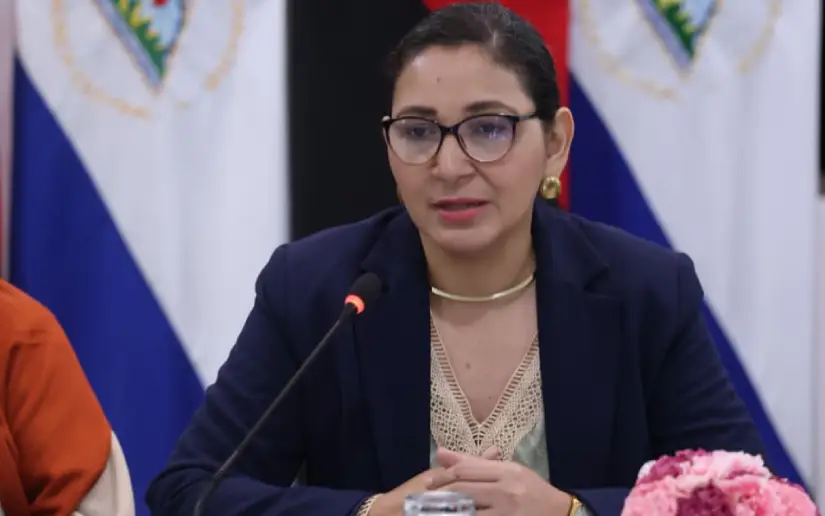
Address by Compañera Wendy Morales
Procurator General of Justice
during the meeting with State Entities
during the Consultation Process on the Constitutional Reforms
Tuesday, August 25th 2026
President of the National Assembly;
Honourable Members and Members;
Authorities of State Organs and Institutions;
We appear before this Honorable Plenary, through the institutional responsibility that corresponds to the Procurator General's Office of Justice, as an organ of representation and legal defense of the interests of the State, to offer -on this occasion- some considerations of a strictly legal and constitutional nature on the initiative to Reform the Political Constitution, currently undergoing this process of consultation.
The Constitution determines the organization of public entities, distributes competencies, recognizes rights, establishes responsibilities and controls and establishes the fundamental rules by which State institutions must act.
A Constitution, as I mentioned in my previous speech, cannot be conceived as a legally immobile norm.
The very existence of constitutional reform procedures demonstrates that the Constituent Assembly recognizes the need for certain elements of the organization of the State to be reviewed when historical, legal, social and institutional circumstances so require.
Therefore, the first consideration is precisely that: The Constitutional Reform does not represent an exception to the Constitutional Order; it constitutes a mechanism provided for by the Constitutional Order itself for its evolution.
In this way, this Reform proposal is exercised within the powers which the Constitution itself grants to the National Assembly.
Consequently, we are dealing with a constitutionally validated and legitimized procedure, which constitutes the immediate source of the juridical-formal legitimacy of any partial reform of the Constitution.
The constitutional periods depend on the type of body, the form of government, the territorial structure, the constitutional history and the decisions taken by each ordinance. There are constitutional systems that establish periods of four, five or six years and there are also organizations that have experienced periods of seven years.
The Constitution of Ireland, for example, currently provides that its President is directly elected by the people and holds office for seven years.
France maintained for decades the so-called septennat (a Latin word meaning a term or period of seven years): between 1962 and 2000, article six of the French Constitution provided that the President of the Republic was elected by suffrage for a period of seven years.
These examples demonstrate that comparative Constitutional Law does not recognize any single number of years as a necessary condition for the existence of a constitutionally valid mandate.
Article 25 of the International Covenant on Civil and Political Rights guarantees the right to vote and to be elected in periodic elections, by universal, equal suffrage. This, along with other related international instruments, does not expressly state that elections must be held compulsorily every four, five, or six years.
The international legal standard basically resides in the fact that the elections continue to be periodic, that the positions maintain a certain duration and that the population can make their will known through suffrage.
In Administrative Law, continuity is linked to the permanence of the State, institutions, competencies, public services, planning and legal obligations, and institutional continuity should be framed to coexist with responsibility, control, transparency and accountability.
A Constitution is a normative system, for that reason, the extension of the constitutional periods proposed in this Reform is not decided in isolation. It has been coherently verified and is proposed taking into account :
* the regulation of electoral processes;
* the dates of elections and inauguration;
* the mandates of other constitutional bodies affected by the reform;
* the legal regulations which currently establish different periods, and
* the necessary transitional provisions to avoid temporary contradictions within the system.
This is an elementary question of legal certainty.
Honourable Members, these are our considerations.;
First, the duration of the terms of public authorities is a matter of constitutional design and has been modified repeatedly throughout Nicaragua’s constitutional history;
Second, there is no single period applicable to all States in Comparative Law, nor is there an international rule that expressly establishes that elected offices must necessarily last four, five or six years;
Third, the legally relevant international parameter requires the preservation of periodic elections and suffrage;
Fourth, Nicaragua has a clear constitutional record of transitioning current mandates when the general duration of the terms of office has been changed;
Fifth: institutional continuity has legal relevance in that it helps preserve planning, public services, investments and State obligations, while it must always be understood as being accompanied by legality, control, responsibility and accountability;
Sixth: Nicaraguan financial legislation expressly recognizes medium-term planning and the coordination of territorial prerequisites with instruments of national development and public investment;
Seventhe: the formal constitutionality of a reform necessarily depends on its being adopted by the competent body and through the procedure that the Constitution itself has established for the exercise of derived constituent power.
Thank you very much.