Meeting with Public Sector Workers
during the Consultation Process on the Constitutional Reforms
Thursday, August 13th 2026
Presentation by Dr. Gustavo Porras:
We have on line connections. How many do we have? 130 on line connections.
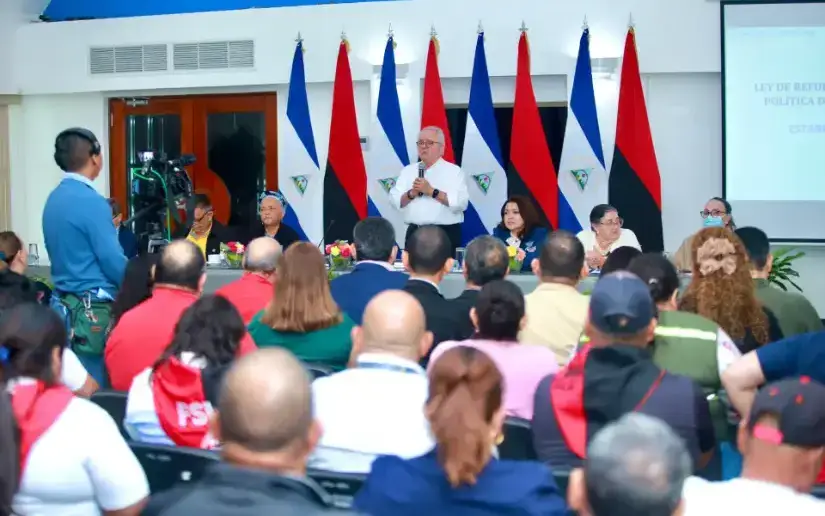
Good afternoon, friends, Compañeros and Compañeras. Let's get started. First of all, to say thank you to all of you for being here, to all the Compañeros and Compañeras who are connected on line, a greeting. We are talking about that this afternoon we have the consultation with the State workers. We have connection with 130 places where there are Compañeros and Compañeras, as you can see in all of them, whom we also greet.
There are also Compañeros and Compañeras here, leaders of UNE, of different labor unions and workers. There are National Assembly workers and there are several other on line connections, and we also some on another floor below so that the presentation can also be transmitted to other on line connections.
Our objective is to consult with you, so that everyone is clear, so that we are all clear about the content of these Reforms to the Constitution that we are promoting. Before starting, and getting on with the transmission of this consultation, I want to present the Compañeros and Compañeras, members of the Special Constitutional Commission with which we are working on this Reform.
The members of the Executive Board are part of that Special Constitutional Commission. Dr. Arling Alonso, who is the First Vice President of the Assembly. Our Heroine, our Compañera, Amada Pineda, who is the Second Vice-President of the Assembly. And our friend María Haydee Osuna, President of the PLC and Third Vice-President of the Assembly, who have been firm in their accompaniment and in this reform that we are working on.
Here too we have the Compañera Loria Dixon Brautigam, who is the First Secretary of the Assembly. Dr. Wilfredo Navarro, who is the Second Secretary of the Assembly. Here too we have our friend Alejandro Mejía Ferretti, who is the Third Secretary of the Assembly.
As members of the Committee we also have the Heads of the Political Groupings. There are three Political Groupings in the Assembly: There is the Political Grouping of the Sandinista Front, the Political Grouping of the Liberal Constitutionalist Party and there is the BID Political Grouping, which is the Democratic Independent Political Grouping, which unites parties such as the PLI, ALN, APRE.
So, we have Dr. Edwin Castro, who is the Head of the Sandinista Front Political Grouping. We have Compañero Lester Flores, who is the Head of the PLC Political Grouping and our friend Mario Asencio, who is the Head of the BID Political Grouping.
We have two more members of the Special Constitutional Commission, who are presidents of Committees of the Assembly. Dr. Auxiliadora Martínez, who is the president of the Justice Commission and Comrade Wálmaro Gutiérrez, who is the president of the Economic Commission.
Here we have Compañero Domingo Pérez, who is the General Secretary of UNE. There too is Ana Yelitza, who is Co- General Secretary of UNE, little by little we are removing the title adjunct, because he is General Secretary and she is Co- General Secretary.
Greetings to all who are connected on line.
This story begins when Comandante Ortega, on July 19th directed us and made public the order that there are no longer to be elections here again allowing those lying in wait, under the protection of the Yankees, to put it clearly, so as to take over the Government again, take over power and start rolling back the conquests of the Revolution. Comandante Ortega clearly said that and, well, the controversy began, you heard it all: "They say there are going to be no more elections.”
Yes, he said so clearly: there are not going to be elections again allowing those seeking to return to government, seeking to return to power, come and commit their outrages. He even mentioned: "For them to come and turn education into a business." And he also said: "We are going to work with the National Assembly to make the laws to ensure this."
That is precisely what we are doing. So, we set out working in that direction: We have to make the laws that allow us to put up a barrier. The Comandante even said, "To put up a barrier, put up a wall so those people cannot come back." And that's what we're doing: putting up a wall, a constitutional barrier so they don't come back. And now we are introducing them to you. We have now made 15 presentations, we are about half way now since there are 30 in all, but each presentation is to thousands of Compañeros and Compañeras.
For example, yesterday, in Education, there were 20,000 people connected on line; now there are also thousands. Today, in the morning, there were thousands of Health Compañeros and Compañeras and so we are going to go on, until we reach the end of the month of August, because we have the proposal and we have the order, furthermore, to approve the reform for the first of September, to salute the beginning of the Month of the Patriotic Nation.
So, for this work, we have identified and, furthermore, our Co-Presidents, Comandante Daniel and Compañera Rosario, have repeatedly said that the main aspiration of all Nicaraguans is Peace. Peace is the main aspiration, Peace is what we need to guarantee. But Peace also means Security, Without Security there is no Peace. We have to keep be on high alert to guarantee Security, which will allow us the guarantee of Peace and both will allow us Stability.
Those are three words that are totally related. There can be no Peace if there is no Security, and there can be neither Peace nor Security if there is no Stability. And vice versa, if there is no Peace, there is no Stability and there is no Security. But those three words lead us to only one thing, which is the central objective that Comandante Daniel and Compañera Rosario have defined for us, and that we should all be clear about: one which unites all Nicaraguans, which is the fight against Poverty.
The fight against Poverty guarantees these aspects. Why? The triumph over Poverty will give us the guarantee of these aspects, and to triumph over Poverty is to achieve definitive Independence, it is to achieve full Freedom, because Poverty is the enemy of all these things. In other words, we have to overcome Poverty in order to have Freedom, Tranquility, Peace, Security and Stability. All these words interlink with each other to give us what we need, which is the happiness of the Nicaraguan people.
With these three words we began to work, and with the central objective of poverty we began to work on the ideas for Electoral Reform. But when we reviewed matters, we realized that we needed the central historical argumentation of why we are currently working on this aspect. Comandante Daniel always makes reference, and he made it on July 19th to the idea that Nicaraguans must understand each other here, and all this discussion is between Nicaraguans, so as to decide on the elections in Nicaragua, elections for Nicaraguans, for candidates who represent the interests of Nicaraguans and the well-being of the Nicaraguan people.
They cannot be elections imposed from abroad, they cannot be elections imposed by foreign powers, they must be our elections. So, we started to review the history, which is why Wilfredo is teaching us this book called Zeledón: Life and Legacy.
So why is that? Because the fact of this very book indicates to us that our history is crossed with the history of the struggle of Nicaraguans against foreign intervention, whatever form it might take. And wherever we look, there is Rubén, we are in the Rubén Darío Meeting Room, and if we read Rubén Darío, he is absolutely anti-imperialist. His ability to write, his beauty, his grandiosity, his universality, his ability to transform Spanish letters, to develop all that modernism, is precisely marked by his being Nicaraguan, by his nationalism, by his anti-imperialism. So, everything that we are is shaped by that struggle.
Let's see where we began: We were not yet Nicaragua as a country, but already the name of Nicaragua was borne by one of our Heroes, the Cacique Nicaragua. He is the one who bore the name and who, together with the Cacique Diriangén, who are our anti-imperialist indigenous Heroes, managed to defeat the Spaniards in their first defeat on this continent. That's the reality and that's why Nicaragua is called Nicaragua, you don't have to look hard for it.
That is to say, his name was Nicaragua and we know him as Nicarao and these territories belonged to Nicarao. So, we have to be clear about that origin and that the defeat we inflicted on the Spaniards happened, it is a reality and it is documented, it was on April 14, 1500, but it was a little after they arrived, and I did learn the name of the place.
And if there are people connected, from Diriamba or Carazo, they know that the struggle, that battle took place in the Quebrada del Perro, which is in Diriamba, and that today it is a street named after a Hero, but it was the Quebrada del Perro then, and everyone knows and they say so. After almost 600 years, there in the Quebrada del Perro, there we Nicaraguans, defeated Gil González, and we expelled him. He left, to return more forcefully and with other invaders.
What I mean is, that gives us our character, that gives us our social DNA, a natural DNA of struggle against intervention, a DNA of struggle and Dignity against all foreign interference. Imagine, we are talking about 1523. And after that we continued fighting, and as we have said in these last presentations, every time a foreign aggression is carried out against Nicaragua, Nicaragua responds by producing, giving birth to Heroes.
In the Spanish colonialist intervention Diriangén and Nicarao appeared, and 300 years passed, Nicaragua went on producing Heroes, Heroes like Adiact, like Yarrince, like Agateyte, that is, to keep on defending all our territory. And that's how we went on producing Heroes for 300 years.
Why am I talking about 300 years? Because 300 years later we come to 1821. From 1523 to 1821, almost 300 years of struggle and the production of Heroes, and we have to go through that history so that we all have it clear.
We arrive at the day that the Independence of Central America was signed, September 15th 1821, one of the dates for which we remember September as the month of the Petriotic Nation. A formal independence was signed and formally the Spanish colonialists released the Central American Federation. But the struggle continued, since what they were trying to do was change the forms of domination because they could not sustain the one they had, and thus they began to develop oligarchies in each of the countries, which were their representatives, the oligarchs, and they chose Creole families, children of Spaniards, born here to dominate the natives or the children of miscegenation born here.
That is our history, and we have been fighting since 1821 when we were divided. They seized the Central American Federation, broke it up, the different countries were formed. Obviously, we were part of that, we were all Federated Republics, it was a federated State comprising all of Central America, and this we were formed our republics.
Such that the first Constitution of our country was made public in 1838, the first Constitution of Nicaragua as a Republic. So, all this is the history of struggle against the Spanish, a history of struggle against those who tried to dominate us in the name of others, a history of struggle against the attempt to make us part of the empire in Mexico under Iturbide, a permanent history of struggle by Nicaraguans against foreign domination. But since the time of the Spanish there was already a desire of all those who wanted to dominate us, to control the Canal, the same Canal currently provoking discussion and attacks.
Why? Because the Spanish came here thinking precisely about that transit. That's documented, they entered by the River San Juan River, "the water outlet”, they called it, to reach the lake and cross there over the Isthmus of Rivas, via Brito, to reach the other side. The English or the British, too, that is why we Nicaraguans have the medal of honor of having fought Spanish colonialism in the Pacific and British colonialism in the Atlantic. We were two engaged on two fronts and they colonized us or maintained their rule until we were liberated and we could come together as a country, but those are realities.
The Canal attracted everyone. Why? Because it made it easier for them to move from the Caribbean to the Pacific or from the Pacific to the Caribbean. While this was all happening, while we are getting rid of Spanish colonialism, while the Spanish empire was losing strength, while the British empire was also losing strength, little by little a new empire was appearing in the world and it was the North American empire that was growing.
The place that one vacates is taken by another. That's a law, there are no vacuums, they are all occupied. Or else the vacuum is occupied by the Dignity of the People from the place itself. So, there are economic and social phenomena, namely, after all, we are talking about some Peoples who were also colonized, they were British colonies, came into being, became independent, organized and began to grow.
That is how they came to have their own particularities in North America, in the territory that is now the United States. There was the gold rush, the quest to move from east to west, the terrible genocide and extermination of the Original Peoples of North America, all of that.
And that made it so difficult for them to cross from East to West, to cross from the Atlantic to the Pacific, that they had to look for other ways to do so and of course, they were keeping an eye on three places: Panama, Nicaragua and the Isthmus of Tehuantepec in Mexico. Then they started making attempts, they had already started building the Panama Canal. I understand that the French were also there but at that time they also had their eye on Nicaragua.
We are talking here about the time around 1838, we were already Nicaragua, we are talking about, approaching the 1850s. So then, there was a certain businessman, Cornelius Vanderbilt, who developed a trade route, identified that this crossing was much faster than fighting a way across the land crossing and he sent filibusters, mercenaries, who apart from being filibusters and mercenaries, were well educated and prepared.
William Walker was a doctor, he was a journalist, he was educated, but that does not stop him being a filibustering mercenary. At that time, he offered his services and he was sent to Nicaragua to undertake a campaign to dominate this territory, together with a soldier, Byron Cole and some mercenaries to take over the territory, all financed by Vanderbilt. Then, history followed its course and just as in the struggle for Independence against the colonialists, Nicaragua gave birth to Heroes and Heroes here as well. During that period, Heroes and Heroes appeared like Tomás Ruiz, or Cleto Ordóñez, a true anti-oligarch popular combatant from Granada. So, every moment of Nicaragua's history produces Heroes, to defend us, against whom? Against foreign interference, that is our history.
So, William Walker came, Byron Cole came, Vanderbilt's money came. Immediately, Nicaragua produced its Heroes, who made the decision to defend it, and José Dolores Estrada appeared, other patriots appeared and after a while too Andrés Castro appeared. Nicaragua returned, fought back and managed to unite Central America after a struggle of three years until it definitively triumphed, after the Battle of San Jacinto, of September 14th 1856.
We all know the Battle of San Jacinto, we know it as an epic and heroic action, but what we needed was to be told what the real background of that phenomenon was, and what was at stake there was the domination of our country to serve imperial interests. That's what they told us at school, they told us at school was that it was a battle against the filibusters, they didn't tell us it was Yankee filibusters against our patriots. That's where Andrés Castro came to the fore, moreover, since the filibusters had rifles and the patriots had arrows, like the Indian archers, or stones, most children wanted to have the rifle.
Then they would say, “No, it's just that I want to be one of the filibusters,” without knowing what it meant, because we were being taught only superficial history, they were not teaching us the true cause. Now we have the opportunity to realize that the filibusters were merely a phenomenon determined by imperialist expansionism that was seeking to dominate us, and so there we had that struggle, there we had those Heroes.
We got through that, from 1856 onward, William Walker was defeated, but in Nicaragua our own contradictions continued between the conservative oligarchs who tried to maintain the archaic conservative model and new people who came with new thoughts, developing the Liberal Revolution of the late nineteenth century. Among these new people, inspired by liberal thoughts, there was Rubén Darío, there was our other National Hero, José Santos Zelaya, there was Benjamin Zeledón himself, who was Zelaya's Minister and was a soldier in that army, and that was the way ahead.
What happened? The issue of the Canal became central and Zelaya saw that this issue of the Canal was very real. Darío wrote clearly mentioning the role that the Canal played in the Yankee intervention and, by 1909, soon after Zelaya was broaching talks with the Japanese, talks with the Germans about the construction of the Canal, the Yankees said: "No, we already have the one in Panama," because they already had the Panama Canal at that point, which they already controlled. Because we should have seen that Panama was part of Colombia and the Yankees created the necessary contradictions in order to split it off and create the Republic of Panama so as to dominate and take over the Canal.
So, by 1909, the Yankees had decided they needed a second option and when they saw that Zelaya wanted to go his own way they acted, they sent some gunboats to Corinto, to Bluefields and sent a note from the US State Department called the Knox Note, which we all know about by now.
That note told Zelaya: "OK, sir, step down. You can't stay in power." And there is another writing by Darío which we have come across in that regard, which clearly says, referring to the Knox Note. Knox was a gentleman, a demon whose name is Philander Knox, he was the US Secretary of State. That's like us talking now a Rubio Note since he is now the US Secretary of State, at that time it was Knox.
After all, the system is the same, only the names change. So, it was an imperialist note telling him: "You have to go." Given the gunboats Zelaya preferred to step. He had friendships and communications with people in Mexico and went into exile and the Yankees put in Madriz. Zelaya hands power over to José Madriz leaving him as President and the Yankees arrive so as to intervene.
And why go through all this history? Again, Yankee intervention, 1912. Once again, Nicaragua reacted by producing Zeledón, that is, it produces another Hero, that was Dignity being asserted, it made him react with heroism, he began fighting the Yankees, and they murdered him. There are some very important texts that should be read, some powerful letters that Zeledón wrote before that last battle, there in Coyotepe and La Barranca, and until he was assassinated by the Conservatives. What a coincidence that the person at the head of the conservative army was a Chamorro.
So, with the Conservatives and the intervention, what the Yankee does is to say: "We're going to put fear into these Nicaraguans." That’s how the Yankees think, what they think today and what they continue to do: "We are going to lauch attacks, we are going to disrupt things and disappear opponents." Aren't they saying that right now? In other words, the actions and the arrogance of terror.
So, to frighten people, at that time, they took our Hero, Benjamin Zeledon, tied his body up on a cart and paraded him through the streets of the White Towns, and dragged him through Catarina. And that led Nicaragua to produce the Father of the Revolution, the greatest Hero we have, the person who has guided us to be here: Sandino.
Sandino was present there. The Yankees expected that all the young people and the whole population would be terrified and that, at a stroke, that would give them domination. But what happened was that it outraged Sandino and Sandino vowed to fight, and that light emerged from among the Nicaraguan people.
So we arrive at 1912. There were several internal struggles, but in fact, the Conservatives prevailed, who are the ones calling for US intervention. Adolfo Díaz controls the government, as President Díaz and so we get to 1923.
But let's remember all of this we are reviewing is in order to realize that the history of the Nicaraguan people is a history of permanent struggle against foreign powers. We have been formed that way, whether we like it or not. We heard so many things. I, kid, I remember that there were even songs, sayings that accustomed us to the idea of the foreign invasion. Rubén Darío put it in a book but we heard it too.
We used to say, "Colorado came down from the sky like a sonchiche," and we talked about, "Gardena Sanamambiche." We were were talking about popular songs referring to Yankee airplanes. We must remember these things, because they are the expressions of what the People keep in their hearts. The people keep that resentment of foreign rule in their hearts.
So, the Yankees came here in 1923, they took the decision to look for more effective forms of domination than the more brutal ways like war, destruction, death. And there are more effective forms of domination: if you have a country and you control the head of the government you can apply laws so that they serve your objective. So that's what they did.
In 1923, they decided that Nicaragua had to be re-made in the image and likeness of the Yankee model. And that means the Yankee model as a bipartisan model, which is the one that still exists today. There are Liberals and Conservatives; in the US they are called Democrats and Republicans.
So, in Nicaragua they decided we had to have a similar model, which is one of Liberals and Conservatives, and they sent a man named Harold Dodds. If you take your smart phones and go into the search engine, put: "Dodds Law" and they will show you Electoral Law in Nicaragua, made by a Mr. Harold Dodds, who was an American sent by a Yankee President to make the Electoral Law in Nicaragua.
Here is Dodds Law and that law established for the first time the National Council of Elections, what we know today as the Supreme Electoral Council, and it was a law that was aimed exclusively, from a legal point of view, to set up a framework so that there would be two parties, Liberals and Conservatives. But this was not what we were taught, we came into the world as we found it, and came to see that there were Liberals and Conservatives and we believed that life was like that.
In addition, we were taught it as the historical parallels: Liberals, Conservatives, with the idea being that over time, first the Liberals, then the Conservatives, and that there would be an “alternation in power”, in quotes.
So, here is an example of what the official ballot paper was at that time. This law was made during the presidency of Adolfo Díaz, who was the one who had requested the Yankee intervention. This ballot paper tells us that there is a Conservative Party, a Nationalist Liberal Party, and the Conservative Party, its candidate for President was Adolfo Diaz and there is the Nationalist Liberal Party, whose candidate was Juan Bautista Sacasa. Both of them, to be regarded with reserve: the first brought the Yankees and Juan Bautista Sacasa is the one who invited Sandino to his last supper so that later he would be murdered.
That is, the Yankees were the ones in command, either way. Win, win, for them: Win with the first, they already knew how it would be, and if the other were to win, they also also already knew how it would be. That is to say, that was the characteristic of our political life: foreign rule.
A series of events followed after 1923. There was the period of the war of the Constitutionalist Army under Moncada. So, the Yankees saw this mature, and then when the Liberal Army was dominating the war, the Yankees saw their moment and imposed themselves.
The Yankees say: Well, let's see, Moncada to lay down your arms we are going to make the Espino Negro Pact, the Moncada-Stimson Pact. So, there was Moncada and there were the Yankees, whereby you will give us the weapons of the army that was winning, and they could shake on that. Thus, we’ll give you a dollar for a rifle, but we also guarantee that next year you will be President, that was on May 4, 192seven.
May 4th 192seven, if this were all that had happened, would have been the day of ignominy, but why do we call it the Day of National Dignity? Because there was a General of the Constitutional Army, of the Liberal Army, who said, "No, I'm neither selling out nor giving up." And it was that boy who had sworn after having been outraged to see Zeledón’s body being abused by the Yankees. So then it was Sandino who says: "No, I'm neither selling out or surrendering" and given that he did not accept surrendering he set off with 30 compañeros.
A month and a few days later after refusing to surrender, he declared in his Manifesto of San Albino, on July 1st 192seven: "Here the struggle is not between ourselves, it is against the Yankees and their lackeys and their traitorous sell-outs," and he sets out well what the path is, identifying for the first time what the contradiction was that had to be resolved: the struggle against American intervention. So, Sandino took his side, and the Yankees continued with their plan.
In 1928, to comply with the Espino Negro agreement, the Yankees brought in US Marines, specifically to take over the electoral process, that is, so that those US marine officers would be the polling station Presidents, the heads of electoral districts throughout the country, at the departmental level and at the local and national levels. And they said, "This is how the elections are going to be."
But, all those arrangements needed a command. They were not going to have a Nicaraguan in charge so they decided that General Frank Ross McCoy was going to be the President of the National Electoral Council, and that's what they did in 1928, why? To ensure the presidency for Moncada.
So, they occupy the Dodds Law, they do the trick, but in order to do this thing about the Yankees being the ones who run the entire electoral process, they make another law: This is the Dodds Law and this is the McCoy Law. The McCoy Act is called the 1928 Act, and this is the Dodds Act, the 1923 Act. This is the one they occupy, but then they do this one to put it on hold, to occupy the ring, the electoral framework, but to give it the characteristics that the Yankees were going to make the elections.
Look at what the Dodds Act says. It's brutal and it was shocking. We here are used to an inclusive language now with the Revolution, and we say: "All Nicaraguans have the right to elect and be elected," except for those... and let's then see who. No, but they didn't say that. They said the other way around: "No citizen may have the right to vote." "or they do not have the right to vote if they do not meet the conditions and qualifications required by the Constitution.” That's the first thing: "No one can vote”" except those we say.
So then the article is brutal, because when I look at this side of the auditorium, and so,pay attention, on each side of the auditoriums, on whichever side you are, that is to say, here in this first row, there are only two votes; on the second, and a little more, there are four; on the third row, one. Why? Because, according to this law, the right to vote belongs only to Nicaraguan men aged 21 or older, that was democracy back then.
So, in Nicaragua, out of every 100 people, 52 are women and 48 are men. That is, for every 100 Nicaraguans, only 48 could vote according to that. But of those 48 only those who are over 21 years can vote. Probably everyone here, I don't see anyone who is under 21. That was the reality: 48.
But we here, we are not a good representation of the general Nicaraguan population, because there are many young people playing in the park or at school. When I put it demographically, in the Nicaraguan population, today those over 21 could be maybe 60% of the population. At that time it was the other way around: those aged 21 or over could be 40% of the population, because at that time the Nicaraguan population was younger. That is, almost 60% of people were under the age of 20.
So, let's do the count again: out of every 100, 48 can vote, who are men, and out of those 48, 22 can vote, which is 40%, because it’s all those who are over 21 years old. So, 20 out of 100 will vote. That was democracy. But someone could say: "But, anyway, let's get on with the vote, because rich or poor, we are all the same." No, wait, the laws are made to guarantee the domination of those interests that have the hegemony, and those interests were the interests of the quislings, of the rich and of the Yankees.
So then they added: those aged 18 or over will also be able to vote, which was an important proportion, however with two characteristics: those who were married, who at that time were all married by the Catholic Church. Then, those who had money and those who had a surname, and some social standing, married in the Catholic Churc. So, you know who that was going to favor.
I'm also going to give you another condition: namely, that they can read and write. With the level of illiteracy and with what education there was at the time, it was the children of the landowners, the children of the rich, the children of the oligarchs, who could read and write at the age of 18. The great majority of the population were illiterate. So, all those votes were being guaranteed. And that's the democracy they taught us.
Let's go to the McCoy Act. So, this gentleman came and he was appointed, and there was no shame on the part of these bandits. Well, we also have to say what they are. They said:
In view of the fact that the Supreme Court, the President of the Republic, in view of the fact that the Supreme Court of Justice, by agreement of the 1seventh of the current, has appointed to replace Señor Joaquín Gómez, who submitted his resignation, General Frank McCoy, President of the National Elections Council, and that this high official, in that capacity and having been appointed by the President of the United States, should direct the 1928 election of supreme authorities, as agreed in order to put an end to the civil war ravaging Nicaragua.
That is, the law makes clear who they are going to appoint and then it comes: Considering that the Electoral Law... but it makes it clear that the head of the Supreme Electoral Council is General McCoy, who is appointed by the Yankee President. Then, the Yankee President orders the President of the colony that this Yankee is to be in charge of the elections. Why? To fulfill, as it says here, according to what was agreed. What was agreed upon? For Moncada to be the President. And that is what happened.
And here we have actual graphic evidence, these photographs. There was no artificial intelligence there, those are for real. Here, look, this is a line of voters taken to the polling station, waiting to vote before the polls open. And this one here, he's a US marine presiding at the polling station. That's the truth, that is what we cannot repeat and what we're going to block.
Here is another photo: this is a National Guard, because they were forming the Constabulary, they were forming the National Guard. Here are some people waiting to vote and here you have the head of this electoral district, the Yankee marine, who has to be there since he is the one in charge.
Here you have some voters. It is possible that many of these are workers, they are hired hands, because here there you have some people in hats, bowler hats, who maybe are the bosses who are taking note of who has or hasn’t arrived to vote. But it is not really that they are waiting to see: "You just turn up to vote." Here is this person and there is another who keeping order. That was democracy.
These people here are Marines and these three are here because this is the Esteli electoral committee. But don't think the three Marines are watching over all these voters. They are taking care of this individual, US Major Joseph Pate, presiding over the Electoral Committee in Estelí and the Departmental election board. That was the reality of our electoral processes a hundred years ago, a century ago, which is not a long time in the life of a country.
That's the reality, we're fighting against that. We are moving onward, we have 4seven years of Revolution, more than half of that time, and we are advancing, putting up that barrier, putting up that wall that will allow us never to return to that. And in Peace, that's how we have to move forward little by little: preserving Peace, giving Security, but here we are taking a firm step onward.
So, there was one US marine who was the head of the Electorl Council, others were the head in each of the departments, like this fellow, and then there were also the US Marines who were in each of the local electoral districts.
Amid all that struggle, with Sandino there, and after the betrayal of Sandino so as to murder him, while he was coming to seek Peace. Sandino, who, as I said earlier, one of these new heroes Nicaragua produced and Santos López followed and then Carlos Fonseca appeared and the Sandinista Front appeared, which includes most of us here, and we are multiplying.
So we arrive at this Project of the People President, where what we intend is that, independently of our different opinions, you can have liberal opinions, conservative opinions, Sandinista opinions, but the Patriotic Nicaraguan Nation is Sandinista. Why? Because it is the Patriotic Nation of the Sandinista Popular Revolution and because it is the Nation that gave him life, gave him Dignity, made it possible for him to emerge as the Father of the Sandinista Popular Revolution, General Augusto C. Sandino, General of Free Men and Women. That is the People President Project which includes all of us. Why? Because there is something that unites us all: to have peace and quiet, to be secure, to be free and to overcome poverty, so that all of this will allow every one of us a better future.
That is how we arrived at last year 2025: This Article is in our Constitution, it was approved in January 2025, in the Second Legislature. Already this Article condenses all the history that I have spoken about to you, but it also incorporates the experience that the Yankees themselves made us go through with the coup attempt of 2018. Why? Because it includes the struggle against those traitors to the Nation, who wanted to carry out a coup and wanted to sabotage this path that we are taking.
And this Article, lest we forget, says:
Independence, Sovereignty and National Self-determination, Security and Peace are inalienable rights of the People and foundations of the Nicaraguan Nation. Any foreign interference in the internal affairs of Nicaragua or any attempt to undermine those rights threatens the life of the People. It is the duty of all Nicaraguans to preserve and defend these rights. Consequently, all those who violate these sacred rights of the Nicaraguan people will be considered traitors to the Nation.
Thus we are already clear that anyone who undermines this constitutional precept, we must consider it as constitutionally established that they are a traitor to the Nation, and that leads to the consequence that they lose their nationality and, consequently, also lose their political rights.
After all this introduction, we are going to present to you the six ideas of the Reform. The first one: "They won't be able to.” This is the mandate of the Commander and our sentiment is clear: "Citizens have the right to elect and be elected and to opt for public office, except for the limitations contemplated in this Political Constitution.” That's what Article 4seven says. We are going to add to it, with a better wording, more broad, all the following:
“They may not be candidates for positions of popular election nor may they hold public offices by appointment of the President of the Republic or election of the National Assembly.”
Who are they? We remember four groups: the coup plotters, the traitors to the Nation will not be able and those who commit or have committed acts that undermine Independence, Sovereignty, Self-Determination, Security and Peace, against Article 1, those will not be able to take part. And nor will those who violate or have violated the Fundamental Principles contemplated in the Constitution. Those won't be able to take part.
We have to be clear. People will ask: "And is there going to be no elections?" Yes, there are going to be. And can all Nicaraguans participate? Yes, we all have the right to choose and be elected. So then who won't be able to take part? We will let neither the coup plotters take part, nor traitors to the Nation, nor those who have violated Article 1 of the Constitution or any other Fundamental Principle of the Constitution, such people will not be able to take part.
The text is more detailed, because we do not want things to remain abstract, because we want any compañero or compañera, any person who takes their smart phone and starts writing, posting on TikTok: "Oh, I can't stand this situation anymore, I wish the planes, the aircraft carriers would come and invade us." They should not even joke about this. It has to be clear that anyone asking for military intervention means they will not be able to take part. Usually, that kind of thing is done by people outside Nicaragua, who can no longer take part anyway.
So, here it specifies: "Those who commit or have committed acts that undermine Independence, Sovereignty, Self-Determination and the Security of Peace, who incite and promote foreign interference, who call for military intervention, who organize with financing from abroad, who propose measures or support economic, commercial or financial blockades and who propose measures or support sanctions against the State of Nicaragua, its institutions and its citizens." They won't be able to take part in elections, that's the first idea.
The second idea: "Stability". We need stability, we need more settled electoral times. In the world there are electoral periods of 4, 5, 6, seven and 10 years. The countries that have greater economic development have electoral periods of 10 years. So those of us who are looking to get ahead in the fight against poverty need electoral periods that go beyond the general medium term of 5 years.
We are proposing seven years. That is, we want a period giving enough time to show that, if we intend to build a hospital in one period, we can get it done in seven years. We have already shown we can, or if we have to build a road in seven years, if we have to reach electricity coverage goals, seven years gives us enough time to do so.
This is the second idea: Stability means seven years, a period established in the Constitution of the Republic for popularly elected positions and for the election or ratification of the Assembly: seven years. So, now we have looked at: "They won't be able to" and "Stability”.
The third idea is "Cohesion and Security". We need to be cohesive and to have security. This means that, just as the positions of popular election have seven years and those of appointment by the President have seven years, in this Reform, as of right, the laws of the Army and the Police are modified, guaranteeing that the Commander-in-Chief of the Army and the Heads of the Police Forces serve for seven years, so that everything is cohesive and going in the same direction.
We call the fourth idea "Guaranteeing our Electoral Democracy". We think Electoral Democracy is a small piece of Democracy. Electoral Democracy, for us, is not Democracy, it is the corresponding part whereby the People express themselves for or against the project being carried out and those who are carrying it forward.
It's a small part, because true democracy is that no one can take children out of school and that they are free of charge, and that they give you your examination grades and don't say they won't because you haven't paid, and that children in school don't faint because they don’t get a school snack or because they arrived to class without having eaten, or that you go to the Hospital Velez Paiz, the HEODRA hospital, or the Choir of Angels Hospital in Esteli, the Heroes de la Segovia Hospital, or that you go to the one we are building in Bluefields, or the one we are about to build here in eastern Managua, the Lesbia Carrasquilla Hospital.
That is Democracy: the fact that you can have a high-tech hospital where you are not going to have to pay, or that you arrive at a health center and that they do not charge you for the consultation, or that they do not give you a number for which you have to pay 10 pesos. But, in addition, there may be some unhinged person, a clueless person or someone is doing something wrong, but since we are part of the People President, we understand and know there there are mechanisms which enable us to say: "Look, compañeros, compañeras, there are people who are doing this in that place," so they can go and check, because here we have to be on high alert to all that kind of thing.
It's democracy, that we have electricity most of the time. Now we worry because I've been to all these meetings and not once has there been a blackout, so now we get concerned and if the power goes out, we ask “what happened?" 20 years ago, we were saying “The light’s back on now” because we were so used to being in the dark.
That is, things are changing for the better. That's Democracy, having 99.5% national energy coverage. That my compañera here can leave right now and before midnight she can reach Bilwi, in Puerto Cabezas. It is democracy having the possibility of being able to move aboout the country. And why this kind of democracy? Because if you go to other countries, even if there is such a road, you pass through some toll booth where you have to pay for each stretch of road you use and you have to choose whether to pay or not, that’s not democratic. It's democratic here because you can use the roads whether you can afford to pay or not, you have these roads for the People of Nicaragua, these well-made roads. So, democracy for us is much more than the electoral kind.
Anyway, this idea refers to Article 152 of the Constitution, which is the article of our Supreme Electoral Council. Obviously, we, after our Revolution, do not need to discuss whether the President of the National Supreme Council or the President must be Nicaraguan. That is already a requirement by law, but back then they needed to make sure it was going to be the Yankee, so in other words, we have now erased that forever.
By the way, now the President of our Supreme Electoral Council is a Nicaraguan Heroine, Compañera Brenda. So, here we give to the Supreme Council, in its Article 152, the power to convene elections every seven years. If we now accept and reform the Constitution so that elections are going to be every seven years, the Supreme Council must have the capacity to convene them every seven years.
In addition, if we say who will not be able to take part, the Supreme Electoral Council must be able to ensure that they cannot, that is, so that they do not grant legal personality to political parties constituted with foreign financing, or when any of their directors have violated the Fundamental Principles of the Constitution, or that they can cancel the legal personality of a political party when that party, its director or candidates receive foreign financing or have violated those principles, and the power to verify and impose corresponding sanctions on all candidates, officials of any Electoral Body and members of the Executive Boards, who commit or have committed acts that undermine the Independence, Sovereignty and Self-Determination of Nicaragua.
So, here comes a given political party, the Sandinista Front, the PLC, the ALN and they say: "Well, here is my list of proposals for members of the electoral councils." The first thing to do is to check, to verify and, if any of them, whoever they may, turns out to have posted: “I would like them to come here and intervene" then they cannot go on the Electoral Council's list. They won't be able to. It says: "To verify and impose the corresponding sanctions on any candidate, candidate, official of the body or member of the Executive Board who incurs in that violation of Article 1." Is that clear? And so, we have ensured that our Supreme Electoral Council is going to have those attributes via the Constitution.
The fifth idea is a simple one: "PAX”, January 18th, the date of the birth of Rubén Darío. That is the day we propose make the date of the investiture, the inauguration of the Government. We are correcting a historical mistake. That is to say, for us, Sandino and Dario are our great expressions, two National Heroes who have defined the Nation since Dario is Universal and Sandino too.
We had the 18th of January and but we made that date the 10th of January. So, now we are saying: "No, we are going to take advantage of this reform and we are going to correct this, we are going to correct that oversight, we are going to make the inauguration, which is a civic act of the greatest importance in a country, in a republic, on the day of Rubén Darío's birth, on January 18th."
Finally, the idea that we call "Coherence". Coherence is, if we approve this Reform, and there are going to be elections every seven years, and there has to be coherence in everything we approve.
That is, those of us who were elected six years ago, or for six years, the law has to say that our period is extended to seven so that it is operative, that it is coherent. And so, that's what it says here: The terms of the authorities elected by popular vote in the last General, Municipal, Regional, current elections are extended to seven years from this last election.
The term of the positions appointed by the Presidency of the Republic, or their election or ratification by the National Assembly, are extended by seven years from the date of the appointment, election or ratification. Here it is from the election, there it is from the appointment of each post.
And thirdly, just in case, in all national legislation, where you look at the periods of service you will see seven years for posts in the civil service. So, those are the six ideas.
I want to take advantage here, I also want to test if you were paying attention.
The first idea of the reform is: "They will not be able to." Now who are not going to be able to take part: coup plotters, terrorists, so we can be calm, none of them are not going to be able to take part, they will not be able to.
The second is “Stability." Seven years if people approve, and we are doing the consultation.
The third is "Cohesion and Security". That is, the Heads of the Army and the Police, seven years too.
The fourth: "Guarantee of Electoral Democracy", to ensure the attributes of the Supreme Electoral Council.
We are reviewing it because it is up to you to multiply this, because you are going to ask: "Look, is it true that there will no longer be elections?". Yes, there are going to be elections and they are going to be every seven years. And can we participate? Yes indeed, offer your candidacy. But so-and-so, and others cannot take part... everyone else, yes.
The fifth: "PAX", Rubén Darío, January 18th is the inauguration.
And the sixth: "Coherence".
You won't forget these now, I'm sure. Even though it’s two o'clock in the afternoon which is a wearisome time, you were attentive.
I thank you on behalf of my colleagues.
Interval for Comments
Compañera Ana Yelitza:
Good afternoon everyone, Compañeros, Compañeras, Members of the Executive Board, Dr. Gustavo Porras, also to the Head of our Political Grouping, all the Deputies present, Public Sector workers of Nicaragua. Thank you, Doctor, for that excellent exposition of the our People’s history of struggle. It has indeed been a difficult history, it has cost all Nicaraguans, but it is good to know and to learn it so that we can share it too.
In general, I want to make a statement on behalf of all Public Sector workers and all our Compañeras and Compañeros who are also connected on line. Here we have present of more than 100 union members and we have thousands of public sector workers on line.
Today, August 13th the Public Sector workers of the State, on the date of the centenary of the birth of Comandante Fidel Castro and the 96th anniversary of the birth of the founding Comandante of the Sandinista National Liberation Front, Comandante Tomás Borge Martínez, who bequeathed his loyalty to all of us in the Sandinista Front, in the national public sector, we thank the invitation of the National Assembly to be here at this important Consultation Session on the partial Reform of our Political Constitution and to learn and be clear that this process of Consultation with the Nicaraguan People strengthens Stability, Security and Peace.
Therefore, the public sector workers of the Nicaraguan State express our firm and forceful support for the Reform of the Political Constitution and we are convinced that constitutional transformations strengthen our institutions and guarantee transparent elections.
We reaffirm our institutional commitment to fulfill and enforce what is mandated by our Political Constitution and by our Supreme Chiefs, Co-Presidents, Comandante Daniel Ortega and Compañera Rosario Murillo, a mandate which we are fulfilling, received from Comandante Daniel last July 19th, with his extraordinary political and social vision in favor of the People of Nicaragua.
We workers are not going to allow the murderers of our people, who caused such great damage to our economy, or anyone who intends to do so, to participate in the national, municipal or regional elections of our Blessed Patriotic Nation; so that Nicaragua, thanks to the Sandinista Front, will not return to levels of extreme poverty and social exclusion, like those under which Somocismo kept us subjected for more than 45 years of dictatorship and 16 years of neoliberalism.
We support any preventive action for the protection and continuity of the Rights of our Country and so as to continue ensuring access to drinking water and sanitation, the modernization of the country's public transport system and the development of the telecommunications sector, of electric energy for the People, health, free and quality education for the People, social infrastructure with significant investment in hospitals, education centers, housing, streets and roads and sports facilities, as well as strengthening the participation of young people and women in economic, productive, cultural and social tasks in all areas of national life.
We are going to preserve and defend the great economic, labor and social transformations that our Government of Reconciliation and National Unity has made and which have enhanced the human development of Nicaraguans.
For all these reasons, all the public sector workers of the State agree and with unanimous hand vote we reaffirm our approach and our total, absolute support for the Constitutional Reform.
Long live Comandante Tomás Borge Martínez!
Long live Comandante Fidel Castro!
Long live Sandino!
Long live Comandante Carlos Fonseca!
Long live Comandante Daniel!
Long live Compañera Rosario!
Long live the People President!
Long live the working class! Thank you, Compañeras and Compañeros!
They Couldn't Prevail, Nor Will They!
Thank you
Intervention:
Good afternoon, Compañeras and Compañeros, Members of the Special Commission in charge of these transformations which are building our Patriotic Nation. I think that this Commission deserves a big applause here for the great work they are doing, because every day they are building our Patriotic Nation.
Doctor Porras, with that masterful explanation, the presentation you made today for all the workers who are here, State workers, we want to say the truth that we, as leaders who are here, as representatives of labor union organizations and as workers, totally support these Reforms.
Because here we must be clear that we cannot take a step back. Here we can no longer allow those school meals not to reach our children, or that housing not reach the impoverished, that more roads get built and that there are more schools.
We remember, as Doctor Porras said, all those blackouts, and we remember how many of our children had to carry their own classroom desk, not today; today they have a free quality education. We have universities for the People, we have free primary and secondary education and also, Compañeras and Compañeros, as representatives of the workers of the National Technological Institute, we also say: we have a free, quality technical education to get this country out of poverty.
And that is why we say: They Could Not Prevail, Nor Will They!
Long live Comandante Daniel!
Long live Compañera Rosario!
Not one step back!
Thank you Compañeras and Compañeros.
Compañero Edgardo Chávez:
Good afternoon, Brothers and Sisters presiding, Dr. Gustavo Porras, Brother and Sister workers, union leaders of the public sector. It's good that we are in this historical moment which we are marking here. It's great to be able to participate in this Consultation because we workers are Presidents with Daniel and Rosario at our head.
My name is Edgardo Chávez, General Secretary of the Energy Confederation, affiliated to UNE-FNT, with great pride, with great tenacity, with great vision, to attend to the unions organized in UNE-FNT in order to continue making the Progress that our Sandinista Front, that our model of Government, has been delivering to the Nicaraguan people.
The 99.7% of electrification, only few Presidents could achieve in the contexts the world is going through today, that humanity is going through today as our Brother Gustavo was saying. The empires have wanted to make our energy system collapse, but they were mistaken, they did not realize that here is Daniel, that here is Rosario and that here are men and women also at the head of this model of government, willing to carry Nicaragua's economy forward over any difficulty, over any stumbling block.
The workers affiliated with UNE-FNT are aware and we are totally in agreement in supporting this Reform of the Political Constitution of Nicaragua, because the genes that our Brother Gustavo told us about, do not come from now, the anti-imperialist genes that we inherited from Sandino, we inherited from those men and women who also founded the Sandinista Front which Daniel and Rosario are making a reality today and their leadership of this model of Government, we, the workers, also recognize.
And we, the workers affiliated to UNE-FNT, are going all the way with our model, with Daniel as President, with Rosario also at our head. We are going to continue supporting this Reform and we are going to continue supporting the shield it represents so no empire here is going to impose on us the method of election that Nicaraguans have.
We are pure Nicaraguans, full of that ideological fervor that our Heroes and Martyrs have bequeathed to us and we are with Daniel and Rosario to the last.
Long live the workers of Nicaragua!
Long live the FNT!
Long live the Sandinista Front!
Long live all Nicaragua!
Compañero William Reyes
(Virtual Participation):
Good afternoon, Compañeras and Compañeros Members of the Executive Board of the National Assembly. Congratulations to you for all that intense hard work, a very busy schedule. We want, as workers of the National Assembly, to support one hundred percent this Law of Partial Reform to the Political Constitution of Nicaragua under those concepts of: They will not be able to, Stability, the Guarantees of the Supreme Electoral Council that will allow us to continue advancing and it is important to point out Article 1: Independence, Sovereignty and Self-Determination, which allows us to define our own future. Likewise, Article 2 sets a seal that the mandate is of the People and for the People.
We keep moving onward and we congratulate you, Compañeras and Compañeros. Thank you.
Closing Words of Dr. Gustavo Porras Cortés
President of the National Assembly:
According to the oligarchs, there are only about three people in the group present here who can vote. Look, almost everyone here are all women. That's the strength of women, the strength of our Compañeras.
We are going to close, Compañeras and Compañeros, remembering our Comandante Tomás Borge, remembering our Comandante Fidel Castro Ruz, and we are going to close by requesting all of you after this meeting and the many others we are going to do, since we are learning communication methods here too.
I think we can create mechanisms so as to communicate periodically with all the different sectors and workers, to give information, to offer updates, and put things in context, I think it is very important. We thank you for your participation and we will close by asking you to do the work of dissemination that we all should do.
That is why I am convinced that this path is now unstoppable, because we are guided by Unity, we are guided by the will to succeed in combating Poverty, we are guided by the will for Peace, Security, Stability, we are guided by history.
It may seem hard to believe but history is not just what has already happened, history is how what has already happened guides us for the future, how it leads us not to repeat mistakes again and to know and be clear about what we are likely to find at each juncture. That helps guide us.
And the strength of these workers we have experienced too during all these days of meetings. We, the Compañeras and Compañeros here, we have seen, yesterday we were with writers, artists; today in the morning with health workers; yesterday with educators; today with public sector workers; tomorrow we are going to be with workers in general; then, next week, we are going to be with workers from the Free Trade Zones, we are also going to be with construction workers, with transport workers, with mining workers. We will be covering all sectors.
That is to say, this is not only a process of Consultation, the one that the Comandante recommended to us; it is a process of Unity to continue promoting the Revolution and of Unity for the defense of the Nation.
And how right were the Comandante and the Compañera? We had prepared a relatively short program and we would have already finished it, but in communication with them they told us: "Look, we must spend the whole of August in Consultation." And how much strength that has gives us, how much satisfaction it has given us all to be able to see the solidity in defense of the Revolution.
Here they are not going to catch us asleep again as they did when we were at peace... No, the Revolution is minute by minute, hour by hour, day by day, permanently, day and night, and we have to maintain it and deepen it.
So, Compañeras and Compañeros, thank you and let’s go onward.