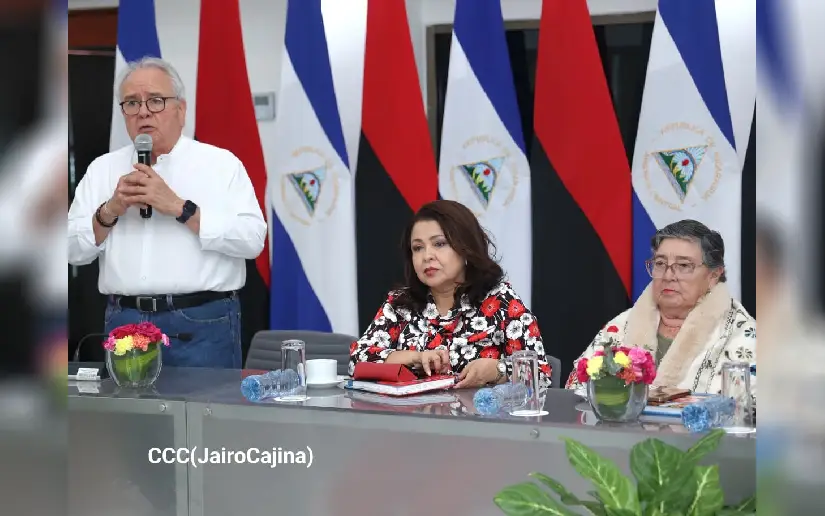
Encuentro con Trabajador@s en General
durante el Proceso de Consulta
de las Reformas Constitucionales
Viernes 14 de Agosto de 2026
Exposición del Doctor Gustavo Porras:
Buenas tardes, Compañeras y Compañeros. Tenemos 241 puntos de conexión y en bastantes puntos se puede ver que hay una gran cantidad de Hermanos y Hermanas, de Compañeros y Compañeras, Trabajadores de todas las diferentes áreas sectoriales.
Les quiero presentar a todos los Compañeros que están conectados a los compañeros que están presentes: la Comisión Especial Constitucional que está compuesta por los Miembros de la Junta Directiva, queremos aprovechar para que ustedes conozcan a la Doctora Arling Alonso, ella es Chinandegana y es la Primera Vicepresidenta de la Junta Directiva de la Asamblea Nacional.
Por aquí tenemos a nuestra Heroína, nuestra Compañera Amada Pineda, que es la Segunda Vicepresidenta de la Asamblea Nacional. Aquí tenemos a la Compañera María Haydee Osuna, Presidenta del Partido Liberal Constitucionalista y que es la Tercera Vicepresidenta de la Asamblea Nacional, somos parte de la Comisión Especial Constitucional.
Por este lado tenemos a la Compañera Loria Dixon Brautigam, mujer Caribeña de Bilwi y es la Primera Secretaria de la Asamblea Nacional. Tenemos al amigo Alejandro Mejía Fernández, Granadino, del Partido Alianza Liberal Nacionalista Nicaragüense y es el Tercer Secretario de la Asamblea Nacional.
También en la Comisión Especial Constitucional están los tres Jefes de las Bancadas existentes. Tenemos al Doctor Edwin Castro, es el Jefe de la Bancada del Frente Sandinista. Tenemos al amigo Lester Flores, que es el Jefe de la Bancada del PLC. Y tenemos al amigo Mario Asencio, que es el Jefe de la Bancada Independiente Democrática.
Tenemos dos Presidentes de Comisiones, de las más importantes de la Asamblea. Tenemos a la Compañera Auxiliadora Martínez, que es la Presidenta de la Comisión de Justicia y al Compañero Wálmaro Gutiérrez, que es el Presidente de la Comisión Económica y tenemos con nosotros a todos los Miembros de la Comisión Laboral de la Asamblea Nacional, que están aquí presentes.
Entonces, los Miembros de la Junta Directiva, los Jefes de Bancada y los Compañeros de las dos comisiones, la de Justicia y de la Comisión Económica, conformamos la Comisión Especial Constitucional. A todos nuestros Hermanos trabajadores y trabajadoras deben de saber que eso es lo que nos mandata la Constitución y la ley orgánica, que si va a haber una Reforma Constitucional, se forma una Comisión Especial Constitucional para revisar y proponer esta Reforma.
Nosotros comenzamos esta discusión desde el 19 de julio con el mandato del Comandante Ortega. Estoy claro que todos ustedes que están en los diferentes lugares, municipios, áreas, están informados porque lo vieron, estuvieron, se movilizaron, conmemoramos el 19 de julio. En esa ocasión el Comandante Daniel Ortega, con mucha claridad, dijo: "No van a volver a haber elecciones en este país que permitan que los enemigos del Pueblo asuman el Gobierno, asuman el poder y echen para atrás las conquistas del Pueblo". Eso es lo que el Comandante dijo.
Después agregó: "Vamos a trabajar con la Asamblea Nacional para hacer las leyes que pongan un muro, que ponga un bloque para que esos enemigos del Pueblo que se encuentran agazapados no quieran regresar a hacernos daño. No podrán, aunque quieran, no podrán, no podrán, no podrán". Esas fueron las palabras del Comandante Daniel Ortega y de la Compañera Rosario, donde se nos dan las instrucciones claras de trabajar. Eso lo acordamos todos.
Además, siempre el Comandante Ortega nos ha insistido que tenemos que estar claros de cuál es la historia de nuestro país y que nosotros vivimos permanentemente luchando contra la injerencia extranjera, y eso lo sabemos todos. Vamos a recorrer esa historia, pero también sabemos que la más reciente, en el dos mil dieciocho, los reales, el financiamiento, los objetivos y el plan fueron diseñados por potencia extranjera, fueron diseñados por los yanquis, los que han sido históricamente enemigos de Nicaragua.
Eso lo sabemos, eso salió y es más, creo que cada cierto tiempo hay que volver a revisar toda aquella cantidad de dinero que se logró identificar de dónde venía para financiar todas estas acciones desestabilizadoras.
Esos son los elementos con los que comenzamos a trabajar: garantizar las leyes para que no haya desestabilización, garantizar las leyes para que no vuelvan los enemigos a tratar de hacerse del Gobierno y echar para atrás las conquistas del Pueblo. Y además, estar claros de que hay una injerencia extranjera permanente de la cual debemos defenderlo.
Con eso nosotros comenzamos a trabajar la Propuesta de la Reforma. Lo primero que uno hace es identificar las ideas que después, una vez consensuadas con el Pueblo de Nicaragua, se van a transformar en los Artículos de la ley de Reforma Constitucional.
La Propuesta de Reforma, lo que está basada sobre, tiene conceptos que permanentemente nosotros escuchamos y que además todos interiorizamos. Es decir, es una Propuesta de Reforma que busca que haya Estabilidad, que busca que haya Seguridad y que busca que haya Paz. Esto no está en orden de importancia, esto está enunciado porque estos tres conceptos son totalmente indivisibles.
La aspiración más grande que tiene el Pueblo nicaragüense, que tienen todos los trabajadores, es la Paz. Nosotros queremos vivir en Paz, garantizar la Paz hoy y para el futuro de nuestros hijos, de nuestros nietos y para las futuras generaciones. Pero para garantizar la Paz necesitamos Seguridad. Ya nos dimos cuenta que si bajamos la guardia y no tenemos garantía y Seguridad, nos rompen la Paz.
Basta acordarse hace ocho años que eso fue lo que pasó. Pero además, para tener Seguridad y para tener Paz, necesitamos Estabilidad, necesitamos los tres conceptos. Acuérdense que nosotros teníamos una Estabilidad que veníamos construyendo envidiable, aquel modelo de diálogo, alianza y consenso. Diez años de crecimiento permanente al 2018 y esa Estabilidad envidiable fue la que motivó a que inyectaran dinero, planes y romper la Seguridad y la Paz. Después de romper la Seguridad y la Paz, inmediatamente rompieron la Estabilidad porque había inestabilidad.
Entonces, tenemos claro que estos conceptos son totalmente indivisibles. Ahora, ¿para qué queremos esto? Podemos decir para sacar pecho: nosotros somos un país estable, seguro y en Paz. Sí, pero al fin y al cabo, eso lo queremos para buscar cómo nuestro Pueblo sea feliz. La felicidad no solo basta con tener estos enunciados, sino también con tener la posibilidad de resolver las necesidades materiales de todo nuestro Pueblo. Eso es un proceso paulatino, un proceso de crecimiento económico. Ese es un proceso de Lucha Contra la Pobreza.
Es decir, esto lo queremos para tener la fuerza suficiente para derrotar la pobreza. Ese es el concepto general. Nosotros necesitamos hacer una Reforma Electoral donde cumplamos claramente con la orientación del Comandante de garantizar y poner ese muro, ese bloque contra los enemigos del Pueblo, contra los que quieren rompernos la Estabilidad, la Seguridad y la Paz. ¿Por qué? Porque no quieren que este país y que el Pueblo de Nicaragua salga de la pobreza. Ese es el concepto.
A partir de ahí, las ideas que tenemos que desarrollar. Pero sobre la base de esto, nosotros revisamos esa historia que hace referencia siempre al Comandante, esa historia de lucha del Pueblo nicaragüense, de dónde venimos, y comenzamos a revisarla. Nosotros encontramos que la historia que conocemos comenzó cuando vinieron los españoles. Estamos hablando de 1521, que vinieron los españoles y que comenzaron a andar por aquí hasta que se decidieron imponerse, porque a eso venían.
Entonces comenzó la resistencia de nuestros Héroes Indígenas Antiimperialistas: Nicaragua y Diriangén. En ese tiempo no existía como país Nicaragua, lo que existía era el nombre del cacique Nicaragua y existía el nombre del cacique Diriangén, y de varios caciques que había en ese tiempo. Los españoles vinieron a sacudir, a fuego con sus arcabuces, con la Biblia en una mano, con la espada en el otro, a dominarnos. Pero nuestros Héroes Indígenas Antiimperialistas hicieron resistencia.
En 1524, es decir, tres años después, logran sacar a los colonialistas españoles de nuestro país, le infringen una derrota y los sacan. Los derrotan en Diriamba, en un lugar que se conoce como La Quebrada del Perro, ahí derrotan a Gil González y él se va, porque encontró la unión de Diriangén y Nicaragua en ese enfrentamiento. Entiendo que se fue a Panamá, después regresó con nuevas fuerzas.
Después vino Francisco Hernández de Córdoba y comenzó una lucha permanente de nosotros, los nicaragüenses, los nicaraguas, los diriangenes, todos nosotros, luchar contra el colonialismo español. Imagínense que fue de 1521 a 1821, una lucha de 300 años de lucha permanente.
En esos 300 años de lucha, estamos comprometidos nosotros a buscar los principales puntos de la historia que hay que resaltar de la resistencia. Precisamente por eso de andar buscando allá por 1770, unos 50 años antes de la Independencia, el cacique de los Boacos y de los Ulwas, Yarrince, en la zona de Chontales y Boaco, hizo su resistencia. Incluso los españoles le habían respetado por su capacidad de resistencia, lo habían nombrado Capitán.
Pero cuando los españoles comenzaron a humillar a su Pueblo, dijo: "No", mandó ese nombramiento y asumió su cacicazgo y comenzó a luchar contra los españoles. Lo apresaron y lo mandaron a Guatemala, murió en una cárcel, torturado en Guatemala. Esa es la historia del cacique Yarrince.
Entonces, 300 años de lucha que nos llevaron hasta 1821, que es cuando firmamos el Acta de la Independencia de Centroamérica. Nosotros lo aprendimos todo en escuela, por eso son los Días Patrios: 15 de septiembre, una de las fechas que hace que septiembre sea el Mes Patrio.
El día que se firmó formal y por escrito la Independencia, pero no una Independencia del reinado del colonialismo español, que lo ejercían a través de un virreinato y se logra hacer la Independencia. Pero los colonialistas ya habían dejado quienes iban a continuar la dominación, eran los oligarcas, los criollos, que eran los que tenían los derechos. Porque los otros, los pobres, los indígenas, no tenían ningún derecho.
Además nos dividen a Centroamérica. Después de 1821 comienzan las luchas entre los centroamericanos y se dividen en las cinco repúblicas centroamericanas. Porque ahí, entran otros aspectos históricos, lo que era el imperio de Iturbide, que estaba en México, que quiso adueñarse. Pero el hecho es que nosotros aparecemos como república, como país, no como república federada, como república unitaria: Nicaragua aparece con su primera Constitución, que fue en 1838 y ahí somos ya república.
¿Para qué llevamos todo ese recorrido? Porque lo venimos siguiendo, porque nos damos cuenta de que nos vamos deshaciendo del imperio español. Vamos buscando cómo ser independientes, pero ahí nomás viene otro imperio, uno viene bajando y otro comienza a subir, comienza a hacerse dueño. ¿Por qué? Porque luchan por tener colonia, porque las colonias son las que le garantizan su nivel de vida.
Si los países son colonizados, según ellos porque vienen a traernos Paz, desarrollo, todo lo que nos dicen. No, los países son colonizados para esclavizarlos, para que una vez colonizados, todo lo que producen o parte de lo que producen pasen al imperio para sostener los niveles de vida de los que viven en la metrópoli, en el centro del imperio.
Eso es una ley, de tal forma que cuando los españoles comenzaron a disminuir con su imperio y dejaron de serlo, aparecieron otros imperios que se fueron desarrollando. El británico quiso, por estos lados, en el Caribe, buscar cómo hacerse de esta tierra. No pudieron y los españoles se iban largando.
Se formó Nicaragua, entonces vino el nuevo imperio. En los momentos en que estaban naciendo ese nuevo imperio, apareció el filibustero William Walker con unos mercenarios, con Byron Cole al frente. Estamos hablando de 1854 y vino a Nicaragua como parte de la expansión del imperialismo, persiguiendo lo mismo que perseguían los españoles, que era el tránsito a través de Nicaragua entre el Pacífico y el Caribe, o entre el Caribe y el Pacífico.
Ese tránsito tan deseado que nos pertenece a los nicaragüenses, lo querían tomar porque ellos estaban expandiéndose, porque para ellos era una barbaridad el poder cruzar del este al oeste en los Estados Unidos por la distancia, y además porque todavía había una población indígena de los indios americanos suficientemente grande para hacerles resistencia.
Después los exterminaron totalmente. Entonces Cornelius Vanderbilt, era un empresario que comenzó a ver esta ruta, comenzó a desarrollar y a invertir en esa ruta y financió la expedición de William Walker, con una orientación a hacerse cargo para garantizar que esta zona fuera el tránsito para su empresa.
Entonces William Walker vino, pero además hizo un plan de dominación macabro, se juntó con los vende patrias, con la oligarquía, con los que habían quedado de resabios del Imperio Español. Se juntó, se amarró con ellos, les dijo que les iba a dar todas las posibilidades, y se juntó con la Iglesia Católica, con los curas, con el cura Vigil y con sus soldados que eran disciplinados, porque eran mercenarios y eran terribles delincuentes, un yanqui filibustero, William Walker, se erigió en Presidente de la República de Nicaragua. Tenía que estar en contubernio con los vende patrias, ahí están las doscientas siete cartas de damas granadinas agradeciéndole a Walker por la pacificación.
Ahí está la carta, cuando el cura Agustín Vigil predica y le dice a William Walker: “La estrella del norte que viene a darnos luz”. Ahí están todas esas cartas, pero es una realidad, siempre han habido vende patrias. Y ¿cómo le pagó Walker?, Todos eran granadinos y le pegó fuego de Granada. Ahí puso un rotulito: "Aquí fue Granada". Es decir, son realidades, Compañeros, Compañeras, no estamos hablando, hay que leerla, hay historia y son realidades.
Después de eso, de mil ochocientos cincuenta y seis, que fue la batalla de San Jacinto, que es la parte que conocimos, que fue la parte inocultable, que fue la parte que le dio a septiembre la característica del Mes de la Patria, nos daban más fuerza que en el mes de la Independencia, pero no nos daban la diferencia de los años, uno fue en mil ochocientos veintiuno y el otro en mil ochocientos cincuenta y seis, y la de mil ochocientos cincuenta y seis era el mes de la Patria, porque los nicaragüenses derrotamos en San Jacinto a los yanquis en ese momento, y después unimos a todos los centroamericanos para que tres años después, cuando Walker quería venir a Honduras, le llegaron sus días, creo que ahí está enterrado Walker.
Eso nos ha hecho a nosotros un Pueblo Digno que tiene en su alma, en su sentimiento, en sus venas, el sentimiento de Dignidad, de Anticolonialismo y Antiimperialismo, es decir, no es cuento, es realidad. Después siguieron las luchas, siguió la vida, hasta llegar a finales de ese siglo, y aparecen una corriente de nuevos pensadores, de nueva gente, una corriente que no aceptaba el poder que existía, de la Iglesia, que comenzó a decir: los ciudadanos tienen derechos civiles, los ciudadanos no necesitan pedirle permiso, o tienen derecho a ser enterrados en un cementerio, tienen derecho a casarse civilmente, tienen derecho a tener una instrucción pública, laica, porque en esos tiempos, a finales del siglo XIX, en Nicaragua, los encargados de la educación eran las órdenes religiosas, los encargados de la salud eran las órdenes religiosas, los encargados de los derechos civiles eran las órdenes religiosas, de tal forma que si alguien no era bautizado, no existía.
A ver, los Compañeros que están aquí, díganme si no es cierto, si no, vayan a preguntarles a sus papás. En este país, antes de la Revolución, no te pedían la cédula, no te pedían tu partida de nacimiento, más frecuentemente te pedían tu fe de bautismo. ¿Por qué? Porque la fe de bautismo es la que en ese tiempo se usaba como la existencia tuya como nicaragüense. Esas son realidades, no son inventos de nosotros.
Llegamos así hasta la Revolución Liberal. Ese grupo de intelectuales, de personas que lograron estudiar, que tenían nuevos pensamientos, que habían recibido las nuevas ideas de las revoluciones que había en el mundo, asumen y combaten y hacen la Revolución Liberal al frente estaba el Héroe Nacional José Santos Zelaya, dentro de ese grupo estaba nuestro Héroe Nacional y Poeta Universal Rubén Darío, que con su idea esparció la Dignidad nicaragüense en todo el mundo y los pensamientos imperialistas en todo el mundo y estaba también otra serie de Compañeros de Héroes nicaragüenses.
Entonces, ya llegamos a la Revolución Liberal. ¿Qué es lo que encontramos en todo el comportamiento? En cada acción del imperialismo, cada acción del colonialismo, Nicaragua responde con Héroes. Los Pueblos así son, responden con Héroes. Cuando los españoles quisieron avasallar a los nicaragüenses de Chontales y de Boaco, salió Yarrince. Cuando quisieron avasallar al Pueblo de Sutiaba, salió Adiact. Cuando quisieron avasallarnos en esta zona, desde el principio, en la meseta hasta Rivas, ahí salieron Nicarao y Diriangén.
Después, cuando querían detener la independencia, ahí salieron los Próceres de nuestra Independencia, salió Tomás Ruiz, indígena que fue el primer sacerdote y el primero que estudió. Además, ya estamos hablando un poco después de la Independencia, que lo apresaron y lo mandaron a Chiapas y murió en Chiapas. Es decir, siempre sale un Héroe, un Prócer. Nicaragua produce un Héroe cada vez que lo atacan.
Después, cuando vino la Revolución de Zelaya y Zelaya quiso nuevamente hacer el canal por Nicaragua, pero aparte de la influencia de los yanquis, entonces vienen los yanquis e intervienen. Ponen cañoneras en Corinto, ponen cañoneras en Bluefields y mandan la Nota Knox que todos conocemos.
A nosotros solo nos cuentan el cuento de la Nota Knox y nosotros decíamos: pero ¿cómo Zelaya, porque le mandó una nota, ese Knox se va a ir? No, manda la nota Knox, le hacen un movimiento interno de desestabilización y le ponen cañonera en Corinto y le ponen cañonera en Bluefields y lo obligan a irse a México, esa es la realidad de nuestro país en 1909.
Es decir, la Revolución Liberal no pudo desarrollar, por decirlo algo, el capitalismo nacional, era lo que da como resultado una revolución de ese tipo, sino que vino y lo que hace es el neocolonialismo, la imposición imperialista. Ahora, sacan a estos con la nota Knox, se llama Knox porque el Departamento de Estado de ese tiempo era dirigido por el secretario del Departamento de Estado era Philander Knox y él la firmó.
Es como que si ahora existiera la nota Rubio, firmada por el Jefe Secretario del Departamento de Estado. Eso es lo comparativo. Pero en Nicaragua se mantienen quienes no aceptan eso, quienes no están de acuerdo. Y entonces Adolfo Díaz, conservador, que estaba visceralmente en contra de la Revolución Liberal, pide la intervención yanqui, la intervención de 1912, y llama a los yanquis. Vinieron los marines, intervinieron, pero encontraron lo que les decía: Cada una de esas acciones encuentra un Héroe nicaragüense, Nicaragua pare un Héroe. Entonces, viene y sale el General Benjamín Zeledón, que Sandino lo llamó Apóstol de la Libertad.
Este General resiste y da la batalla en el Coyotepe, en la Barranca, es decir, con una cantidad de hombres inferior, le cayeron conservadores y yanquis. Lo asesinan y lo arrastran por los Pueblos Blancos, lo arrastran por Catarina, los Pueblos de la meseta, lo arrastran por Catarina, donde la fuerza superior se encarga de que Sandino fuera caminando cuando ve que arrastran a Zeledón y Sandino, en vez de acobardarse, que es lo que pretendían ellos, meter en miedo, tal vez les recuerda algo del golpe fallido, que querían meter en miedo a todo el Pueblo y entonces nos quemaban a nuestros Compañeros y lo filmaban y lo tiraban en las redes para que todo mundo tuviera terror.
Era terrorismo, lo hicieron y arrastraban a los Compañeros, los desnudaban, les pegaban alambrazos, los pintaban, los amarraban a los postes, los filmaban y los tiraban. El objetivo era aterrorizar lo mismo hacían los yanquis.
Esa es la misma práctica dirigida por los yanquis. Agarraron a Zeledón, lo amarraron en una carreta y lo arrastraron. Pero eso más bien te enoja, te indigna, te saca esa historia que tenés adentro de lucha, de Dignidad. Y entonces Sandino, en vez de que le entrara miedo, le entró indignación y se comprometió a que iba a sacar a los yanquis de este país. Esas son las realidades. Después los yanquis siguieron, es decir, matan a Zeledón, tienen a Adolfo Díaz, que es el que los llamó y lo ponen de Presidente.
En 1923, los yanquis deciden que la forma de dominar a este país tenía que ser diseñando unas leyes, un modelo, un sistema parecido al de ellos y entonces mandan a un hombre de apellido Dodds. Este es un académico, lo contrata el Gobierno yanqui, lo manda a Nicaragua y lo contrata el Gobierno de Adolfo Díaz como su Asesor y le encargan que haga la ley electoral que se conoce como Ley Dodds.
¿Cuál era la misión de este hombre? Hacer una ley electoral que garantizara a través de las elecciones que el modelo que iba a haber en Nicaragua fuera a imagen y semejanza del modelo yanqui: El bipartidismo. Es decir, Liberales y Conservadores ese es el modelo Yanqui. Los Liberales son los que conocemos como los Demócratas y los Conservadores son los que conocemos como Republicanos.
La verdad es que no importa quién esté. El fondo es hacer que prevalezca el imperio. Porque puede decir: “No, es que uno es mejor” o “que el otro es mejor", nada tiene que ver. Todo el debate es quién hace que la metrópoli esté mejor. Es decir, los Demócratas son aquellos que brindaron cuando asesinaron a Gaddafi. Los Republicanos son estos que festejan en los bombardeos de Gaza o en los bombardeos en Irán.
Es decir, de todos modos, siempre su línea es la del imperio. Entonces desarrollaron de acuerdo a las leyes para que pudieran haber elecciones entre dos partidos: los Liberales y los Conservadores. Y ahí todos nos acordamos, los que vivimos antes de la Revolución y después, nos lo enseñaron ya por referencia: Nos hablaban de las paralelas históricas.
Las paralelas históricas eran los Liberales y los Conservadores. Y desde chavalos te decían que eran las paralelas históricas. Como quien dice, esto va a ser así siempre: Liberales, Conservadores. Hasta que apareció alguien que partió de esas paralelas históricas, que fue Sandino porque cambia el contexto, como lo vamos a ver.
Aquí viene un ejemplo que es importante para todos los Compañeros: Esta es una papeleta oficial del 6 de noviembre de 1932. Estábamos viendo que las elecciones siempre son en noviembre y tenían sentido porque en algún momento, efectivamente, desde la primera Constitución, la de 1838.
Ahora Aniuska me pasó datos e información que buscó, desde ese momento se habla del mes de noviembre. Porque ahí, en ese momento, había varias elecciones: Una era las elecciones por circunscripciones pequeñas. Otra era por departamento. Entonces, una era en noviembre, la otra en diciembre y la otra en enero. Desde noviembre viene eso, me imagino que tiene que ver porque las lluvias van pasando, es decir, las condiciones del clima. En noviembre todo el mundo se pone como tranquilo, blandito, ya viene diciembre, hay menos pleitos.
Después se mantuvo así porque hay varias Constituciones que dicen que la toma de posesión era el primero de enero. Entonces, se hacían en noviembre para tomar posesión el primero de enero. Todo eso es parte de la historia, pero es la resultante por eso es que seguimos nosotros haciendo nuestras elecciones en el mes de noviembre.
Pero aquí tenemos: ¿Quiénes eran? Candidato Adolfo Díaz y Juan Bautista Sacasa. Adolfo Díaz, Conservador, y Juan Bautista Sacasa, del Partido Liberal Nacionalista. Entonces, “A los dos y con miedo”: Adolfo Díaz, el que trajo a los yanquis y Juan Bautista Sacasa, el que invitó a Sandino a la última cena para que después fuera traicionado y asesinado. Es lo mismo, para los yanquis no importaba cuál ganaba. Ellos sabían que cualquiera de los dos estaba al servicio de ellos.
Después llegamos a 1927. Entre 1923, 1924, 1925, 1926, lo que había fue una guerra, creo que le llaman Constitucionalista, y había un Ejército Liberal Constitucionalista, que su jefe era Moncada. En ese ejército, uno de sus Generales que estuvo al frente de un contingente era Sandino. Cuando Moncada va ganando, cuando los Liberales van ganando, los yanquis esperan que madure la cosa y entran.
No iban a dejar que el que los había traído los destruyeran. Entonces, paran la guerra y hacen el Pacto del Espino Negro, el Pacto Moncada-Stimson, que es este que está aquí. Este es el Espino Negro, esto es en Tipitapa, este es Moncada y estos son los Generales del Pacto del Espino Negro. Hay otra foto donde ya salen los civiles gringos, pero este es el Pacto del Espino Negro.
¿Qué decía? No decía nada, no estaba ni escrito. Fue un pacto donde se pusieron de acuerdo y entonces le dijeron a Moncada: "Mirá, vos entregás los rifles, yo te doy un dólar por cada rifle, pero además me comprometo", le dice el yanqui, "a que el año que viene vos vas a ser el Presidente de la República" y ese fue el pacto.
Entonces, para garantizar eso, entregaron los rifles, entonces tenían que traer fuerzas militares para mantener que no siguiera la guerra, pero para garantizar esto, tenían que traer marines norteamericanos. Pero ahí, en 1927, se parte la historia de Nicaragua, porque hay un General que dice: "No, estos majes son vende patrias, yo no me vendo ni me rindo". Y se fue con sus hombres y no aceptó, y entonces ahí comienzan a decirle bandolero a Sandino. Sandino parte la historia para que agarre el rumbo definitivo, que es el que tenemos que defender hoy. Sandino se fue.
El 4 de mayo de 1927, se podría haber llamado el Día de la Ignominia, pero por Sandino, por su actitud, por su posición Digna, se llama el Día de la Dignidad Nacional. Logra rescatar la Dignidad Nacional, la Dignidad de los nicaragüenses, se va, espera que pase mayo y que pase junio, y el primero de julio Sandino está sacando su Manifiesto de San Albino, donde deja clara la posición de lucha contra el imperio. Esa es la historia de todos nosotros, eso lo llevamos aquí adentro.
Entonces, los yanquis, para cumplirle, en 1928 traen marines que venían dirigidos a controlar las elecciones, venían orientados a hacerse cargo de las mesas, los cantones electorales y los Consejos Departamentales Electorales y, como son marines, entonces tienen que poner a un jefe de ellos al frente del Consejo Nacional Electoral, y como son militares, nombran al Brigadier General Frank Ross McCoy como Presidente del Consejo Nacional de Elecciones. Esas eran las elecciones en nuestro país.
Entonces, había un Yanqui Presidente del Consejo Nacional de Elecciones, varios yanquis por cada departamento, y un montón de yanquis por cada centro de votación. Ahora, para hacer esto tenían las leyes, la Ley Electoral que refería: la Ley Dodds, fue publicada el 3 de abril de 1923. ¿Qué es lo que quiero decir con esto, Hermanos? Todo esto que estamos diciendo, díganlo con fuerza, que es verdad, no es mentira, hay que convencer a todo mundo, esta es la historia de nosotros. Aquí está, en esta Asamblea, están estos elementos, estos documentos, esta historia.
Y miren lo que decían los dos primeros artículos de esta ley. El primero deja claro de que no es derecho de los nicaragüenses el votar, es al revés, se habla en un lenguaje excluyente: "Ningún ciudadano tendrá derecho a votar si no reúne las condiciones y calificaciones requeridas por la Constitución y por la presente Ley Electoral". En un lenguaje inclusivo: todos los nicaragüenses tienen derecho a votar, excepto los que no cumplan con la ley. En la Ley de ellos ninguno tiene derecho a votar, “excepto” quiere decir que son poquitos los que tienen derecho a votar.
Miren el segundo: el derecho al sufragio pertenece solamente a los varones nicaragüenses. Es decir, aquí en esta Directiva solo votaríamos dos, y en este auditorio, votarían ocho de diecisiete, que es más o menos la proporción. El 48% de los nicaragüenses somos varones, el 52% son mujeres. Esto dice aquí que de cada 100 nicaragüenses solo 48 pueden votar.
Además de eso, dice aquí: esos nicaragüenses tienen que tener 21 o más años de edad. Imagínense, en ese tiempo, hace 100 años, cuántos nicaragüenses tenían 21 o más años de edad. La mayoría de los nicaragüenses, hasta que la Revolución cambió eso, la mayoría de los nicaragüenses estábamos por debajo de los 20 años, la mayoría, como el 60% de los nicaragüenses éramos de 20 años o menos.
Ah, bueno, si podían votar los de 18 años, si eran casados o si sabían leer y escribir. ¿Quiénes eran los casados por la Iglesia?: Los ricos, los hacendados, porque la Iglesia no te casaba a los trabajadores, no te casaba a los peones, tenía que ser de los que daban limosna. Pero además, que eran garantía del voto a favor de la oligarquía y además tenían que saber leer y escribir. Ahora tenemos un analfabetismo bajísimo, pero en ese tiempo solo sabían leer y escribir los menores de 18 y 20 años, los hijos de los oligarcas, porque eran en órdenes religiosas donde los mandaban, eran escuelas privadas.
Zelaya hizo el intento de crear la escuela pública y después le cayeron y todo quedó a medio palo. A nosotros no nos dejaron desarrollar, vinieron los yanquis y nos partieron. Entonces, esto es verdad, esa es la democracia que nos recetan.
Después esto siguió así desarrollándose, pero para efecto de lo que estamos diciendo, vinieron los yanquis, utilizaron esta ley, utilizaron todos estos conceptos, pero inventaron otra ley, un decreto ley, que le llamaron la Ley McCoy. Es un decreto ley que deja viva la organización de la ley Dodds, pero que impone cómo iba a ser el mando, quiénes iban a estar al frente de cada uno de los lugares.
Entonces, desde el arranque lo pueden ver ustedes aquí:
El Presidente de la República, en vista de que la Corte Suprema de Justicia, por acuerdo del 17 del corriente, me ha nombrado, en sustitución del señor Doctor don Joaquín Gómez, que elevó su renuncia, nombró al señor General Frank Ross McCoy, Presidente del Consejo Nacional de Elecciones.
Y aquí saca la cabeza el que verdaderamente manda en ese tiempo, en ese momento. Lo que quisieran que sucediera ahora:
Que elevó su renuncia y nombró al señor General Frank Ross McCoy, Presidente del Consejo Nacional de Elecciones, y que este alto funcionario, en ese carácter y por haber sido designado por el señor Presidente de los Estados Unidos, debe dirigir el acto electoral de 1928 de autoridades supremas, conforme a lo convenido para poner término a la guerra civil.
¿Qué es lo convenido? Lo convenido es: me entregás las armas y te nombro Presidente. Esa era la función, llevar a Moncada a ser Presidente. Todos ustedes me pueden decir esto lo escriben, pero vámonos a la foto: aquí están las evidencias fotográficas de lo que estamos hablando. Estas son las elecciones de 1928, no me vayan a decir que ahora es inteligencia artificial, esa es la realidad, en ese tiempo no había nada de eso.
Aquí está, miren, estos son los votantes llevados al centro de votación, esperando votar antes que abran las urnas. Y miren quién está aquí, con polaina, de corbata, con el sombrero característico, con su pistola: el jefe del centro de votación, el yanqui. Esas eran las elecciones, esta es la democracia que nos quieren recetar.
Aquí hay lo que posiblemente son unos votantes, aquí está un Guardia Nacional, de ese tiempo estaba formando la Constabularia, aquí está otro y aquí está el jefe del centro de votación, un yanqui, con su corbata, con su sombrero característico, con su fajón. Ahí están los votantes y aquí están los encargados de hacer el llamado al voto.
Este tipo que está aquí, es el Mayor Joseph Pei, este es del centro, estos marines lo están cuidando a él. Él es el Presidente del Comité Electoral en Estelí y estos son los miembros de la Junta Departamental. Eso era lo que había aquí, eso es lo que quieren recetarnos, eso no va a volver a pasar. Las elecciones nuestras son entre nicaragüenses, para nicaragüenses y para desarrollar Nicaragua.
Queremos recordar que todas estas luchas, toda esta reacción, nos lleva a este Artículo 1: la Independencia, la Soberanía. Este es el Artículo 1 de la Constitución, la aprobamos el año pasado ya completo, porque incorporamos la lucha del 2018, el triunfo que tuvimos en el intento de golpe, lo incorporamos y dijimos:
La Independencia, la Soberanía, la Autodeterminación Nacional, la Seguridad y la Paz son derechos irrenunciables del Pueblo y fundamentos de la Nación nicaragüense. Toda injerencia en los asuntos internos de Nicaragua, o cualquier intento de menoscabar esos derechos, atenta contra la vida del Pueblo. Es deber de todos los nicaragüenses preservar y defender estos derechos.
Y aquí viene el centro: “Por consiguiente, que esto lo tenemos que cumplir todos, aquellos o aquellas que atenten contra estos sagrados derechos del Pueblo nicaragüense serán considerados traidores a la Patria”.
Ese es el centro de toda esa explicación histórica y es lo que nos llevó a poner seis ideas, que es la que estamos sometiendo. Todas estas ideas calzan desde lo que nos dijo el Comandante, toda esta historia.
Idea uno: “No Podrán”, lo que dice el Artículo 1 de la Constitución: entonces no podrán ser candidatos a cargos de elección popular, ni podrán ejercer cargos públicos por designación de la Presidencia o elección de la Asamblea Nacional, los golpistas, los traidores a la Patria, los que violen el Artículo 1 de la Constitución o quienes violenten o han violentado los Principios Fundamentales que están en nuestra Constitución. Esos son los que nos van a poder.
¿Quiénes? Para seguir remarcando, porque este es un párrafo que estamos redactando con los Compañeros, para que quede así: además de los que violen el Artículo 1, los que inciten o promuevan la injerencia extranjera. Es decir, aquí no pueden andar agarrando un celular y poniendo un TikTok: "Necesitamos que vengan las fuerzas de los cascos azules, los cascos verdes, los yanquis…". Estás incitando o promoviendo la injerencia extranjera, ellos pierden sus derechos civiles. Los que piden intervención militar, eso no lo podemos permitir los nicaragüenses ni en broma. Los que se organizan con financiamiento proveniente del extranjero, repetirían la historia que nos quisieron hacer hace ocho años. Los que propongan, gestionen o respalden bloqueos económicos, comerciales o financieros, o los que propongan, respalden y gestionen sanciones contra el Estado de Nicaragua, sus instituciones y sus ciudadanos. Eso no lo vamos a permitir, esa es la idea uno.
Idea dos: Estabilidad. Nosotros les estamos planteando a ustedes, Hermanos, al Pueblo de Nicaragua, de acuerdo con el planteamiento que tenemos y la orientación del Comandante, que nuestros períodos sean de siete años. Los tuvimos una vez en cinco, después los tuvimos en seis, que nuestros períodos queden definitivamente, por: siete años. ¿Por qué? Porque siete años es el tiempo suficiente para darnos cuenta los resultados de las políticas que se están llevando adelante, porque nuestra Democracia no es la Democracia de una elección.
Nuestra Democracia es la Democracia de una elección para garantizar seguir avanzando en la gratuidad y la calidad de la educación, seguir avanzando en la gratuidad y la calidad de la salud, seguir avanzando en la gratuidad y la calidad de las carreteras, seguir avanzando en la gratuidad y la calidad de la luz eléctrica, seguir avanzando en todos esos campos, en la merienda escolar, seguir avanzando en la gratuidad y en la calidad de la recreación del Pueblo, en los parques, en las instalaciones deportivas. Es decir, la Democracia es mucho más. Entonces, siete años es tiempo suficiente. Por lo tanto, aquí dice que los cargos de elección o de ratificación van a ser siete años. Naturalmente, si estos cargos son siete años, tenemos que poner cohesionado todo.
Esta es la otra idea, se llama: “Cohesión y Seguridad”. Es decir, siete años los cargos de elección, también siete años para el cargo de Comandante en Jefe del Ejército y para los cargos de los jefes de las Fuerzas Policiales. Entonces, vamos haciendo estabilidad, cohesionado y garantizando la Seguridad con los mandos y siete años de períodos.
Pero, además, tenemos que garantizar que eso se lleve bien. Entonces, hicimos esta idea de “Garantía de nuestra Democracia Electoral”: Eso significa las atribuciones de nuestro Consejo Supremo Electoral. Nuestra Presidenta del Consejo Supremo Electoral es una Heroína nicaragüense, la Compañera Brenda Rocha. Es decir, nosotros sabemos que esa es la esencia de nosotros. Nosotros no necesitamos andar diciendo que las características de nuestro Consejo Supremo son de los nicaragüenses, esa es una convicción que tenemos.
Nuestro Consejo debe garantizar que esa Democracia Electoral, y le ponemos Democracia Electoral porque esa es una partecita de la Democracia. La Democracia, ya dijimos, que es mucho más integral. En esa Democracia Electoral este Consejo tiene que tener el mandato de llamar a las elecciones cada siete años en las diferentes características de elección, en las diferentes, los tres tipos de elecciones que existen: nacionales, municipales y regionales. Cada vez, cada uno en el tiempo que le corresponde.
Pero, además, el Consejo tiene que tener el mandato constitucional de no otorgar personalidad jurídica a los partidos políticos que reciban financiamiento extranjero, cuyos dirigentes actúen violando el Artículo 1 de la Constitución o cualquier otro artículo constitucional.
Pero no solo no otorgar, sino también cancelar la personalidad si un directivo o un partido comienza a recibir financiamiento extranjero o violan los principios. Y, además, en el caso de los candidatos, los funcionarios del Órgano Electoral o los miembros de la Junta Directiva de los partidos, verificar e imponer sanciones correspondientes a eso. Es decir, es este artículo es el que mandata o le da la potestad y la fuerza al Consejo Supremo Electoral de aplicar las consecuencias de esta Reforma.
La idea cinco es que hagamos la toma de posesión en nuestro país el 18 de enero, en honor al nacimiento de Rubén Darío. Le pusimos PAX por el poema de Rubén Darío, “Paz”, para que no se nos olvide: 18 de enero va a ser la toma de posesión en Nicaragua. Esa es la propuesta.
Finalmente, hay una idea que le llamamos “Coherencia”, que quiere decir que la nueva realidad establecida por la Constitución y la realidad actual tienen que ser coherente. Entonces, una vez aprobada esta Reforma, si se aprueba, las próximas elecciones son en noviembre del 2028. Entonces, los cargos nacionales, los que se eligen en las elecciones nacionales, tienen que extender su período hasta esa nueva elección y recibir cuando toca el 18 de enero del 2029.
Eso es lo que dice esta de “Coherencia”: Los períodos de las autoridades electas por el voto popular en las últimas elecciones generales, municipales y regionales vigentes, quedan ampliados a siete años a partir de la última elección. Los períodos de los cargos designados por la Presidencia de la República o su elección o ratificación por la Asamblea, se amplían a siete años a partir del nombramiento, elección o ratificación. Este es a partir de la última elección y este es a partir de cuándo fue nombrado y los períodos en toda legislación nacional vigente sobre función pública donde se estipula y regula el período de funciones, se le dará siete años.
Pero a todos los Compañeros que están conectados, fíjense bien, es función pública. No vaya a salir un dirigente sindical: "Es que yo tengo la federación sindical, ahora yo tengo siete años, el estatuto dice dos, pero yo tengo siete". No, ese es privado, ese es una cooperativa, porque las preguntas no las hicieron a nosotros: "Es que el estatuto de mi cooperativa dice dos años, entonces ahora voy a pasar a siete". Nada tiene que ver. Esto es función pública, para que estén claros.
Yo les agradezco a todos los Compañeros que están conectados. Gracias a todos. Recordemos esta información es para ir a trabajar.
¡Adelante, Compañeros!
---------------------------------------------------------
Versión en inglés
Meeting with Workers in General
during the Consultation Process of the Constitutional Reforms
Friday, August 14th 2026
Presentation by Dr. Gustavo Porras:
Good afternoon, friends, Compañeros and Compañeras. We have 241 on line connections and at many of these you can see that there are many Brothers and Sisters, Compañeros and Compañeras, workers from all the different sectors.
I want to present to all the Compañeros and Compañeras who are connected the Compañeros and Compañeras who are present here: the Special Constitutional Commission is composed of the Members of the Executive Board. We want to take this opportunity for you to meet Dr. Arling Alonso, she is from Chinandega and is the First Vice President of the Executive Board of the National Assembly.
Here too we have our Heroine, our Beloved Compañera Pineda, who is the Second Vice-President of the National Assembly. Also here we have the Compañera María Haydee Osuna, President of the Liberal Constitutionalist Party and who is the Third Vice President of the National Assembly, who is part of the Special Constitutional Commission.
On this side we have Compañera Loria Dixon Brautigam, a Caribbean woman from Bilwi and she is the First Secretary of the National Assembly. We have our friend Alejandro Mejía Fernández, from Granada, from the Nicaraguan Nationalist Liberal Alliance Party. He is the Third Secretary of the National Assembly.
Also in the Special Constitutional Commission are the three Heads of the existing Political Grouping. We have Dr. Edwin Castro, he is the Head of the Sandinista Front Political Grouping. We have our friend Lester Flores, who is the Head of the PLC Political Grouping. And we have our friend Mario Asencio, who is the Head of the Democratic Independent Political Grouping.
We have two Committee Chairs, two of the most important in the Assembly. We have Compañera Auxiliadora Martínez, who is the president of the Justice Committee, and Compañero Wálmaro Gutiérrez, who is the president of the Economic Committee, and we have with us all the members of the Labor Committee of the National Assembly, who are present here.
Thus, the members of the Executive Board, the Heads of the Political Groupings and the colleagues of the two commissions, the Justice and the Economic Commission, formed the Special Constitutional Commission. To all our Brothers and Sister workers, you should know that this is what the Constitution and the corresponding law mandate, that if there is going to be a Constitutional Reform, a Special Constitutional Commission must formed to review and propose the Reform.
We began this discussion on July 19th following the mandate from Comandante Ortega. I am sure that all of you who are in the different places, municipalities, areas, are informed because you will have seen it, since you were mobilized, when we commemorated July 19th. On that occasion, Comandante Daniel Ortega, very clearly, said: "There are not going to be elections again in this country allowing the enemies of the People to assume the Government, assume power and roll back the conquests of the People." That's what the Comandante said.
Then he added: "We are going to work with the National Assembly to make laws that will put up a wall, put up a barrier so that those enemies of the People who are lying in wait to do so cannot come back to harm us. They will not be able to, even if they want to, they will not be able to, they will not be able, they will not be able." Those were the words of Comandante Daniel Ortega and Compañera Rosario, from whom we received clear instructions to set to work. We all agreed on that.
In addition, Comandante Ortega has always insisted that we have to be clear about the history of our country, namely, that we live permanently fighting against foreign interference, and we all know that. We are going to go through that history, but we also know the most recent one, that took place in two thousand and eighteen, this real intervention, its financing, its objectives and its planning were designed by a foreign power, they were designed by the Yankees, who have historically been enemies of Nicaragua.
We know this, it all came out and what's more, I think that every so often we have to revisit all the amounts of money in regard to which it was possible to identify where it came from to finance all these destabilizing actions.
These are the elements with which we began to work: guaranteeing the laws so that there is no destabilization, guaranteeing the laws so that enemies do not return to try to take over the Government and roll back the conquests of the People. And also, to be clear that there is a permanent foreign interference from which we must defend our People.
With that we started working on the Reform Proposal. The first thing one does is to identify the ideas that later, once agreed with the People of Nicaragua, will be turned into the Articles of the Constitutional Reform Law.
The Reform Proposal, which is based on concepts to which we are constantly alert and which we also internalize. That is to say, this is a Reform Proposal that seeks Stability, that seeks Security and that seeks Peace. This is not in order of importance, this is stated because these three concepts are totally indivisible.
The greatest aspiration that the Nicaraguan people have, that all workers have, is peace. We want to live in peace, to guarantee peace today and for the future of our children, our grandchildren and for future generations. But to ensure peace we need security. We have already realized that if we let down our guard and do not have a guarantee and security, our Peace will be broken.
It's enough to remember eight years ago that that's what happened. But also, to have Security and to have Peace, we need Stability, we need all three concepts. Remember that we had an enviable stability that we had been building, that model of dialogue, alliance and consensus. Ten years of permanent growth to 2018 and that enviable stability was what motivated them to inject money, plans and break Security and Peace. After breaking the Security and Peace, they immediately broke the Stability because there was instability.
So, we are clear that these concepts are totally indivisible. Now, what do we want this for? We can say with pride: we are a stable, safe and peaceful country. Yes, but at the end of the day, we want that to be the case for our People will be happy. To be happy it is not only enough to have these statements, but also to have the possibility of solving the material needs of all our People. This is a gradual process, a process of economic growth. This is a process of combating poverty.
In other words, we want this in order to have enough resources to be able to defeat poverty. That's the general concept. We need to carry out an Electoral Reform whereby we clearly comply with the Comandante's directive of guaranteeing and putting up that wall, that barrier against the enemies of the People, against those who want to disrupt our Stability, Security and Peace. Why is that? Because they don't want this country and the people of Nicaragua to escape from poverty. That's the concept.
From there come the other ideas we have to develop. But on that basis, we have reviewed the history our Comandante constantly refers to, the history of struggle of the Nicaraguan people, where we came from, and we set out to review this. We find that the history we are familiar with began when the Spanish came. We are talking about 1521, when the Spaniards came and started going around here until they decided to impose themselves, because that's what they came here for.
Then the resistance of our anti-imperialist indigenous Heroes began: Nicaragua and Diriangén. At that time Nicaragua did not exist as a country, what existed was the name of the cacique Nicaragua and there was the name of the cacique Diriangén, and of several caciques that existed at that time. The Spaniards came to disturb all that, to fire their arquebuses, with the Bible in one hand, with the sword in the other, to dominate us. But our anti-imperialist indigenous Heroes resisted.
In 1524, that is, three years later, they managed to expel the Spanish colonialists from our country, inflict a defeat on them and get them out. They were defeated in Diriamba, in a place known as the Quebrada del Perro, there they defeated Gil González and he left, because he saw the union of Diriangén and Nicaragua in that confrontation. I understand that he went to Panama, then returned with new strength.
Then Francisco Hernández de Córdoba came and there began a permanent struggle for us, the Nicaraguans, the Diriángens, all of us, fighting against Spanish colonialism. Imagine how it lasted from 1521 to 1821, a 300-year period of permanent struggle.
In those 300 years of struggle, we are obliged to find the main points of that history of resistance which need to be highlighted. Precisely for that reason, back in 1770, about 50 years before Independence, the chieftain of the Boacos and the Ulwas, Yarrince, in the area of Chontales and Boaco, engaged in his resistance. Even the Spanish respected him for his resilience, they had even appointed him Captain.
But when the Spanish began to humiliate his people, he said, "No," he sent back that appointment, vindicated his chieftainship and began to fight the Spanish. He was captured and sent to Guatemala, where he died in a prison, after being tortured there in Guatemala. That is the story of Cacique Yarrince.
So, those 300 years of struggle took us up to 1821, which is when we signed the Act of Independence of Central America. We learned about that at school, about why we have the Patriotic Days like September 15, one of the dates which makes September our Patriotic Month.
The day that Independence was formally signed in writing, did not mean Independence from the reign of Spanish colonialism, which was exercised through a Viceroyalty and from that we achieved Independence. But the colonialists had already put in place the people who were going to continue their domination, these were the oligarchs, the Creoles, who were the only ones who had any rights. Because the others, the poor, the indigenous, had no rights.
We wee also divided as Central America. After 1821 the struggles between the Central Americans began and they were divided into the five Central American republics. Because there, other historical aspects appear, for example the empire of Iturbide, which was in Mexico, wanted to take over. But the fact is that we appear as a republic, as a country, not as a federated republic, but as a unitary republic: Nicaragua appears with its first Constitution, which was in 1838 and by then we were already a republic.
Why did we take all that route? Because we had been following it, because we realize that we need to get rid of the Spanish empire. We are looking for how to be independent, but then here comes another empire, one comes down and another begins to rise, and begins to claim ownership. Why? Because they sought to have colonies, because colonies are what that guarantee their standard of living.
If countries are colonized, according to them it is because they come to bring us peace, development, everything they tell us. No, countries are colonized so as to enslave them, so that once colonized, everything they produce or part of what they produce passes to the empire to sustain the living standards of those who live in the metropolis, in the center of the empire.
That is a fixed law, in such a way that when the Spanish empire began to decline and ceased to be, other empires appeared that were developing. The British sought, around this region, in the Caribbean, to try and get control of this land. They couldn't and although the Spanish were retreating and
Nicaragua was formed, then the new empire came.
At the moment when this new empire was being born, the filibuster William Walker appeared with some mercenaries, with Byron Cole at the head. We are talking about 1854 and they came to Nicaragua as part of the expansion of imperialism, pursuing the same thing that the Spaniards pursued, which was the transit through Nicaragua between the Pacific and the Caribbean, or between the Caribbean and the Pacific.
That much-desired transit belongs to us Nicaraguans, but they wanted to take it because they were expanding, because for them it was a severe trial trying to cross overland from east to west in the United States because of the distance, and also because there was still an indigenous population of American Indians large enough to resist them. But they were totally exterminated.
At that time Cornelius Vanderbilt, was an entrepreneur who began to study this route, began to develop and invest in that route and he financed the expedition of William Walker, with the order to take over so as to ensure that his company controlled the transit in this area.
Then William Walker came, and he also devised a macabre plan for domination and got together with the sell-outs, with the oligarchy, with those that had been left over from the remnants of the Spanish Empire. He got together, did a deal with them, told them he was going to give them all the opportunities, and he got together with the Catholic Church, with the priests, with the priest Vigil.
His soldiers were disciplined, because they were mercenaries but they were terrible criminals and so a Yankee filibuster, William Walker, became President of the Republic of Nicaragua. To do so he had to have cooperation from the sell ours and there are these two hundred and seven letters from ladies in Granada thanking Walker for pacifying the country.
There is a letter too from the priest Agustín Vigil in which he preaches calling William Walker: "The Northern Star which comes to give us light". There are all those letters, and this is a reality, there have always been quislings. And how did Walker repay them? All those people in Granada suffered the fire that burned it down. And there Walker left a sign: "Granada was here." That is to say, these are realities, Compañeros, Compañeras, this is not just words, we have to read this history and these are the realities.
After that, in 1856, came the Battle of San Jacinto, which is the part we know, which was the most famous part, the part that made September the Month of the patriotic Nation, and strengthened our national sense more than simply the month of Independence, not taking into account the difference in the years, one being in 1821 and the other in 1856, where 1856 really did give us the month of the Patriotic Nation, because we Nicaraguans defeated the Yankees in San Jacinto at that time, and then we united all the Central Americans so that three years later, when Walker wanted to invade Honduras, his days were up and I think Walker is buried there.
This has made us a dignified People who have in their soul, in their feelings, in their veins, the sense of Dignity, of anti-Colonialism and anti-Imperialism, in other words, this is not just history, it is reality. So then the struggles continued, life went on, until at the end of that century, a stream of new thinkers appeared, of new people, a stream that rejected the existing power of the Church and which began to say: citizens have civil rights, citizens do not need to ask permission, and they have the right to be buried in a cemetery, they have the right to civil marriage, they have the right to public, secular education, because at that time, at the end of the nineteenth century, in Nicaragua, those in charge of education were the religious orders, those in charge of health were the religious orders, those in charge of civil rights were the religious orders, so that if someone was not baptized, it was as if they did not exist.
Let's see, among the Compañeros and Compañeras who are here, tell me if it's not true, or if you don’t know, go ask your parents. In this country, before the Revolution, they didn't ask for your identity card, they didn't ask for your birth certificate, more often they asked for proof of your baptismal faith. Why? Because the faith of baptism is the one which in those days was used as proof of your existence as a Nicaraguan. These are realities, they are not our inventions.
This is how we arrived at the Liberal Revolution. That group of intellectuals, of people who managed to study, who had new thoughts, who had received new ideas from the revolutions taking place in the world, assumed the fight to make the Liberal Revolution at the forefront of which was the National Hero José Santos Zelaya, and also within that group was our National Hero and Universal Poet Rubén Darío, who with his ideas spread Nicaraguan Dignity all over the world and anit-imperialist thoughts all over the world and thus we had also another series of Compañeros and Compañeras who are Nicaraguan Heroes.
So, we have now reached the Liberal Revolution. What do we find in all those events? To every action of imperialism, to every action of colonialism, Nicaragua responds with its Heroes. Our people are like that, they respond with Heroes. When the Spanish wanted to subjugate the Nicaraguans of Chontales and Boaco, Yarrince appeared. When they wanted to subdue the people of Sutiaba, Adiact appeared. When they wanted to overwhelm us in this whole area, from the very beginning, on the plateau across to Rivas, Nicarao and Diriangén appeared.
Then, when they wanted to stop independence, the Heroes of our Independence came out, Tomás Ruiz, an indigenous man who was the first priest and the first indigenous person to study, appeared. Furthermore, although we are already talking a little after Independence, he was captured and sent to Chiapas and he died in Chiapas. That is to say, there are always heroes, heroines. Nicaragua produces Heroes every time it is attacked.
Later, during Zelaya’s Revolution, Zelaya wanted to build the Canal for Nicaragua, but independently from the influence of the Yankees, so then the Yankees came and intervened. They sent gunboats to Corinto, they sent gunboats to Bluefields and they sent the Knox Note that we are all familiar with
.
They only tell us the story of the Knox Note and people may say: but how come Zelaya stepped down, just because Know sent him that note? No, Knox sent the note, the US created an internal destabilization movement and also sent a gunboat to Corinto and a gunboat to Bluefields so as to force him to leave and go to Mexico, that was the reality of our country in 1909.
That is to say, the Liberal Revolution could not develop, so to speak, national capitalism, which was what might result in such a revolution, but it resulted in neocolonialism and imperialist imposition. Now, this took place with the Knox memorandum, it's called the Knox Note because the US State Department at that time was run by the Secretary of the State who was Philander Knox and he signed it.
It's as if a Rubio Note were to exist now, signed by the US Secretary of the State. That's just for comparison thing. But in Nicaragua there were those who do not accept that, who did not agree. And that led Adolfo Díaz, a conservative who was viscerally against the Liberal Revolution, to invite Yankee intervention, the intervention of 1912, and he invited the Yankees. The US Marines came and intervened, but they found out what I was telling you: Every one of these interventions produces a Nicaraguan Hero, Nicaragua stands fast with a Hero. At that time, General Benjamin Zeledón appeared and died, Sandino called him an Apostle of Freedom.
This General resisted and gave the battle at the Barrance in Coyotepe, that is to say, with a smaller number of men, and the Conservatives and Yankees fell on him. They killed him and dragged his body through the White Towns, they dragged him through Catarina and the towns of the plateau, and when they paraded him through Catarina, a higher force made sure that Sandino was there and when he saw how they abused the body of Zeledón, Sandino, instead of cowering, which is what they intended, so as to instill fear, maybe this reminds some of you of the failed coup, they wanted to put fear into the whole People and so they set fire to our Comrades and filmed it and posted it all in the social networks so that everyone would be terrified.
It was terrorism, they did it and paraded Compañeros and Compañeras, stripped them naked, attached wires to them, painted them, tied them to poles, filmed them and disposed of them. The goal was to terrorize us in the same way the Yankees did back then.
That's the same practice used by the Yankees. They took Zeledon’s body, tied it up in a cart and paraded it around. But that rather makes people angry, it makes people indignant, it arouses that history of struggle people have inside, of Dignity. And so Sandino, instead of being scared, got outraged and promised that he was going to fight to get the Yankees out of this country. Those are realities. Then the Yankees continued, that is, they killed Zeledón, and they had Adolfo Díaz, who was the one who invited them and they made him President.
Then in 1923, the Yankees decided that the way to dominate this country should be by designing some laws, a model, a political system similar to theirs and then they sent a man named Harold Dodds. He was an academic and the Yankee government hired him, sent him to Nicaragua and the Government of Adolfo Díaz made him an Advisor and charged him with making the electoral law known as the Dodds Law.
What was this man's mission? To make an electoral law that would guarantee via the elections that the electoral model in Nicaragua would be in the image and likeness of the Yankee model: a bipartisan system. I mean, Liberals and Conservatives that's the Yankee model. Liberals are what we know as the US Democrats and Conservatives are what we know as the US Republicans.
The truth is, it doesn't matter who might win. The bottom line was to make the empire prevail. Because they can say: "No, it's just that one is better” or “that the other is better", which is irrelevant. The whole debate is over who might make the metropolis better off. In other words, the Democrats are the ones who celebrated the murder of Muamar al Gaddhafi. The Republicans are the ones who celebrate the bombing of Gaza or the bombing of Iran.
Put another way, the bottom line is always that of the empire. Then they developed the laws so that there would be elections between two parties: the Liberals and the Conservatives. And there we all remember, those of us who lived before the Revolution and after, how we were taaught to refer tothis system as that of the historical parallels.
The historical parallels were the Liberals and the Conservatives. And since childhood we were told that they were the historical parallels. As if someone had said, it is always going to be like this: Liberals, Conservatives. Until someone appeared who upset those historical parallels, who was Sandino because the context changed, as we are going to see.
Here is an example that is important for all our Compañeros and Compañeras: This is an official ballot paper from November 6th 1932. We can seeing that elections are always in November and that made sense because that was established, really since the first Constitution, the one of 1838.
Now Compañera Aniuska has passed me data and information that she researched, since that moment the month of November is being talked about. Because there, at that time, they held several elections: One was the election by small constituencies. Another was by department. So, one was in November, the other in December and the other in January. Since
November is in view because, I imagine it has to do because the rains will have passed, that is, it has to do with weather conditions. In November everyone gets kind of quiet and relaxed, December is coming, there are fewer lawsuits.
But it remained that way because there several Constitutions stipulate that the inauguration was on the first of January. So, the elections were made in November to be able to take possession on the first of January. All that is part of the story, but it is the result is that this is why we continue to hold our elections in the month of November.
But here we have: Who were they? Candidate Adolfo Díaz and Juan Bautista Sacasa. Adolfo Díaz, Conservative, and Juan Bautista Sacasa, of the Liberal Nationalist Party. Then, “Regard both of them with fear”: Adolfo Díaz, the one who brought the Yankees and Juan Bautista Sacasa, the one who invited Sandino to the last supper so that later he would be betrayed and murdered. It's all the same to the Yankees, it didn't matter which of them won. They knew that both were at their service.
Then we come to 1927. Between 1923, 1924, 1925, 1926, there was a war, I think they call it Constitutionalist, and there was a Liberal Constitutionalist Army, whose leader was Moncada. In that army, one of its generals who was at the head of a contingent was Sandino. When Moncada was winning, when the Liberals are winning, the Yankees waited for things to mature and then they intervened.
They were not going to let the one who had invited them in be destroyed. So, they stopped the war and made the Espino Negro Pact, the Moncada-Stimson Pact, which is this one here on the screen. This is the Espino Negro, this is in Tipitapa, this is Moncada and these are the Generals of the Espino Negro Pact. There is another photo where the Gringo civilians are already leaving, but this is the Espino Negro Pact.
What does it say? Well, it didn't say anything because it wasn't even written down. It was a verbal pact where they agreed telling Moncada: "Look, you hand over the rifles, we'll give you a dollar for each rifle, but I also promise" the Yankee told him, "that next year you're going to be the President of the Republic," and that was the pact.
So, to guarantee this agreement, they handed over the rifles, and then they had to bring military forces to keep the war from continuing, and to guarantee this, they had to bring in US Marines. But there, in 1927, the history of Nicaragua changes, because there is a General who says: "No, these people are selling out the Nation, I'm neither selling out nor giving up." And he left with his men and didn't accept the deal, and then they start calling Sandino a bandit. Sandino changed history so that he could take that definitive course, which is the one we have to defend today. Sandino left.
May 4th 1927, could have been called the Day of Ignominy, but thanks to Sandino, thanks to his decision, thanks to his Dignified position, it is called the Day of National Dignity. He managed to rescue the National Dignity, the Dignity of Nicaraguans, he left, he waited for May to pass and for June to pass, and on the first of July Sandino declared his Manifesto of San Albino, where he makes clear the position of struggle against the empire. That's the story of all of us, we carry it inside ourselves.
So, the Yankees, to comply with their pact, in 1928 they brought in the US marines who were tasked with controlling the elections, they were told to take charge of the polling stations, the electoral districts and the Electoral Departmental Councils and, since they were US marines, then they had to put a US marine officer at the head of the National Electoral Council, and since they are military, they appointed Brigadier General Frank Ross McCoy as president of the National Elections Council. Those were the elections in our country.
So there was a Yankee president of the National Elections Council, several Yankees for each department, and a bunch of Yankees in each polling station. Now, to do this they had the laws, the Electoral Law already referred to: the Dodds Law, which was published on April 3, 1923. What do I mean by that, brothers and sisters? All this we are saying, we can say forthrightly, that it is true, it is not a deceit, everyone can be certain that this is our history. Here it is, in this Assembly, there are these elements, these documents, this history.
And look at what the first two articles of this law said. The first makes it clear that it is not the right of Nicaraguans to vote, but the other way around, it is put in a language of exclusion: "No citizen will have the right to vote if they do not meet the conditions and qualifications required by the Constitution and by the present Electoral Law." In an inclusive language: all Nicaraguans have the right to vote, except those who do not comply with the law. Under their Law no one has the right to vote, "except" means that there are just a few who have the right to vote.
Look at the second one: the right to vote belongs only to Nicaraguan men. That is to say, here in this Executive Board only two of us could vote, and in this auditorium, only eight out of seventeen would vote, which is more or less the proportion. 48% of Nicaraguans are men, 52% are women. This rule says here that out of every 100 Nicaraguans only 48 can vote.
In addition to that, it says here: those Nicaraguans have to be 21 years of age or older. Imagine, at that time, 100 years ago, how many Nicaraguans were 21 years old or older. Most Nicaraguans, until the Revolution changed that, most of us Nicaraguans were under 20 years old, most, like 60% of Nicaraguans were only 20 years old or younger.
Oh, but then, 18-year-olds could vote, on condition they were married or if they could read and write. Who were the people who married in the Church?: The rich, the landowners, because the Church didn't marry the workers, it didn't marry you hired hands, the people who were married had to be from among those who gave alms. But also, that they were a guarantee of the voted for the oligarchy since they also had to be literate. Now we have a very low illiteracy rate, but at that time among people under 18 and 20 years old, only the children of the oligarchs, could read and write, because they were in private schools run by the religious orders.
Zelaya had made the attempt to create a public school system and then he fell and everything was half finished. They didn't let us develop, the Yankees came and disrupted us. So, this is the truth, this is the democracy that was prescribed for us.
Then things continued to develop, but for the purpose we are explaining, the Yankees came, they used this law, they used all these concepts, and they invented yet another law, by decree, which they called the McCoy Decree. It is a decree that leaves intact the arrangements of Dodds Law, but it imposes who would be in command, who was going to be in charge of each of the electoral instances.
So, from the start you can see it here:
The President of the Republic, in view of the fact that the Supreme Court of Justice, by agreement of the 17th of the current month, has appointed, replacing Doctor Don Joaquín Gómez, who submitted his resignation, Mr. General Frank Ross McCoy, as President of the National Council of Elections.
And here the person who really ruled at that time, at that moment, sticks out their head. Which is what they would like to happen now:
… submitted his resignation and appointed General Frank Ross McCoy, President of the National Council of Elections, and that this high official, in that capacity and because he was appointed by the President of the United States, should direct the 1928 election of supreme authorities, as agreed to put an end to the civil war.
What was agreed upon? The agreement was: you give me the weapons and I make you President. That was the deal, so as to ensure Moncada became President. You might tell me this is just what you write, but let's go to the photo: here is the photographic evidence of what we are talking about. These are the elections of 1928, you can't tell me it's artificial intelligence now, this is the reality, because at that time there was none of that.
Here you can see, look, these are the voters taken to the polling station, waiting to vote before the polls open. And look who's here, with their suit and tie, with the characteristic hat, with their gun: the head of the polling station, the Yankee. Those were the elections, this is the democracy they would like to prescribe for us.
Here are what are may possibly be some voters, here is a National Guard, at that time they were called the Constabulary, here is another and here is the head of the polling station, a Yankee, with his tie, with his characteristic hat, with his sash. There are the voters and here are the ones in charge of running the poll.
This guy that's here, he's Major Joseph Pate, this is from Estelí, and these US Marines are protecting him. He is the President of the Electoral Committee in Estelí and these are the members of the Departmental Board. That's what there was here, that's what they want to prescribe for us, and that's not going to happen again. Our elections are among Nicaraguans, for Nicaraguans so as to develop Nicaragua.
We must remember all these struggles, all this reaction, leading us to this our Article One: Independence, Sovereignty. This is Article One of our Constitution, which we approved last year making it complete, because we incorporated the struggle of 2018, the triumph over the coup attempt, we incorporated that and it reads:
Independence, Sovereignty, National Self-Determination, Security and Peace are inalienable rights of the People and foundations of the Nicaraguan Nation. Any interference in the internal affairs of Nicaragua, or any attempt to undermine those rights, threatens the life of the People. It is the duty of all Nicaraguans to preserve and defend these rights.
And here comes the central thing: "Therefore, we all have to fulfill this, those who act against these sacred rights of the Nicaraguan people will be considered traitors to the Nation.”
That is the center of all the historical explanation and it is what led us to offer six ideas, which are the ones we are submitting. All these ideas fit in with what the Comandante told us, with all this history.
Idea one: ”They won’t be able to", which is what Article One of the Constitution says: that coup plotters, traitors to the Nation, those who violate Article One of the Constitution or those who violate or have violated the Fundamental Principles of our Constitution may not be candidates for popularly elected positions, nor may they hold public office by appointment of the Presidency or election of the National Assembly. Those are the ones not going to be able to take part.
Who are they? To continue and to emphasize, because this is a paragraph that we are drafting with the Compañeros and Compàñeras, so that it reads as follows: in addition to those who violate Article 1, those who incite or promote foreign interference. In other words, no one can go around here using their smart phone to post on TikTok: "We need the forces of the Blue Helmets, the Green Berets, the Yankees to come...". That is inciting or promoting foreign interference, and so they lose their civil rights.
Those who call for military intervention, we Nicaraguans cannot allow that, not even in jest. Those that are organized with funding from abroad, would repeat the history that they wanted to impose on us eight years ago. Those who propose, manage or support economic, commercial or financial blockades, or those who propose, support and manage sanctions against the State of Nicaragua, its institutions and its citizens. We're not going to allow that, so that's the first idea.
Idea two: Stability. We are proposing to you, Brothers and Sisters, to the People of Nicaragua, in accordance with the approach we have taken under the guidance of the Comandante, that our electoral periods be for seven years. We had them once at five, then we had them at six, now let our electoral periods stay definitively, for seven years. Why? Because seven years is enough time to realize the results of the policies that are being carried out, because our Democracy is not merely electoral Democracy.
Our Democracy is the Democracy with elections that guarantee the continued advance with free, quality of education, to continue advancing with free, quality health care, to continue advancing with free, good quality roads, with free, high quality electricity coverage, to continue advancing in all these fields, with school meals, to continue promoting free, high quality People's recreation, in parks, in sports facilities. In other words, democracy is much more than just elections. So, seven years is enough time. Therefore, if the reform says that the positions of election or ratification are going to be seven years, naturally, if these charges are seven years, we have to make everything cohesive.
This is the other idea, it is called: "Cohesion and Security". That is, seven years for elected positions, so also seven years for the position of Commander-in-Chief of the Army and for the positions of the heads of the Police Forces. So, we are creating stability, cohesiveness and ensuring Security with the protections and the seven-year terms.
But, in addition, we have to ensure that all this is carried out correctly. So, we included this idea of "Guaranteeing our Electoral Democracy": That means reforming the attributions of our Supreme Electoral Council. Our President of the Supreme Electoral Council is a Nicaraguan Heroine, Compañera Brenda Rocha. In other word, we know this is our very essence. We don't need to go around saying that the characteristics of our Supreme Council belong to Nicaraguans, that's a given.
Our Council must guarantee that this Electoral Democracy, and we put Electoral Democracy because it is a small part of Democracy. Democracy, as we have already said, is much more integral. And in this Electoral Democracy, this Council must have the mandate to call elections every seven years for the various elections we have, in the three different types of elections that exist: national, municipal and regional. Each election, each one in the period which corresponds to it.
But, in addition, the Council must also have the constitutional mandate to dent legal personality to political parties that receive foreign funding, whose leaders act in violation of Article One of the Constitution or any other constitutional article.
And not only to deny, but also to cancel the party’s legal personality if a leader or a party begins to receive foreign funding or violate constitutional principles. And, furthermore, in the case of candidates, officials of the Electoral Body or members of the Executive Board of the political parties, to verify and impose sanctions corresponding to their violation. That is, this article reform mandates, gives the power and strength to the Supreme Electoral Council to apply the meaning of this Reform.
The fifth idea is that we make the inauguration in our country on January 18th in honor of the birth of Rubén Darío. We put PAX for the poem by Rubén Darío, "Paz", so that we don't forget: January 18th is going to be the date of the inauguration in Nicaragua. That's the proposal.
Finally, there is the idea we call "Coherence”, which means that the new reality established by the Constitution and the current reality have to be coherent. So, once this Reform is approved, if it is approved, the next elections will be in November 2028. So, those in national positions, those elected in the national elections, have to extend their term until the new election and those elected will take office on January 18th, 2029.
This is how this idea about “Coherence" reads: The terms of the authorities elected by popular vote in the last general, municipal and regional elections in force, are extended to seven years from the date of the last election. The terms of the positions appointed by the Presidency of the Republic or their election or ratification by the Assembly, are extended to seven years from the date of their appointment, election or ratification. That is from the last election and that is from when they were appointed and the periods in all current national legislation on civil service where the term of office is stipulated and regulated, will be for seven years.
But to all the Compañeros and Compañeras who are connected, please take note, that these are public positions. A trade union leader is not going to change their period saying: "I’m general secretary of a trade union federation, now I’m elected for seven years, the statute says two, but I’ll stay on for seven." No, that post is private, or the same post in a cooperative, because the questions was asked of us: "The statute of my cooperative says two years, so now will it change to seven?" This reform has nothing to do with that because it applies only to public service positions, just to be clear.
I thank all the colleagues who are connected on line. Thank you, everyone. Let's remember this information is so as to set about promoting it.
Onward, Compañeros and Compañeras !