Encuentro con Sector Productivo
y Emprendedores durante el Proceso
de Consulta de las Reformas Constitucionales
Viernes 31 de Julio de 2026
Palabras del Compañero Ovidio Reyes, Presidente del Banco Central de Nicaragua
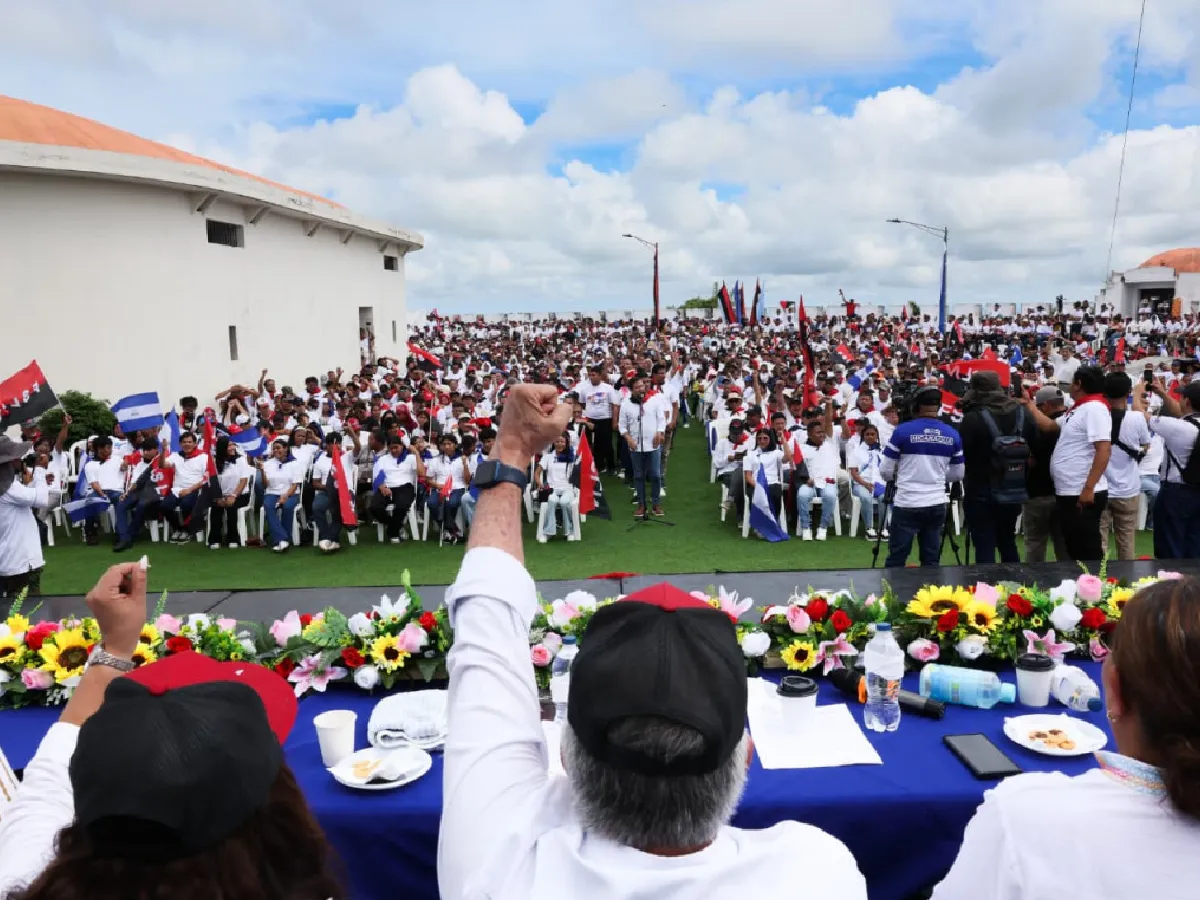
Además de los presentes, también hay personas conectadas a través de un enlace Webex para que participen de este evento, especialmente las personas que viven fuera de Managua. Esta convocatoria fue realizada con el objetivo de presentarles temas de interés Nacional que ustedes ya han estado escuchando a través de los medios y que tienen que ver con las Reformas Electorales y Constitucionales.
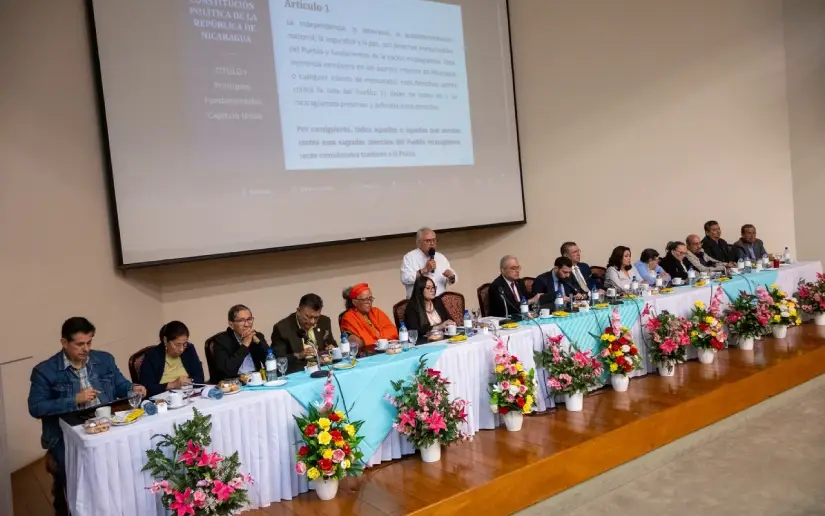
Se encuentra acompañándonos en este momento, nos están visitando en el Banco Central, el Doctor Gustavo Porras, Presidente de la Asamblea Nacional, y la Comisión que está encargada de realizar este Proceso de Consulta y explicación, y que esta tarde va a realizar el trabajo con este grupo, que está compuesto por representantes de empresas, también por cooperativas y grupos que trabajan en el sector de producción, en el sector de la industria y en el sector pesquero.
Así que bienvenidos todos y todas, y esperamos que esta sea una tarde de inspiración y de interés Nacional, que, de hecho, lo es. Entonces, le damos la palabra al Doctor Gustavo Porras, quien hará la presentación. Adelante, por favor, doctor.
Palabras del Doctor Gustavo Porras Cortés
Presidente de la Asamblea Nacional
Gracias.
Buenas tardes a todos y a todas. Voy a permitirme ponerme de pie para poder hacer esta presentación con mayor tranquilidad…, algunos acostumbramos a hablar caminando.
En primer lugar, quiero agradecerles la presencia a todos y a todas, agradecerles la presencia de los diferentes sectores. Veo que hay sectores de diferentes realidades de la economía y diferentes rubros. Hay sector azucarero, hay sector avícola, hay sectores grandes, hay sectores medianos y pequeños; todos. Porque lo que nos une, en general, es la producción y el hecho de que somos nicaragüenses. Y esto se trata de una Consulta al Pueblo de Nicaragua, a los ciudadanos nicaragüenses.
Nosotros, después del 19 de Julio, cuando el Copresidente Daniel Ortega expresó que iba a trabajar con la Asamblea Nacional y que mandataba a la Asamblea Nacional a trabajar leyes que nos garantizaran que las elecciones fueran tranquilas, con Seguridad y con Estabilidad, nos dimos a esa tarea. Porque ustedes recordarán que una cosa es lo que se dice y otra cosa es lo que los medios con determinados intereses transmiten.
Ustedes recordarán que el Comandante Daniel dijo claramente: “No habrán elecciones que permitan que los que están agazapados regresen a destruir lo que hemos construido, que permitan que entren a tomar el Gobierno, a tomar el poder y a trastocar toda una realidad que venimos construyendo todos”. Y dijo: “Vamos a discutir con la Asamblea Nacional; le mandamos a la Asamblea Nacional a que prepare leyes para poner un muro, un bloque, a esos sectores que están agazapados”.
Evidentemente, la interpretación es clara. Como en cualquier país, lo que tiene que haber es una defensa del orden legal, jurídico y constitucional en ese país, cualquiera que sea el país y eso lo sabemos todos. Otra cosa es que tengamos pensamientos políticos diferentes. Uno tenga un pensamiento y otro tenga otro. Pero la realidad del país es la misma, independientemente de nuestros pensamientos.
La realidad del país y la historia del país son las mismas, independientemente de lo que nosotros queramos o quisiéramos y eso es así. Entonces, nos dimos a esa tarea y los Compañeros de la Comisión Especial Constitucional, que ustedes pueden ver y a quienes voy a presentar.
Está la Compañera Arling Alonso, que es la Primera Vicepresidenta. También tenemos a la Compañera Amada Pineda, que es la Segunda Vicepresidenta. Tenemos a la amiga María Haydee Osuna, que es la Tercera Vicepresidenta. Por allá tenemos a Loria Dixon, que es la Primera Secretaria de la Asamblea. Está el Doctor Wilfredo Navarro, que es el Segundo Secretario. Y el amigo Alejandro Medina Ferretti, que es el Tercer Secretario.
Tenemos dos Presidentes de comisión: la Doctora María Auxiliadora Martínez, que es la Presidenta de la Comisión de Justicia, y el Doctor Wálmaro Gutiérrez, que es el Presidente de la Comisión Económica.
Por aquí tenemos a los tres Jefes de las tres Bancadas que hay en la Asamblea: el Doctor Edwin Castro, que es Jefe de la Bancada del Frente Sandinista; el amigo Lester Flores, que es el Jefe de la Bancada Liberal Constitucionalista; y el amigo Mario Asensio, que es Jefe de la Bancada Independiente Democrática.
Por parte del Gobierno, tenemos al Compañero Laureano Ortega, Asesor de la Presidencia. Tenemos a nuestro anfitrión, el Presidente del Banco Central. Tenemos a Erwin Ramírez, que es el Ministro de Fomento, Industria y Comercio, y a Frania Peralta, que es la Ministra del Ministerio de Emprendimientos, esos somos los que estamos aquí.
Les decía que nosotros nos dimos a la tarea, como comisión, primero de revisar la historia relacionada con la actualidad y relacionada con lo que dijo el Comandante. Y, después de eso, identificar puntos que pudieran servir como bases políticas para preparar una Ley de Reforma Constitucional y cumplir con el mandato.
Entonces, como pueden ver ustedes aquí, voy a leer lo que aparece al frente. La Ley de Reforma está montada sobre tres pilares fundamentales que nos deben unir a todos: Estabilidad, Seguridad y Paz; esos son los tres pilares.
Ahora, esos tres pilares, articulados e instrumentados por todos nosotros, tienen un objetivo central. Un objetivo central que el Comandante Ortega, la Compañera Rosario, el Gobierno, el Frente Sandinista y todos los que estamos en este barco, todos los nicaragüenses, debemos de buscarlo y el objetivo central es derrotar la pobreza.
Es la lucha contra la pobreza la que nos une a todos: grandes, medianos y pequeños; verdes, rojos, rojo y negro, azul o de cualquier color; cualquiera que sea nuestro pensamiento o nuestra creencia religiosa. Lo que nos une, esencialmente, es que somos nicaragüenses.
En segundo lugar, otro objetivo que nos une a todos es derrotar la pobreza. Entonces, cuando discutimos eso, vimos que era esencial. Vamos a buscar cómo, si queremos alcanzar el objetivo de derrotar la pobreza, necesitamos hacer una Ley de Reforma que preserve la Estabilidad, la Seguridad y la Paz, ese es el centro de esto.
Entonces, nos vimos en la necesidad de comenzar a identificar todo lo que estaba saliendo. Porque, a veces, entre tantas redes, tanta información y todo lo que se decía: que no habría elecciones, que había que reunir a la OEA y que la Democracia se iba a perder... Nosotros comenzamos a ver cuál es la historia de nuestro país. Porque, independientemente del pensamiento de cualquiera de nosotros, ahí están las evidencias, está en los documentos, está la historia de nuestro país.
Y lo primero que identificamos es la realidad de nuestro país. Todos los que estamos aquí sabemos, aunque a unos nos dé una reacción y a otros les dé otra, que en 1856, mucho antes de esto, casi cien años antes, vino William Walker y se hizo Presidente de Nicaragua. Mayor expresión de injerencismo no puede haber. Ahora, puede ser que a mí no me guste oír eso o puede ser que me guste saberlo, pero es una realidad que no podemos permitir que se repita.
Eso provocó una guerra y dio lugar a que surgieran figuras que todos nosotros estudiamos, como Andrés Castro. En las fiestas patrias y en las veladas, uno quería ser Andrés Castro y otros querían ser los filibusteros, esa es una realidad.
Pero lo más importante es que estemos claros que los nicaragüenses reaccionamos, hace casi 150 o 200 años, de esa forma. Incluso, cuando nos unimos y logramos unir a los centro-americanos para derrotar la idea expansionista de Walker, esa es una realidad.
Después vino la historia y llegó la historia de la Revolución Liberal, que creo que fue importantísima en la historia nicaragüense y que, además, chocó con la expansión natural del imperialismo de los Estados Unidos y en 1909 a Zelaya lo sacan con la Nota Knox. También lo sabemos, porque ahí está la historia; ahí está la Nota Knox, que se conserva en la biblioteca y en los pasillos de las Instituciones norteamericanas, y existió.
También existió quien se erigió como defensor en contra de la intervención norteamericana, que es el General Benjamín Zeledón, son realidades. Pero, dentro de esas realidades, hay una que está relacionada con el tema que nos asiste y que es el que tenemos que ver nosotros: ¿qué pasa con las elecciones?
Hay una realidad, y es que en 1928 pidieron la intervención norteamericana. Vinieron, pusieron marines al frente de cada cantón electoral y se nombró como Presidente del Consejo Nacional Electoral de Nicaragua al brigadier General Frank Ross McCoy. Era un norteamericano, un General al que pusieron al frente del Consejo.
Como les digo, puede ser que alguien diga: “Sí, está bien, porque esa era la única forma de poner orden”, o puede ser que alguien diga: “No me cabe esa idea”. Pero, bueno, esa es una realidad. Y, cinco años antes, se había aprobado una ley que se llama Ley Dodds, la cual establecía cómo desarrollar el bipartidismo en Nicaragua. La Ley Dodds es una ley de 1923 y esa es la Gaceta, porque se trata de evidenciar los hechos, no de buscar argumentos falsos.
Entonces, esa es la Gaceta de la ley electoral elaborada por este académico norteamericano, el señor Dodds, quien fue enviado por el Gobierno de los Estados Unidos, por el Presidente y por el Departamento de Estado, y contratado por el Presidente de Nicaragua en ese tiempo, Adolfo Díaz, para trabajar en la elaboración de esta ley electoral.
Ahora, esos eran otros tiempos. Sí, eran otros tiempos, hace cien años. Hace cien años, la mujer no tenía derecho a votar. Ahí dice en el Artículo segundo, señala claramente: “El derecho del sufragio pertenece solamente a los varones nicaragüenses de 21 años o más”.
Es decir, desde ahí esa democracia determinaba que la población votante era el 50% o menos de la población adulta, porque la mitad de los ciudadanos nicaragüenses eran mujeres y la otra mitad eran varones. Pero no se trataba únicamente de los varones, sino de los mayores de 21 años.
Y, hasta hace veinte años, nuestra pirámide poblacional nos determinaba que el 60% de los nicaragüenses eran los menores de 20 años. ¿Qué quiere decir eso? Que, de la mitad de la población que existía, le quitabas el 60% y solamente quedaba un 40%. Pero, además, existían otras condiciones para ejercer el derecho al voto. Y decían: “Bueno, podes votar, aunque tengas 21 años, pero tienes que saber leer y escribir y, además, tienes que ser casado”. De esa manera se iban reduciendo las posibilidades, esa era la democracia de aquel tiempo.
Gracias a Dios, ahora las mujeres son ciudadanas nicaragüenses con derecho a votar. Sin embargo, para que vean que eso era lo que se establecía, se tenía una población bastante reducida. Porque, si se imaginan el índice de analfabetismo de aquella época, habría sido enorme. Si ahora lo hemos reducido y, si mal no recuerdo, en 1979 lo encontramos cerca del 60%, entonces, en aquel tiempo, el índice de analfabetismo habría sido mucho mayor.
Entonces, ¿qué quiere decir eso? Esa era la condición. Nosotros solo estamos mostrando lo que existía. Después de esta ley, la cual sirvió para llevar adelante las elecciones de 1928, porque esta es la ley de 1923, le hicieron, como decimos popularmente, una “chajineada” y salió una Ley que se llamó Ley McCoy, cuyo contenido señala lo que está ahí y que, tal vez, podríamos ampliar un poco más para ver el párrafo completo.
El Presidente de la República, en vista de que la Corte Suprema de Justicia, por acuerdo del 17 del corriente mes, ha nombrado, en sustitución del señor Doctor Don Joaquín Gómez, quien elevó su renuncia, al señor General Frank Ross McCoy, Presidente del Consejo Nacional de Elecciones, y que este alto funcionario, designado en ese carácter por el señor Presidente de los Estados Unidos, ha sido elegido para dirigir el acto electoral de 1928, de Autoridades Supremas, conforme a lo convenido para poner término a la guerra civil en Nicaragua.
Ahí está la realidad.
Pero han pasado cien años y, después de eso, ocurrió mucho. Han pasado muchos años y muchas generaciones de nicaragüenses. Después vinieron las elecciones de 1930 y de 1932, toda la intervención y todo lo relacionado con ese período. Estamos hablando de 1928, de todo lo ocurrido después de 1927, del Pacto del Espino Negro, de Stimson y ya está Sandino, que también es otra realidad que, queramos o no, ningún nicaragüense puede olvidar, por su posición antiimperialista, de Dignidad y de defensa de la Soberanía, es una realidad.
Entonces, cuando estudiamos todo esto, nos preguntamos ¿dónde estamos ahora? Después de tantos cambios, después de la guerra y de todo lo que hemos pasado, como ustedes saben, nos trasladamos a nuestros tiempos actuales.
Y llegamos al Artículo 1 de nuestra Constitución. Todos estos años, estos 47 años que han transcurrido después de la Revolución Sandinista, todos esos años de guerra contra el instrumento de la política norteamericana que fueron los contras, y toda esa etapa del neoliberalismo, nos conducen a este Artículo 1 de la Constitución.
A mí me encanta, puede ser que a alguien no le guste, pero así es. Ese es el Artículo 1 de la Constitución. Porque así son las leyes y así es el orden jurídico. Puede ser que a mí me guste pasarme el semáforo en rojo porque voy rápido; la ley dice que, si me lo paso, me multan y me detienen.
Entonces, el Artículo 1 dice:
La Independencia, la Soberanía, la Auto-determinación Nacional, la Seguridad y la Paz son derechos irrenunciables del Pueblo y fundamentos de la nación nicaragüense. Toda injerencia extranjera en los asuntos internos de Nicaragua o cualquier intento de menoscabar esos derechos, atenta contra la vida del Pueblo. Es deber de todos los nicaragüenses preservar y defender estos derechos.
Por consiguiente, todos aquellos o aquellas que atenten o hayan atentado contra estos sagrados derechos del Pueblo nicaragüense serán considerados traidor a la Patria.
Este Artículo, que ya quedó redactado así en nuestra Constitución, creo que es una de las últimas en incorporar este concepto. Me puse a revisar las constituciones de otros países y, en todas, incluso en las de aquellos países que son considerados ejemplos de Democracia, se hace referencia a quienes son considerados traidores a la Patria, solamente nosotros no lo habíamos incorporado.
Quedaron incorporados en el Artículo 1 todos los elementos centrales que debemos respetar. Sobre esta realidad es que decimos que nuestra guía es cumplir con este Artículo 1, cumplir con los tres conceptos de Estabilidad, Seguridad y Paz, y que esto nos va a permitir continuar, de manera exitosa, la lucha contra la pobreza.
Entonces, de ahí surgieron seis conceptos, que son los conceptos que nos están guiando para elaborar la Ley de Reforma. El primer concepto es: “No podrán"”. Se parece a la frase “No pudieron ni podrán”, pero aquí estamos hablando de que no podrán participar en las elecciones. Es decir, es el concepto que debe dejar claro a todo el mundo que sí van a haber elecciones.
Pero, como dijo el Comandante, no son elecciones para que se metan por ahí a destruir lo que hemos venido construyendo. Van a ser elecciones Limpias, Libres y Transparentes, del Pueblo nicaragüense para el Pueblo nicaragüense, sin injerencia extranjera.
Pero no podrán hacerlo los golpistas, porque no tiene sentido. No podrán hacerlo los traidores a la Patria, porque no tiene sentido, no tiene lógica. No podrán hacerlo quienes incurran o hayan incurrido en actos que menoscaben la Independencia, la Soberanía y la Autodeterminación de Nicaragua. Es decir, quienes hayan afectado el Artículo 1 de nuestra Constitución, el primer principio. Y no podrán hacerlo quienes hayan violentado o violenten cualquier otro Principio Fundamental de la Constitución. Ese es el concepto que refiere al “No Podrán”.
Estaba leyendo que un Presidente suramericano, recientemente, estaba dictando una ley, y ahí lo tienen, en Argentina. No podrán entrar a Argentina aquellos que hablen mal de Argentina, y tienen su derecho a hacerlo; pero, además, sacarán de Argentina a aquellos que hablen mal de Argentina. También tienen ese derecho.
Nosotros lo que decimos es que en nuestras elecciones no podrán hacerlo quienes se encuentren dentro de las situaciones contempladas en el párrafo completo que se está proponiendo. El cual señala:
No podrán las y los que incurran o hayan incurrido en actos que menoscaben la Inde-pendencia, la Soberanía y la Autodeterminación de Nicaragua, inciten o promuevan la injerencia extranjera, pidan intervención militar, se organicen con financiamiento del extranjero, propongan, gestionen o respalden bloqueos económicos, comerciales o financieros y sanciones contra el Estado de Nicaragua, sus Instituciones y sus ciudadanos.
Eso está clarísimo. No puede ser que una persona participe en una elección levantando la bandera y diciendo que está pidiendo una intervención militar. No tiene sentido en Nicaragua. En Nicaragua, menos; pero no tiene sentido ni se permite en ninguna parte del mundo. Para que estemos claros. Ese es el primer punto: “No podrán”, después vamos al segundo.
El segundo elemento es la “Estabilidad”. Es decir, nosotros necesitamos Estabilidad. Yo sé cómo los sectores económicos y productivos, en general, se ponían a pensar mucho, antes más que ahora, en la inestabilidad que traía consigo cada Proceso electoral, cada año electoral o cada período preelectoral. ¿Por qué? Porque eso tiene vaivenes en muchas cosas: en la Estabilidad, en los mercados y en muchos otros aspectos, ustedes lo saben mejor.
Pero es cierto, nosotros necesitamos Estabilidad. Necesitamos mantenerla a lo largo del tiempo y en los tiempos políticos. Ustedes mismos siempre han planteado que necesitamos a qué atenernos en los aspectos impositivos, necesitamos a qué atenernos en los aspectos cambiarios y en cada uno de los ámbitos relacionados con el desarrollo del país. También necesitamos a qué atenernos en los tiempos electorales y en los tiempos políticos.
¿Qué revisamos? Hay países que tienen períodos de diez años y otros que tienen períodos de siete años. Bastantes países tienen períodos de siete años. En América Latina, la mayoría de los países establecen períodos de seis y cinco años. Nosotros mismos hemos venido modificando esos períodos. Tuvimos cinco años, pasamos a seis años y ahora la propuesta es establecer períodos de siete años.
Hay países que tienen períodos de cuatro años y que están pensando cuatro años más cuatro años. Y, últimamente, he escuchado quienes dicen “cuatro veces cuatro”. Entonces, nosotros creemos que, en Nicaragua, siete años es un buen período. Y cuando digo que nosotros creemos, me refiero a que esta es una propuesta que estamos presentando y exponiendo ante todo el país y ante todos los nicaragüenses.
Con ustedes, este es el cuarto encuentro, tenemos más o menos el complimiento de treinta encuentros. Muchos de estos encuentros serán presenciales y virtuales. Pero, en definitiva, el planteamiento es que el período establecido en la Constitución Política de la República de Nicaragua para los cargos de elección popular y para los cargos de elección o ratificación por la Asamblea sea de siete años.
Eso nos daría Estabilidad para la lucha contra la pobreza, pero necesitamos también Cohesión y Seguridad. Por eso decimos: Estabilidad, Seguridad y Paz. “Cohesión y Seguridad”. Entonces, lo planteamos de la siguiente manera: no solamente los cargos de elección popular o los designados por el Presidente tendrían períodos de siete años, sino que, por mero derecho constitucional, también se reformarían las leyes correspondientes al Ejército y a la Policía, para dejar claramente establecido que los períodos de nombramiento del Comandante en Jefe de las Fuerzas Militares del Ejército de Nicaragua y de los Jefes de las Fuerzas Policiales de la República de Nicaragua serán de siete años.
Entonces, cohesionamos todos los elementos. Es decir, tenemos los cargos de elección popular, los designados por el Presidente y aquellos que son elegidos o ratificados por la Asamblea, estamos hablando de entre 16 y 20 cargos con períodos de siete años. Asimismo, se reformarían tanto las leyes de organización militar como las de organización policial., de tal forma que quede cohesionado el concepto.
Después de eso, viene un concepto al que llamamos “Garantía de nuestra Democracia Electoral”. Utilizamos el concepto de Democracia Electoral porque la idea de Democracia que nosotros manejamos, que tenemos y que creo es aceptado por la mayoría del Pueblo nicaragüense: Es que la Democracia va más allá de las elecciones; la Democracia es tener oportunidades, más allá de las elecciones.
Por eso aquí hablamos de Democracia electoral. Pero, para nosotros, también es Democracia haber logrado, en la lucha contra la pobreza, contar con carreteras de buena calidad para llegar a Bilwi, a Bluefields. Eso es parte de la Democracia, porque no puede existir una Democracia para el Pacífico y el Caribe que hay vean ellos.
La Democracia va mucho más allá del concepto de elección. La Democracia es tener la Seguridad de que voy a acudir a un hospital, como el Vélez Paiz, puede ser que alguien no lo conozca, pero es un hospital de primer nivel donde se procura que se atienda al Pueblo nicaragüense sin que le cobren ni un centavo. Eso es parte de la Democracia.
También es Democracia que no te saquen a los chavalos de la escuela cuando no tenías para pagar. También es Democracia haber ampliado la cobertura de la energía eléctrica al 99.5%, claro hay gente que no reconoce, pero esto es parte de la Democracia. También es Democracia tener como moverte con 2.50 de un pasaje de un Managua o teniendo un bus aceptable, esa es parte de la Democracia, esa es una realidad.
Claro que todavía falta mucho por hacer, pero ese es precisamente el objetivo: la lucha contra la pobreza.
Entonces, ¿quién garantiza eso? La Democracia Electoral, el encargado de hacerlo es el Consejo Supremo Electoral.
Aquí aparecen los Artículos que en la Ley de Reforma se adecuarían para darle la fuerza al Consejo Supremo Electoral y permitirle aplicar las reformas que ya les he mencionado; que apliquen la Estabilidad, que apliquen la Seguridad y la Paz. Entonces, son tres incisos que se reforman en el Artículo 152.
Organizar y dirigir las Elecciones Generales, Municipales y Regionales cada siete años, en el año electoral que corresponde.
Es decir, si allá hablamos que los períodos de los cargos de elección son de siete años, el Consejo tiene la obligación de organizar y dirigir las Elecciones cada siete años. Entonces van a haber Elecciones. Pero, además, van a haber, como ha sido así durante todos estos años: tres Elecciones. Un año se realizan las nacionales; al año siguiente, las municipales; y, al tercer año, las regionales. Son tres Elecciones y el Consejo tiene la obligación de garantizarlas.
Después, en el numeral 12 de ese Artículo, se establece la facultad que se le otorga al Consejo para garantizar lo que ya habíamos hablado sobre la Independencia y la Auto-determinación. Se agrega: “No otorgar personalidad jurídica a partidos políticos constituidos con financiamiento extranjero o cuando alguno de sus directivos haya violentado los Principios Fundamentales de la Constitución Política”.
Esa es una facultad de Consejo, no estaba establecida, ahora se establece: “El Consejo tiene la facultad de no otorgarla...”. Porque solo decía: “Otorgar o denegar la personalidad jurídica a los partidos políticos”. Eso era lo único que decía. Ahora se trata de un mandato expreso: otorgar la Personalidad Jurídica a quien cumpla la ley y no otorgarla a los partidos políticos constituidos con rialitos extranjeros.
Está claro. Nadie apuesta para perder, si alguien viene a financiar la constitución de un partido o a aportar con riales del extranjero, está apostando a algo que no podemos permitir, es tan simple como eso.
Después, se establece cancelar la personalidad jurídica del partido cuando alguno de sus directivos o candidatos reciba financiamiento extranjero o haya violado dichos principios.
Yo me pregunto: ¿habrá algún país que no tenga estos conceptos en sus leyes? Creo que no existe, no pasas de “jon” no pasas de arranque, vos vas a cualquier de esos países que se presentan como modelos de la Democracia occidental perfecta y decís: “Voy a hacer el partido de los migrantes”, aquí nos vamos a juntar. No es cierto, eso no existe.
Nosotros decimos que el que es bueno para el ganso es bueno para la gansa. Nosotros también tenemos que dejar definidos nuestros criterios para los nicaragüenses. Entonces, no puede haber nada que esté relacionado con un financiamiento extranjero.
Además, se le da la facultad al Consejo, contenida en el numeral 14, de verificar e imponer las sanciones correspondientes a todo candidato, funcionario del Órgano Electoral e integrantes de las Juntas Directivas de los partidos políticos que incurran o hayan incurrido en actos que menoscaben la Independencia, la Soberanía y la Autodeterminación de Nicaragua.
Y ahí volvemos al párrafo que ya les había leído. Naturalmente, se incluyen aquellos que promuevan invasiones militares, sanciones o bloqueos económicos, comerciales y financieros. El Consejo verifica los hechos y toma las decisiones correspondientes.
Y no se trata únicamente de que lo haya hecho o de que incurra en ello. Es decir, imaginemos el caso de un candidato que diga: “Bueno, yo creo que está bueno que los hayan sancionado a todos, pero, cuando voten por mí, voy a pedir que se quiten esas sanciones”. Espérate, hay reglas, como vas a estar diciendo eso.
Es simple. Estoy claro que estoy poniendo un ejemplo extremo. Ya sería muy estúpido el que sale con eso; pero, como en el mundo existen hay gente estúpida, nosotros no podemos permitir que esas situaciones se manifiesten. Por eso, las cortamos legalmente. Es mejor que no participes.
El quinto concepto, le pusimos el nombre para que no se nos olvide del poema de Darío “PAX”, que es muy bellísimo. La Constitución te dice que la toma de posesión es el 10 de enero, ahora aquí la fecha de la toma de posesión del Copresidente de la República va a ser el 18 de enero. ¿Por qué? Porque es la fecha de nacimiento del Héroe Nacional y Poeta Universal Rubén Darío. Si hay dos figuras nicaragüenses conocidas mundialmente, uno es Rubén Darío y el otro es el General Sandino. Esa es una realidad, entonces nosotros dijimos compongamos esta injusticia histórica que teníamos y el 18 de enero que sea en Homenaje al nacimiento de Darío.
Ahí son dos Artículos el 132 que es el que establece eso y el 130 que se refiere a los Diputados, quienes siempre asumen un día antes de la toma de posesión, porque se instala la Asamblea y el Diputado asume el cargo, y es en la primera sesión de la Asamblea cuando se realiza la toma de posesión. Entonces, el Artículo 130 es el que va a establecer que la Asamblea Nacional se instala el 17 de Enero, para que la toma de posesión se realice el 18.
Y, finalmente, son seis conceptos. El último concepto es la “Coherencia”. ¿Qué significa esto? Que, una vez concluidas las consultas y suponiendo que exista consenso en torno a estos cambios constitucionales, surgiría la siguiente pregunta: ¿Y los que actualmente están electos van a quedar durante un año que no saben dónde están? ¿El Presidente del Banco Central va a permanecer durante un año que no está?
Los nicaragüenses no somos así. Si alguien observa una situación de ese tipo, inme-diatamente se preguntará qué fue lo que ocurrió. Entonces, nosotros no queremos dejar ningún resquicio de duda y queremos que quede claro que los períodos de las autoridades electas por voto popular en las últimas elecciones generales, municipales y regionales, según corresponda, quedan ampliados a siete años, entonces para hacer una coherencia.
Dos, se amplía a siete años el período de los cargos designados por la Presidencia de la República o sujetos a elección o ratificación por la Asamblea. Y, tres, para evitar que quede algún vacío, se establece que, en toda la legislación nacional vigente en la que se estipule o regule un período de funciones, se entenderá reformado de pleno derecho y se interpretará que dicho período será de siete años. Entonces, serán siete años.
Ahora ya quedó claro que sí habrá elecciones y ahora que todo mundo está claro. Se trata de un principio que existe en muchas partes del mundo: que un golpista o quien viola la Constitución o traiciona la Patria no puede participar. Entonces, algunos dicen ahora que se está promoviendo el “setenta veces siete”. Bueno, eso fue lo último que oí… bueno, debe ser cabalístico esto. Pero lo cierto es que se trata de un período orientado a la Estabilidad.
Entonces, ¿cuáles son los cargos que se amplían?
Ya habíamos mencionado a las Fuerzas Militares, las Fuerzas Policiales, la Corte Suprema, el Consejo Supremo Electoral, los Procuradores Generales de Justicia, los Miembros del Consejo de la Contraloría, el Presidente del Banco Central, los Miembros del Consejo Monetario y Financiero, el Superintendente y el Vice-superintendente de Bancos y de otras Instituciones Financieras, el Presidente y los Miembros del Consejo Directivo del Banco de Fomento a la Producción, los Miembros del Consejo Directivo de la Comisión Nacional de Microfinanzas, los Miembros del Tribunal Aduanero y Tributario Administrativo, los Miembros del Consejo Nacional de Administración y Carrera Judicial, el Consejo Directivo del INE, el Director Ejecutivo de la Autoridad Nacional del Agua y los Miembros de la Comisión de Apelación del Servicio Civil.
Lo hacemos para que no quede ninguna duda y para dejar claro de qué estamos hablando. En esencia eso es, lo bueno es que el Pueblo de Nicaragua entiende, la alharaca inicial ha caído. Y aquí la idea es muy sencilla: No podrán participar quienes incumplan estas disposiciones.
Necesitamos Estabilidad, al menos mediante períodos de siete años. Necesitamos Seguridad, de tal manera que exista una articulación entre esos períodos y el Ejército y la Policía. Necesitamos fortalecer las facultades del Consejo Supremo Electoral para que pueda aplicar esta Reforma. Y, finalmente, buscamos la Coherencia, le rendimos Homenaje a Darío.
Buscamos Coherencia con la realidad. Es decir, que la Reforma y la realidad vayan de la mano. Esa es, en esencia, la Reforma y eso es lo que queríamos transmitirles para que todo quede claro. Este es un trabajo en el que ustedes participan en la cuarta sesión.
Y lo más importante es no olvidar aquello que nos une a todos: el objetivo de alcanzar Estabilidad, Seguridad y Paz. Y, a partir de ello, avanzar de manera exitosa en la lucha contra la pobreza.
Muchas gracias.
Espacio de preguntas y respuestas
Palabras del Compañero Ovidio Reyes:
Damos ahora un espacio para preguntas, respuestas, comentarios o para conocer su opinión. Allá tenemos una intervención.
Palabras de Participante:
Solo es una cuestión meramente de forma. Las elecciones, digamos, los períodos se extienden a siete años. Pero, cuando lleguemos a las elecciones, vamos a llegar al 17 y 18 de enero y, en ese momento, coincidirán los períodos de los Magistrados de la Corte Suprema, de los Diputados, de los Contralores y de los integrantes del Consejo Supremo Electoral. ¿No sería mejor alternar eso y modificar los vencimientos de los períodos para poder tener Estabilidad en los procesos que estamos viviendo?
Porque, cuando lleguemos a ese momento, a todos se les extenderá el período a siete años y a todos se les vencerá el mismo día. Entonces, vamos a tener un momento en el que nadie va a estar electo y la Asamblea va a celebrar su primera sesión el 17 de enero y, en ese momento, tendrá que nombrar Contralores, Magistrados y demás funcionarios.
Palabras del Diputado Wálmaro Gutiérrez:
Buenas tardes. El Presidente del Parlamento Nacional me ha permitido hacer una breve aclaración sobre esta legítima inquietud que acaba de hacer. Creo que es importante entender que todos los cargos que actualmente están en ejercicio han sido nombrados en momentos distintos. Por lo tanto, eso significa que la gran mayoría de esos cargos no concluyen en la misma fecha y eso permitirá que, al extenderse los períodos a siete años, los cargos se vayan ajustando una vez que venza el período correspondiente.
De suerte tal que no existirá ninguna posibilidad de vacío legal o de que una Institución no tenga una cabeza legítima, una cabeza legal para desarrollar el ejercicio de un determinado cargo.
Palabras del Doctor Gustavo Porras:
Tal vez ese vacío o esa duda queda porque lo que leímos fue una presentación, pero lo que tenemos preparado lo explica claramente. En el caso, solo pusimos aquí el caso de las elecciones, los cargos de elección popular. Se dice: siete años a partir de su elección popular.
En el articulado relacionado con los cargos de nombramiento, de ratificación de la Asamblea o de elección de la Asamblea, Consejo Supremo Electoral, Corte Suprema, Procuradurías, etcétera, se establece un período de siete años a partir de su designación o de su nombramiento. Eso permite un traslape. Sin embargo, estemos claros en que eso no le quita la potestad a quien corresponda de pedir la renuncia, de hacer el cambio o lo que sea.
Lo que sí está claro es que, si uno de estos cargos que fueron mencionados fue nombrado recientemente, hay ejemplos recientes, como el caso de la Superintendente de Bancos, se le otorgarán siete años a partir de esa elección que se realizó en la Asamblea. Eso trasciende el planteamiento de elecciones en el cumplimiento del primer período. De acuerdo con el planteamiento, si quedara así, estamos hablando del año 2028 y ese nombramiento iría siete años después de 2026, es decir, hasta 2033.
Entonces, cuando hablamos de Coherencia, no es que de pronto todo se iguale y, después, se establezcan siete años para todos. No. Hablamos de Coherencia, de que todos los conceptos que constituyen la base de esos siete años se apliquen a cada uno cuando le corresponda, pero tiene razón y eso nos va a permitir mejorar esa parte en la presentación para la Doctora Aniuska Abea, que es la que lleva la Secretaría de la Comisión, podrá incorporar, tal y como está la propuesta de redacción, la expresión “siete años a partir de su nombramiento”. No sé si hay alguna otra intervención.
Palabras del Compañero Ovidio Reyes:
Otro comentario, intervención o consulta.
Palabras de Representante del Sector Lácteo
Buenas tardes. Soy representante del sector lácteo y de los productores de la zona norte, central y del Caribe, NICACENTRO representamos a cinco municipios y a más de mil productores. Las leyes son para mejorar, pero aquí estamos hablando de todos los Órganos de dirección del país. Quisiera saber si habrá alguna Reforma relacionada con las cooperativas, cuyos Presidentes ejercen períodos de uno a tres años, no es porque yo quiera estar más tiempo en la cooperativa, sino que debe ir relacionado a la Ley General de la República.
Por otra parte, nosotros, como sector primario, productor de alimentos básicos para las familias nicaragüenses, como NICACENTRO tenemos algunos problemas tributarios. Aunque no es el tema central, quisiera aprovechar este momento para plantearlo, porque se nos está tratando como empresas privadas y no como cooperativas. En el caso de NICACENTRO, somos más de mil productores asociados, en su mayoría pequeños y medianos productores. Muchos producen entre veinte y cuarenta litros, máximo cinco pichingas y solo un pequeño porcentaje alcanzar de veinte a treinta pichingas. Como sociedad y empresa privada nos deben considerar esa parte tributaria, no quiero extenderme más porque no es el punto, pero quisiera que me den espacio en algún momento y apoyo para exponer esta situación.
Gracias.
Palabras del Doctor Gustavo Porras Cortés:
Señalan los Compañeros, y yo comparto ese concepto, que debemos recordar que esta es una Reforma Constitucional orientada a aspectos de la función pública. Estamos hablando de Órganos del Estado, de procesos de elección, de cargos de elección popular y de cargos designados por la Presidencia o por la Asamblea, esos son los que se han afectado.
Por lo tanto, esta Reforma no afecta aspectos de orden privado. Cada estatuto establece si una Junta Directiva ejercerá sus funciones durante dos, tres o cinco años, esa es la lógica. Entonces, con respecto al primer concepto, de por qué se puede pasar a la primera pregunta de los siete años, eso no; esto es exclusivamente para la función pública.
En cuanto a lo otro, efectivamente, como usted misma lo dijo, está fuera de tema y, si bien es cierto, aquí están Compañeros que tienen que ver con los aspectos económicos. Sería bueno que al final lo vieran y quedara planteado, pero me parece que, en cuanto a la pregunta relacionada con el tema, dejamos claro que esto es para la función pública.
Palabras del Compañero Ovidio Reyes:
Muchas gracias. Tomamos nota de su comentario relacionado con el tema de producción y lo atendemos aparte.
¿Otra pregunta o comentario?
Palabras de Participante Inés Espinoza:
Buenas tardes. Mi nombre es Inés Espinoza y pertenezco al Ministerio para la Promoción de Emprendedores. No soy funcionaria, sino emprendedora. Quiero felicitar a todos los Compañeros y Compañeras que han elaborado esta propuesta de manera tan clara, tan explícita porque nos permite explicarla a otras personas que estén equivocadas o quieran enredarnos. Esto es muy importante la única sugerencia que yo tengo para el Compañero es, en el orden de los pilares, que sería muy importante tener como primer pilar la Paz, que es lo que nos ha conllevado a estos 20 años que ya vamos a cumplir en esta segunda etapa de la Revolución: la Paz, la Seguridad y la Estabilidad.
¿Por qué se los digo de esta manera? Porque con la Paz nosotros podemos tener la Seguridad de poder trabajar, de poder vivir, de poder gozar de tantos beneficios que hemos tenido y, además, la Estabilidad, que es lo que nos ha permitido estar aquí, la Estabilidad que es la que hoy estamos gozando. Yo me siento muy orgullosa de ser sandinista, muy orgullosa, y de ver todo este avance para mí es grandioso y voy muy clara para poderlo explicar en cualquier parte. Muchísimas gracias, Compañeros, por habernos permitido estar aquí presentes.
Palabras de Participante David Narváez:
Buenas tardes, Compañeros y Compañeras, Diputados y Diputadas de la Asamblea Nacional, Compañeros y Compañeras que integran la mesa. David Narváez, Presidente Nacional de la Red de Emprendedores Nicaragüenses del Reciclaje (RENIC).
Más que una pregunta, nos sumamos a todo este esfuerzo que está haciendo nuestro buen Gobierno, a través de consolidar todos los programas que se están desarrollando en este país, donde se está llegando verdaderamente y dando una respuesta a la población más pobre de Nicaragua.
Estamos seguros de que esta Reforma a la Constitución Política nos ayudará a consolidar, la lucha contra la pobreza en Nicaragua, dentro del Plan Nacional de Lucha contra la Pobreza 2025-2026, que son programas que se vienen desarrollando en beneficio y en pro de nuestra población. Y, como decía la Compañera, la profesora, para nosotros hay que dar este mensaje a todos los sectores, a nuestras comunidades.
En el caso nuestro transmitimos este mensaje positivo a más de 13, 500 recicladores de base en todo el país, organizados en 50 cooperativas de recicladores y recicladoras de base en Nicaragua.
Muchísimas gracias.
Palabras de Compañero Ovidio Reyes:
¿Otra pregunta o comentario?
Palabras de Participante Merlin:
Muy buenas tardes, Compañeros y Compañeras. Mi nombre es Merlin. Soy gerente de una cooperativa de pequeños productores de café, PRODECOOP, y también miembro del Consejo Nacional de Transformación de la Caficultura, en representación de las cooperativas.
Para nosotros es muy importante que podamos ver la ley de manera sencilla, como usted la explicaba ahora y como decía la Compañera, de tal manera que podamos defender, a nivel nacional e internacional, esta Reforma, ya que hay muchos comentarios negativos que nos afectan a todos en el sector.
Ese espacio, donde nosotros podemos entenderla de manera clara y sencilla y que nos permita transmitir eso, es muy importante. Agradezco a todos por habernos invitado, a los Compañeros Diputados, a los Compañeros presentes, y esa es la diferencia de nuestro Gobierno. Es un Gobierno que trabaja en conjunto con el sector, con los diferentes sectores, y que seguimos respaldando.
Muchas gracias.
Palabras de Participante Gonzalo Castillo
Buenas tardes a todos. Primero, darles gracias a Dios porque estemos aquí hoy. Y gracias a nuestro Buen Gobierno y a nuestras Autoridades, tenemos una Democracia moderna. Hay muchos países que nos acusan de muchas cosas, pero hay Democracias que son del tiempo del príncipe y del rey.
La primera Democracia de los Estados Unidos, para ser más claros. Los líderes, un colegio electoral; todos los líderes del Pueblo son colegios electorales. Nuestra Democracia es moderna. Felicidades a nuestra Asamblea, felicidades a nuestros Copresidentes y a todo el Pueblo de Nicaragua. Los felicito también porque tenemos un Gobierno que tiene una Democracia moderna, no del tiempo del colonialismo, del imperialismo, sino de la Democracia activa.
Mi nombre es Gonzalo Castillo. Soy también, igual que Merlin, de la Junta Directiva de CONATRADEC, y, dichosamente, también fui elegido para modernizar nuestra caficultura.
Muchas gracias y felicidades a todos.
Palabras de Participante Eda Castellón:
Buenas tardes. Mi nombre es Eda Castellón. Yo soy emprendedora, mi proyecto tiene 18 meses y represento a la marca Macalli. Somos productoras de vinagre de sidra de manzana, junto con mi compañera y damos las gracias por la oportunidad que nos dieron.
Quiero agradecer a la Compañera Frania, del Ministerio de Emprendedurismo, por apoyarnos a nosotros, los jóvenes, a salir adelante. Tengo mi punto de venta en Monseñor Lezcano y me siento contenta de seguir capacitándome. He mejorado mucho mi plataforma gracias a ese acompañamiento del buen Gobierno.
Gracias también por haber compartido, porque mi hijo estudia Ingeniería en Arquitectura y yo sé que a él le interesa esto, porque siempre estamos pendientes de lo que el Gobierno comparte en sus redes sociales y en los medios de comunicación. Y gracias también por la invitación a mis Compañeros y por la oportunidad de escucharme y saber que también hay jóvenes que estamos emprendiendo. Que no se olviden de nosotros; yo sé que no lo hacen, deben incentivarnos más para que nos emocionemos y salgamos adelante. Gracias por el tiempo y la oportunidad de habernos invitado a esta presentación.
Palabras del Compañero Ovidio Reyes:
Bueno, si no hay más preguntas y comentarios, Doctor Porras, para cerrar este encuentro.
Palabras del Doctor Gustavo Porras Cortés:
Gracias. Reiterando el agradecimiento por su presencia y refiriéndome un poco a lo que dice la Compañera, tiene razón. La idea no es poner en un orden de prioridad la Estabilidad, la Seguridad y la Paz, no lo dudamos, lo que ella dice es cierto. El bien más preciado del Pueblo nicaragüense es la Paz, en todas las encuestas sale. En todos los sentimientos sale. El bien más preciado es la Paz.
Lo que pasa es que esto es indisoluble. Es decir, para que haya Paz es necesario que haya Seguridad. Para que haya Paz y haya Seguridad es necesario que haya Estabilidad. Eso es absolutamente indisoluble, es un vínculo que no se puede separar. Pero, en cualquier orden, o todo en el mismo orden, tenemos el objetivo final es la lucha contra la pobreza. Y eso nos interesa a todos.
El gran productor está interesado totalmente porque, en la medida en que Nicaragua salga de la pobreza, sus ventas, su capacidad de producción y su comercio van a aumentar. El pequeño igual, por muy pequeño que sea, cuánta alegría le da a una persona que vive de vender comida que, de pronto, se instale un proyecto de construcción, allá va a buscar cómo ponerse ahí, porque de eso vive, y eso le va a permitir la misma alegría que le da, como les decía, no estar pensando que, si tiene que comprar medicina, va a dejar de aportar dinero para la comida, porque lo que queremos es tener esa medicina asegurada en el hospital.
Ese es el concepto y, en eso, yo estoy seguro de que estamos todos unidos. Entonces, nos une el hecho de que seamos nicaragüenses y nos une la lucha contra la pobreza, y ese es el objetivo. No tiene sentido que venga alguien a querer meterse en un Proceso electoral con una bandera de guerra, de inestabilidad o con una bandera de división.
Aquí nos ven a nosotros, ahí está la Presidenta del PLC, y yo quiero reconocerla porque aguanta ataques día y noche. Sin embargo, el partido tiene sus Juntas Directivas departamentales y municipales, hacen sus actividades y van a rendir homenaje a sus próceres, que, en el caso de Zelaya, también es Héroe Nacional. Estamos construyendo otra Nicaragua, una Nicaragua donde, poco a poco, las disputas tienen que ser en el sentido económico, innovador, de mejoría y en otros sentidos y todos los sectores somos necesarios.
Y así, casi incidentalmente, les digo que yo, hace tres días, estuve en el Banco Central, en una reunión con el sector financiero y bancario. Yo les decía, en broma, pero es cierto: imagínense cómo vamos convenciéndonos de que todos somos necesarios, que yo estoy aquí y les digo a ustedes que son necesarios para este país, cosa que ustedes no habrían creído hace no sé cuántos años. ¿Por qué? Porque todos vamos entendiendo, poco a poco, que no podemos seguir con inestabilidades ni con injerencias externas.
Pero también debemos entender que no podemos permitir que nos vengan a introducir esas distracciones y esos elementos de fuera, financiados. Si quieren, desde fuera, gastar dinero, que vengan a invertir, como lo han hecho otros. Yo sé que eso es lo que nos une y eso es lo que quería agradecerles, de parte de la Presidencia, de los Miembros de la Comisión, del Banco Central y de todos los Ministros que están con nosotros, por esta presencia.
Y recuerden, yo insisto siempre: Estabilidad, Seguridad y Paz. Eso es lo que nos va a garantizar la victoria frente a la pobreza, es el eje central de todo.
¡Gracias, Compañeros!
--------------------------------------------------------------------------------------------------
Meeting with Productive Sector and Entrepreneurs
during the Consultation Process of the Constitutional Reforms
Friday, July 31st 2026
Introduction by Compañero Ovidio Reyes,
President of the Central Bank of Nicaragua
In addition to those present, there are also people connected through a Webex link to participate in this event, especially people who live outside Managua. This call was made with the aim of presenting you with issues of national interest that you have already been hearing about through the media and that have to do with Electoral and Constitutional Reforms.
Accompanying us at the moment, we are being visited at the Central Bank by Dr. Gustavo Porras, President of the National Assembly, and the Commission which is in charge of carrying out this Consultation and explanation Process, and which this afternoon is going to carry out the work with this group, which is composed of representatives of businesses, also of cooperatives and groups working in the production sector, in the industrial sector and in the fishing sector.
So welcome one and all, and we hope that this will be an afternoon of inspiration and of national interest, which it is after all. So, we give the floor to Dr. Gustavo Porras, who will make the presentation. Go ahead, please, Doctor.
Presentation by Dr. Gustavo Porras Cortés
President of the National Assembly
Thank you.
Good afternoon everyone. I'm going to allow myself to stand up so that I can make this presentation more calmly..., some of us are more used to walking as we talk.
First of all, I would like to thank everyone for their presence, to thank the presence of the different sectors. I see that there are sectors of diverse economic realities and different sectors. There is a sugar sector, there is a poultry sector, there are large business sectors, there are medium and small sectors; all of them. Because what unites us, in general, is production and the fact that we are Nicaraguans. And this is about a consultation with the People of Nicaragua, to Nicaragua’s citizens.
We, after July 19th when Co-President Daniel Ortega expressed that he was going to work with the National Assembly and that he was giving a mandate to the National Assembly to work on laws that would guarantee that our elections would be tranquil, secure and stable, we took on that task. Because you will remember that one thing is what is said and actually another thing is what the media with certain interests report.
You will remember that Comandante Daniel said clearly: There will be no elections that allow those who are hiding to return and destroy what we have built, that allow them to enter to take over the Government, to take power and to disrupt the entire reality we have all been building. And he said; We are going to discuss with the National Assembly; we are telling the National Assembly to prepare laws to put a wall, a barrier, against those sectors that are crouching in wait.
Obviously, the interpretation is clear. As in any country, there has to be a defense of the legal, juridical and constitutional order in that country, whatever the country and we all know that. It is another thing that we have different political thoughts. One person thinks one way and someone another. But the reality of the country is the same, regardless of what we think.
The reality of the country and the history of the country are the same, regardless of what we want or would like and that is simply the case. So, we gave ourselves over to that task and the Compañeros and Compañeras of the Special Constitutional Commission, whom you can see and whom I am going to introduce.
There is Compañera Arling Alonso, who is the First Vice President. We also have Compañera Amada Pineda, who is the Second Vice President. We have our friend Maria Haydee Osuna, who is the Third Vice President. Over there we have Loria Dixon, who is the First Secretary of the Assembly. There is Dr. Wilfredo Navarro, who is the Second Secretary. And our friend Alejandro Medina Ferretti, who is the Third Secretary.
We have two Commission presidents: Dr. María Auxiliadora Martínez, who is the president of the Justice Commission, and Dr. Wálmaro Gutiérrez, who is the president of the Economic Commission.
Here we have the three heads of the three political groupings in the National Assembly: Dr. Edwin Castro, who leads the Sandinista Front grouping; our friend Lester Flores, who leads the Constitutionalist Liberal grouping; and our friend Mario Asensio, who leads the Democratic Independent grouping.
On the part of the Government, we have Compañero Laureano Ortega, Adviser to the Presidency. We have our host, the President of the Central Bank. We have Erwin Ramírez, who is the Minister of Development, Industry and Trade, and Frania Peralta, who is the Minister for Entrepreneurship, those are the ones who are with us here.
I was telling you that we took it upon ourselves, as a Commission, to first review the history related to the present and related to what the Comandante said. And, after that, to identify any points that could serve as political bases for preparing a Constitutional Reform Law and fulfilling the mandate.
So, as you can see here, I'm going to read what appears on the slide. The Reform Law is based on three fundamental pillars that should unite us all: Stability, Security and Peace; these are the three pillars.
Now, those three pillars, articulated and implemented by all of us, have a central objective. A central objective which Comandante Ortega, Compañera Rosario, the Government, the Sandinista Front and all of us on this vessel, all Nicaraguans, must seek and the central objective is to defeat Poverty.
It is the fight against Poverty that unites us all: large, medium and small; green, red, red and black, blue or any color; whatever our thinking or our religious belief. What unites us, essentially, is that we are Nicaraguans.
Secondly, another objective uniting us all is indeed to defeat Poverty. So, when we discussed that, we saw what was essential. We are going to look at how, if we want to achieve the goal of defeating Poverty, we need to make a Reform Law that preserves Stability, Security and Peace, that is the center of this.
So, we felt the need to start identifying everything that was being reported. Because, in some cases, among so many networks, so much information and everything that was being said: that there would be no elections, that the OAS had to be convoked and that Democracy was going to be lost... We began looking at what the history of our country has been. Because, regardless of what any of us think, there is the evidence, it is in the documents, there is the history of our country.
And the first thing we identify is our country’s reality. All of us who are here know, even if some of us look at it one way and others look at it another way, that in 1856, long before these times, well over a hundred years before, William Walker came along and became President of Nicaragua. There can be no greater expression of interference. Now, it may be that I don't like to hear that or it may be that I am glad to know it, but it is a reality that we cannot allow to be repeated.
That provoked a war and led to the emergence of figures whom all of us have studied, such as Andrés Castro. In the independence holidays in the afternoons, some of us wanted to be Andrés Castro and others wanted to be the filibusters, that's a reality.
But the most important thing is that we are clear that Nicaraguans reacted, around150 or 200 years ago, in the way they did. Even that we united and managed to unite the Central Americans so as to defeat Walker's expansionist idea, that is a reality.
Then came more history and there came the history of the Liberal Revolution, which I think was very important in Nicaragua’s history and which, moreover, collided with the natural expansion of US imperialism such that in 1909 Zelaya was removed via the Knox Note. We also know this, because there is the history; there is the Knox Note, which is kept in a library there in the corridors of US Institutions, and it really existed.
There was also a person who stood up as a defender against the US intervention, which is General Benjamin Zeledón, these are realities. But, within these realities, there is one aspect which is related to the issue that concerns us and that is the one we have to look at: what about the elections?
There is one reality, namely that in 1928 some people asked for US intervention. So they came and put marines at the head of each electoral district and Brigadier General Frank Ross McCoy was appointed as President of the National Electoral Council of Nicaragua. He was a US citizen, a general who was made the head of the Electoral Council.
As I have noted to you, it may be that someone says, "Yes, that's okay, because that was the only way to impose order,” or it may be that someone might say, “I don't like that idea.” But, well, it's a reality. And, five years earlier, a law called Dodds’ Law had been passed, which laid out how to develop a bipartisan system in Nicaragua. Dodds’ Act is a 1923 law and there it is in the Gazette, because this is about establishing proven facts, not looking for false arguments.
So, there is the Gazette of the Electoral Law prepared by this US academic, Mr. Dodds, who was sent by the United States Government, by the US President and by the US State Department, and hired by the President of Nicaragua at that time, Adolfo Díaz, to work on the formulation of this Electoral Law.
Now, those were different times. Indeed, those were different times, a hundred years ago. A hundred years ago women did not have the right to vote. There it says in the second Article, it clearly states: ”The right to vote belongs only to Nicaraguan men 21 years of age or older."
That is to say, on that basis democracy determined that the voting population was 50% or less of the adult population, because half of Nicaraguan citizens were women and the other half were men. But it was not only about men, but about those over the age of 21.
And, up until twenty years ago, our population pyramid was that 60% of Nicaraguans were under the age of 20. What does that mean? That, of the half of the population that existed, you took away 60% and only 40% remained. But, in addition, there were other conditions for exercising the right to vote. And they said, "Well, you can vote if you're under 21, but you have to be able to read and write and, besides, you have to be married.” That way the possibilities were being reduced, that was the democracy of that time.
Thank God, women are now Nicaraguan citizens with the right to vote. However, you can see what was established, you had a very small voting population because, you can imagine the illiteracy rate at that time, it would have been huge. If we have reduced it now and, if I remember correctly, in 1979 we found it close to 60%, then, at that earlier time, the illiteracy rate would have been even higher.
So, what does that mean? Those were the conditions of the time. We are just showing what existed. After this law, which served to carry out the 1928 elections, because this is the law of 1923, they made, as we popularly say, a rejigging and a Law came out that was called the McCoy Law, whose content indicates how things were and, perhaps, we could expand a little more to see the complete paragraph:
The President of the Republic, in view of the fact that the Supreme Court of Justice, by agreement of the 17th of this month, has appointed, in place of Mr. Dr. Joaquín Gómez, who submitted his resignation, Mr. General Frank Ross McCoy, President of the National Elections Council, and that this high official, appointed in that capacity by the President of the United States, has been chosen to direct the 1928 electoral act of Supreme Authorities, as agreed to put an end to the civil war in Nicaragua.
There's the reality.
But a hundred years have passed and, after that, a great deal has happened. Many years and many generations of Nicaraguans have passed. There came the elections of 1930 and 1932, all the intervention and everything related to that period. We are talking about 1928 and everything that happened after 1927, the Espino Negro Pact, Stimson and there's Sandino, which is also another reality that, whether we like it or not, no Nicaraguan can forget, because his anti-imperialist position, Dignity and Defense of Sovereignty, is a reality.
So, when we study all this, we ask ourselves, where are we now? After so many changes, after the war and everything we have been through, as you all know, we moved on to our current times.
And we come to Article 1 of our Constitution. All these years, these 47 years that have elapsed since the Sandinista Revolution, all those years of war against the instrument of US policy that were the Contras, and all that stage of neoliberalism, lead us to this Article 1 of the Constitution.
I love it, maybe someone might not like it, but that's the way it is. This is Article 1 of the Constitution. Because that's the way the laws are and that's the legal order. Maybe I like running the red light because I'm going fast; the law says that if I pass it, I get stopped and get a ticket.
So, Article 1 says:
Independence, Sovereignty, National Self-determination, Security and Peace are inalienable rights of the People and foundations of the Nicaraguan nation. Any foreign interference in the internal affairs of Nicaragua or any attempt to undermine those rights threatens the life of the People. It is the duty of all Nicaraguans to preserve and defend these rights.
Consequently, all those who act against or have attempted to act against these sacred rights of the Nicaraguan People will be considered traitors to the Nation
This Article, which has already been written like this in our Constitution, I think is one of the last to incorporate this concept. I started to review the constitutions of other countries and, in all of them, even in those countries that are considered examples of democracy, reference is made to those who are considered traitors to the Nation only we had not incorporated it.
All the central elements that we must respect were incorporated in Article 1. It is with regard to this reality that we say that our guide is to comply with this Article 1, to comply with the three concepts of Stability, Security and Peace, and that this will allow us to continue, successfully, the fight against Poverty.
So, six concepts emerged from there, which are the concepts guiding us to formulate the Reform Law. The first concept is: "They won't be prevail." It is similar to the phrase “They could not prevail and will not be able to”, but here we are saying that they will not be able to participate in the elections. In other words, the concept should make clear to everyone that there are going to be elections.
But, as the Comandante said, these are not to be elections for them to set about destroying what we have been building. They are going to be Free, Fair and Transparent elections, of the Nicaraguan People for the Nicaraguan people, without foreign interference.
And the coup plotters won't be able to take part, because that just doesn't make sense. Traitors to the Nation will not be able to take part, because that makes no sense and has no logic. Those who have committed or who do commit acts that undermine the Independence, Sovereignty and Self-determination of Nicaragua may not take part. That is, those who have violated Article 1 of our Constitution, the first principle. And those who have violated or violate any other Fundamental Principle of the Constitution will not be able to take part. That is the concept that refers to the “They will not prevail”.
I was reading that a South American president, recently, dictated a law, and there you have it, in Argentina. Those who speak badly about Argentina will not be able to enter Argentina, and they have their right to do so; but, in addition, those who speak badly about Argentina will be removed from Argentina. They have that right too.
What we are saying is that in our elections those who fall within the offenses contemplated in the full paragraph that is being proposed will not be able to take part. The text reads:
Those who commit or have committed acts that undermine the Independence, Sovereignty and Self-determination of Nicaragua, incite or promote foreign interference, call for military intervention, organize with foreign financing, propose, manage or support economic, commercial or financial blockades and sanctions against the State of Nicaragua, its institutions and its citizens may not take part.
That's very clear. It cannot be that someone participating in an election raises a banner saying that they are calling for a military intervention. It makes no sense in Nicaragua. Even less so in Nicaragua; but neither does it make sense nor is it allowed anywhere in the world. Just so we're clear. That's the first point: “They won't be prevail,” so then let's go to the second.
The second concept is "Stability". In other words, we need Stability. I know how the economic and productive sectors, in general, used to worry a lot, before more so than now, about the instability that each electoral process, each electoral year or each pre-election period brought with it. Why? Because they caused ups and downs in many things: in stability, in the markets and in many other aspects, you know as well as anyone.
But it's true, we need Stability. We need to maintain it over time and in political moments. You yourselves have always stated that we need to take care of the taxation aspects, we need to take care of the exchange rate aspects and in each of the areas related to the development of the country. We also need to take care over electoral periods and over political moments.
What did we review? There are countries that have ten-year electoral periods and others that have seven-year periods. Quite a few countries have seven-year terms. In Latin America, most countries establish periods of six years or five years. We have been modifying these periods ourselves. We had five years, we moved to six years and now the proposal is to establish seven-year periods.
There are countries that have four-year periods and they think in terms of four years plus four years. And, lately, I've even heard people say "four times four." So, we believe that, in Nicaragua, seven years is a good period. And when I say that we believe this, I mean that this is the proposal we are presenting and making clear to the whole country and to all Nicaraguans.
With you here, this is now the fourth meeting and we have to complete about thirty meetings. Many of these meetings will be face-to-face and some will be virtual. But, in short, the approach is that the period established in the Political Constitution of the Republic of Nicaragua for the positions of popular election and for the positions of election or ratification to posts by the National Assembly is seven years.
That would give us stability for the fight against Poverty, but we also need Cohesion and Security.
That's why we say along with Stability, Security and Peace, "Cohesion and Security”.
So, we put it in the following way: not only the popularly elected positions or those appointed by the President would have seven-year terms, but, by simple Constitutional Right, the laws corresponding to the Army and the Police would also be reformed, to clearly establish that the terms of appointment for the Commander-in-Chief of the Military Forces of the Nicaraguan Army and the Chiefs of the Police Forces of the Republic of Nicaragua will be seven years.
So, we bring all the different components together. That is to say, we have the popularly elected positions, those appointed by the President and those which are elected or ratified by the Assembly, we are talking about between 16 and 20 official positions with seven-year terms. Both the military organization and the police organization laws would also be reformed., in such a way that the concept is coherent.
After that, comes a concept we call "Guarantee of our Electoral Democracy." We use the term Electoral Democracy because the idea of Democracy that we manage, which we have and which I think is accepted by the majority of the Nicaraguan people: Is that Democracy goes well beyond elections; Democracy is to have opportunities, not simply elections.
That's why we're talking about electoral democracy here. But, for us, it is also to have a Democracy to manage the fight against Poverty, to have good quality roads to reach Bilwi and Bluefields. That is part of democracy, because there cannot be a democracy for the Pacific and the Caribbean that they cannot see.
Democracy goes far beyond the concept of elections. Democracy is having the security that I can go to a hospital, like Velez Paiz, some of you may not know it, but it is a first-class hospital where the Nicaraguan people are treated without being charged a penny. That's part of Democracy.
It's also Democracy that they don't take children out of school because they cannot pay. It is also Democracy to have expanded electricity coverage to 99.5%, of course there are people who do not recognize this, but this is all part of Democracy. It is also Democracy to be able to move with just C$2.50 for a bus ticket across Managua or doing so on a bus in good condition, that is part of Democracy, that is a reality.
Of course, there is still a lot to be done, but that is precisely the objective: the fight against Poverty.
So who guarantees that? That Electoral Democracy? The body in charge of doing so is the Supreme Electoral Council.
Here one is dealing with those Articles that would be appropriate to include in the Reform Law so as to reinforce the Supreme Electoral Council and allow it to implement the reforms I have already mentioned; that they apply Stability, that they apply Security and Peace. So, there are three paragraphs that are amended in Article 152.
To organize and direct the General, Municipal and Regional Elections every seven years, in the corresponding election year.
That is to say, if we say there that the terms of the elected positions are for seven years, the Council has the obligation to organize and direct elections every seven years. That is when there are going to be elections. But, furthermore, there are going to be, as has been the case over all these years: three Elections. One year the national ones are held; the following year, the municipal elections; and, the third year, the regional ones. There are three elections and the Council has an obligation to guarantee them all.
Then, in paragraph 12 of that Article, the power granted to the Council to guarantee what we have already talked about, Independence and Self-determination, is established. To it is added: “Not to grant legal personality to political parties constituted with foreign financing or when one of their directors has violated the fundamental principles of the Political Constitution.”
That is a faculty of guidance, but it was not defined, now it is defined: "The Council has the faculty not to grant it...”. Because before it only said: "To grant or deny legal personality to political parties." That was all the article said. Now it is a matter of an express mandate: to grant Legal Personality to those who comply with the law and not to grant it to political parties constituted with foreign money.
It's clear. No one bets to lose, if someone comes to finance the constitution of a party or to contribute with money from abroad, then they are betting on something that we cannot allow, it's as simple as that.
Then, it is established to cancel the legal personality of a political party when any of its directors or candidates receives foreign financing or has violated these principles.
I wonder: can there be a country anywhere that does not have these concepts in its laws? I think not, you don't get to pass “Go” you don't even get past the initial beginnings. You go to any of those countries that are presented as models of the perfect Western democracy and tell them: “I'm going to create a political party of migrants, here we are going to get together.” It's not true, it’s never going to happen.
We say that what’s good for the goose is good for the gander. Also, we have to define our criteria for Nicaraguans. So, there can be nothing allowed related to foreign financing.
In addition, the Council is given the power, contained in paragraph 14, to verify and impose the corresponding sanctions on any candidate, official of the Electoral Body or members of the Executive Boards of political parties who commit or have committed acts that undermine the Independence, Sovereignty and Self-determination of Nicaragua.
And there we return to the paragraph that I have already read to you. Naturally, they include those that promote military invasions, sanctions or economic, commercial and financial blockades. The Council verifies the facts and makes the corresponding decisions.
And it's not just that someone did so and thus incurred the penalty. That is, let's imagine the case of a candidate who says: “Well, I think it's good that they have all been sanctioned, but, when you vote for me, I'm going to ask for those sanctions to be removed.” But hold on a moment, there are rules, so how can you go and say that.
It's simple. I am clearly setting an extreme example. It would already be very stupid for whoever might come out with that, however since there are such stupid people in the world, we cannot allow that kind of situation to come about. That is why we eliminate them legally. It is better, if you think that way, for you not to participate.
The fifth concept, we named it so as to commemorate Darío's poem “PAX”, which is very beautiful.
The Constitution states that the inauguration is on January 10th now, here the date of the inauguration of the Co-Presidents of the Republic is going to be January 18th Why? Because that is the date of birth of our National Hero and Universal Poet Rubén Darío. If there are two Nicaraguan figures known worldwide, one is Rubén Darío and the other is General Sandino. That is a reality, so we decided to make up for this historical injustice that we had and to let January 18th be a tribute to the birth of Dario.
There are two Articles there, Article 132, which establishes this, and Article 130, which refers to Deputies, who always take office one day before the inauguration, because the Assembly is installed and the Deputies take office, and the inauguration takes place in the first session of the Assembly. So, Article 130 is the one that will establish that the National Assembly is installed on January 17th so that the inauguration will take place on the 18th.
And finally, there are six concepts. The last concept is "Coherence". What does this mean? That, once the consultations have been concluded and assuming that there is a consensus on these constitutional changes, the following question would arise: And are those who are currently elected going to be left in suspense for a year not knowing their status? Is the President of the Central Bank going to stay for a year for which he is not ratified?
Nicaraguans are not like that. If someone observes such a situation, they will immediately wonder what’s going on. So, we do not want to leave any room for doubt and we want it to be clear that the terms of the authorities elected by popular vote in the last general, municipal and regional elections, as appropriate, are extended to seven years, so as to make things consistent.
Secondly, the term of the positions appointed by the Presidency of the Republic or subject to election or ratification by the Assembly is extended to seven years. And, thirdly, in order to avoid leaving any vacuum, it is established that, in all current national legislation in which a period of functions is stipulated or regulated, it will be understood as fully reformed and it will be interpreted that this period will be seven years. So, it will in fact be seven years.
Now it has become clear that there will be elections and everyone is clear on that now. This is a principle that exists in many parts of the world: that a coup plotter or someone who violates the Constitution or betrays the Nation cannot participate. So, some comment now that the “seventy times seven” is being promoted. Really, that was the most recent thing I have heard... well, this must be from the Kaballah. But the truth is that this is a stability-oriented period.
So what are the official posts whose terms are being extended?
We had mentioned the Military Forces, the Police Forces, the Supreme Court, the Supreme Electoral Council, the Attorney General of Justice, the Members of the Comptroller's Council, the President of the Central Bank, the Members of the Monetary and Financial Council, the Superintendent and the Vice-superintendent of Banks and other Financial Institutions, the President and Members of the Board of Directors of the Production Development Bank, the Members of the Board of Directors of the National Microfinance Commission, the Members of the Customs and Administrative Tax Tribunal, the Members of the National Council of Administration and Judicial Career, the Board of Directors of the INE, the Executive Director of the National Water Authority and the Members of the Civil Service Appeal Commission.
We explain this so that there is no doubt and to make it clear what we are talking about. In essence that's it, the good thing is that the People of Nicaragua understand, the initial hype has fallen away. And here the idea is very simple: Those who do not comply with these provisions will not be able to participate.
We need Stability, through periods of at least seven years. We need Security, so that there is an articulation between these periods and those of the Army and the Police. We need to strengthen the powers of the Supreme Electoral Council so that it can implement this Reform. And, finally, we look for Consistency and we pay tribute to Darío.
We are looking for consistency with reality. That is, this reform and reality go hand in hand. That is, in essence, the Reform and that is what we wanted to convey to you so that everything is clear. This is a task in which you are participating in the fourth session.
But the most important thing is to remember what unites us all: the goal of achieving Stability, Security and Peace. And, from this base, to make successful progress in the fight against Poverty.
Thank you very much.
Space for questions and answers
Compañero Ovidio Reyes:
We now have a space for questions, answers, comments or to know your opinion. We have an intervention there.
Participant:
It’s just a question of form. Elections, let's say, the terms are extended to seven years. But, when we get to the elections, we are going to arrive to January 17th and 18th and, at that time, the terms of the Judges of the Supreme Court, of the Deputies, of the Comptrollers and of the members of the Supreme Electoral Council will coincide. Wouldn't it be better to alternate that and modify the expirations of the periods in order to have stability in the processes that we are living through?
Because, when we get to that time, everyone's term will be extended to seven years and everyone will be due on the same day. So, we are going to have a moment when no one is going to be elected and the Assembly is going to hold its first session on January 17th and, at that time, it will have to appoint Comptrollers, Magistrates and the other officials.
Deputy Wálmaro Gutiérrez:
Good afternoon. The President of the National Assembly has allowed me to make a brief clarification on this legitimate concern that has just been put. I think it is important to understand that all the positions currently in office have been appointed at different times. Therefore, this means that the vast majority of these charges do not end on the same date and this will allow, by extending the periods to seven years, the charges will be adjusted once the corresponding period expires.
In such a way that there will be no possibility of a legal vacuum or that a given institution does not have a legitimate head, a legal head to carry out the exercise of their position.
Dr. Gustavo Porras:
Maybe that void or that doubt remains because what we read was a summary presentation, but what we have prepared does explain it clearly. In the case, we only put here the case of elections, the positions of popular election. It is said: seven years from their popular election.
In the articles related to the positions of appointment, ratification of the Assembly or election of the Assembly, Supreme Electoral Council, Supreme Court, Procurators, etc., a period of seven years is established from their appointment or their ratification. This allows for an overlap. However, let's be clear that this does not take away the power of whoever it may concern to ask for a resignation, or to make some other change or whatever it may be.
What is clear is that, if one of the positions mentioned was appointed recently, there are recent examples, such as the case of the Superintendent of Banks, she will be granted seven years from her election in the National Assembly. This goes beyond the approach of elections in the fulfillment of any first period. According to the approach taken, if things stand as they are, we are talking about the year 2028 and that appointment would go seven years after 2026, that is, until 2033.
So, when we talk about Consistency, it's not that suddenly everything becomes equal and then seven years are established for everyone. No. We are talking about Consistency, about all the concepts that form the basis of those seven years being applied to each case as appropriate, but you are right and that will allow us to improve that part in the presentation for Dr. Aniuska Abea, who is the person who heads the Secretariat of the Commission, she will be able to incorporate, as in the drafting proposal, the expression “seven years from their appointment”. I do not know if there is any other intervention...
Compañero Ovidio Reyes:
Another comment, intervention or consultation?
Representative of the Dairy Sector
Good afternoon. I am a representative of the dairy sector and the producers of the north, central and Caribbean areas, NICACENTRO we represent five municipalities and more than a thousand producers. The laws are to improve, but here we are talking about all the governing bodies of the country. I would like to know if there will be any Reform related to cooperatives, whose Presidents serve terms of one to three years, it is not because I want to be in the cooperative longer, but it should be related to the General Law of the Republic.
On the other hand, we, as a primary sector, producer of basic foods for Nicaraguan families, as NICACENTRO we have some tax problems. Although it is not the central issue, I would like to take this moment to raise it, because we are being treated as private companies and not as cooperatives. In the case of NICACENTRO, we are more than a thousand associated producers, mostly small and medium-sized producers. Many produce between twenty and forty liters, maximum five churns and only a small percentage reach twenty to thirty churns. As a society and a private company, we should consider this tax matter, I don't want to amplify further because it's not the point, but I would like to be given space at some point and support to present this situation.
Thank you.
Dr. Gustavo Porras Cortés:
The Compañeras and Compañeros point out, and I share their point, that we must remember this is a Constitutional Reform aimed at aspects of the public service. We are talking about State organs, election processes, popularly elected positions and positions appointed by the Presidency or by the Assembly, those are the ones that are to be affected.
Therefore, this Reform does not affect private aspects. Each relevant statute establishes whether an Executive Board will serve for two, three or five years, that's the logic. So, with regard to the first concept, as to why one can move on to the first question of the seven years but not elsewhere; this is exclusively for the government civil service positions.
As for the other, indeed, as you said yourself, it is off topic, however it is true that here are Compañeros who have to do with economic aspects. It would be useful if they could look at it since it was raised, but it seems to me that, as for the question related to the topic, we made it clear that this is for the public service.
Compañero Ovidio Reyes:
Thank you very much. We take note of your comment related to the production issue and can attend to it separately.
Another question or comment?
Participant Inés Espinoza:
Good afternoon. My name is Inés Espinoza and I work with the Ministry for the Promotion of Entrepreneurs. I am not a civil servant, but an entrepreneur. I want to congratulate all the Compañeros and Compañeras who have elaborated this proposal so clearly, so explicitly because it allows us to explain it to other people who are mistaken or who want to confuse us. The only suggestion I have for the Compañero is, in the order of presenting the pillars, it would be very important to have Peace as the first pillar, which is what has led us to these 20 years which we are about to fulfill in this second stage of the Revolution: Peace, Security and Stability.
Why do I see things this way? Because with Peace we can have the Security of being able to work, of being able to live, of being able to enjoy so many benefits that we now have and, in addition, Stability, which is what has allowed us to be here, the Stability that we are enjoying today. I feel very proud to be a Sandinista, very proud, and seeing all this progress is great for me and I am very clear now so as to be able to explain it anywhere. Thank you very much, compañeros and compañeras, for allowing us to be present here.
Participant David Narváez:
Good afternoon, Compañeros and Compañeras, Deputies of the National Assembly, Compañeros and Compañeras who make up the Commission. David Narváez, National President of the Nicaraguan Recycling Entrepreneurs Network (RENIC).
More than a question, we support all this effort our good Government is making, by consolidating all the programs that are being developed in this country, where the poorest population of Nicaragua is truly being reached and given a response to their needs.
We are sure that this Reform to the Political Constitution will help us consolidate the fight against Poverty in Nicaragua, within the National Plan to Combat Poverty 2025-2026, which are programs that have been developed for the support and for the benefit of our population. And, as the Compañera, the teacher, just said, for us to be able to give this message to all sectors, to our communities.
In our case, we transmitted this positive message to more than 13,500 grassroots recycling workers throughout the country, organized into 50 grassroots recycling cooperatives in Nicaragua.
Thank you very much.
Compañero Ovidio Reyes:
Another question or comment?
Participant Merlin:
Good afternoon, friends and colleagues. My name is Merlin. I am the manager of a cooperative of small coffee producers, PRODECOOP, and also a member of the National Council for the Transformation and Development of Coffee Cultivation, representing cooperatives.
It is very important for us to be able to see the law in a simple way, as you explained it now and as the Compañera said, in such a way that enables us to defend, nationally and internationally, this Reform, since there have been many negative comments that affect all of us in our sector.
This space, where we can understand the Reform in a clear and simple way and which allows us to transmit it correctly is very important. I thank everyone for having invited us, the Compañeras and Compañeros of the National Assembly, all the Compañeros and Compañeras present, and this is what sets our Government apart. It is a government that works together with our sector, with all the different sectors, such that we continue our support.
Thank you very much.
Participant Gonzalo Castillo
Good afternoon, everyone. First, thank God that we are all here today. And thanks to our Good Government and our Authorities, we have a modern Democracy. There are many countries that accuse us of many things, among them democracies from the time of Princes and Kings.
The first democracy in the United States, to be more clear. Their leaders have an electoral college; I think all the leaders of their Peoples are electoral colleges. Our democracy is modern. Congratulations to our National Assembly, congratulations to our Co-Presidents and to all the People of Nicaragua. I also congratulate you because we have a Government that has a modern Democracy, not from the time of colonialism, imperialism, but from the active Democracy.
My name is Gonzalo Castillo. I am also, like Merlin, on the Board of Directors of CONATRADEC, and, fortunately, I was also elected to modernize our coffee cultivation.
Thank you very much and congratulations to everyone.
Participant Eda Castellón:
Good afternoon. My name is Eda Castellón. I am an entrepreneur, my project is 18 months old and I represent the Macalli brand. We are producers of apple cider vinegar, together with my partner and we thank for the opportunity we were given.
I want to thank Compañera Frania, from the Ministry of Entrepreneurship, for supporting us young people, helping us to get ahead. I have my point of sale in Barrio Monseñor Lezcano and I am pleased to be able to continue training. I have improved my platform a lot thanks to the accompaniment of our Good Government.
Thank you also for sharing, because my son studies Architectural Engineering and I know he is interested in this, because we are always aware of what the Government shares on its social networks and in the media. And thank you also for the invitation to my compañeros and compañeras and for the opportunity to listen to me so you know that there are also young people who are entrepreneurs. Please don't forget about us; I know you don't, and will encourage us more so that we get inspired to get ahead. Thank you for the time and the opportunity for us to have been invited to this presentation.
Compañero Ovidio Reyes:
Well, if there are no more questions and comments, Doctor Porras, please close this meeting.
Dr. Gustavo Porras Cortés:
Thank you. Repeating our gratitude for her presence and referring a little to what the Compañera says, she is right. The idea is not to put Stability, Security and Peace in an order of priority, we do not doubt that what she says is true. The most precious asset of the Nicaraguan people is Peace, it comes out in all the opinion surveys. In everyone’s feelings it comes out. The most precious good is Peace.
The thing is, this is indissoluble. In other words, for there to be Peace, there needs to be Security. For there to be Peace and Security, there needs to be Stability. That is absolutely indissoluble, it is a bond that cannot be separated. But, in any order, or all in the same order, we have the ultimate goal which is the fight against Poverty. And that is in the interest of all of us.
The big producers are completely interested because, to the extent that Nicaragua gets out of poverty, their sales, production capacity and trade will increase. The small business too, no matter how small it is, for example how much joy it gives a person who lives by selling food that, suddenly, a construction project is installed, so then they will seek to set up their business there, because that's what they live by, and that will allow them the same joy that it gives them, as I was telling you, not to need to worry, if they have to buy medicine, that they will have to stop buying food, because what we want is to have that medicine guaranteed for them in the hospital.
That is the concept and, in that, I am sure that we are all united. So, we are united by the fact that we are Nicaraguans and we are united in the fight against Poverty, and that is the goal. It makes no sense for someone to come along wanting to take part in an electoral process under a banner of war and instability or under a banner of division.
Aquí nos pueden ver, está la Presidenta del PLC, y quiero reconocerla porque soporta ataques día y noche. Sin embargo, el partido cuenta con sus Juntas Ejecutivas departamentales y municipales, que realizan sus actividades y rinden homenaje a sus héroes, quien, en el caso de Zelaya, es también un Héroe Nacional. Estamos construyendo otra Nicaragua, una Nicaragua donde, poco a poco, las disputas se centren en temas como la economía, la innovación, las mejoras que se deben realizar y otros asuntos, y en todos los sectores según sea necesario.
Y así, casi por casualidad, les cuento que hace tres días estuve en el Banco Central, en una reunión con el sector financiero y bancario. Les decía, medio en broma, pero es cierto: fíjense en cómo nos estamos convenciendo de que todos somos necesarios, de que estoy aquí diciéndoles que este país los necesita, algo que nadie habría creído hace años. ¿Por qué? Porque todos estamos comprendiendo, poco a poco, que no podemos seguir con la inestabilidad ni con la intervención externa.
Pero también debemos comprender que no podemos permitir que esas distracciones y esos elementos financiados desde fuera lleguen e se introduzcan. Si fuerzas externas quieren invertir aquí, que vengan y lo hagan como otros lo han hecho. Sé que esto es lo que nos une y por eso quiero agradecerles a todos, en nombre de la Presidencia, los miembros de la Comisión, el Banco Central y todos los ministros que nos acompañan, su presencia.
Y recordemos, como siempre debemos insistir: Estabilidad, Seguridad y Paz. Eso es lo que nos garantizará la victoria contra la pobreza, que es el eje central de todo lo que hacemos.
¡Gracias Compañeros y Compañeras!