NICARAGUA TRIUNFA EN PAZ Y UNIDAD
SIEMPRE MÁS ALLÁ
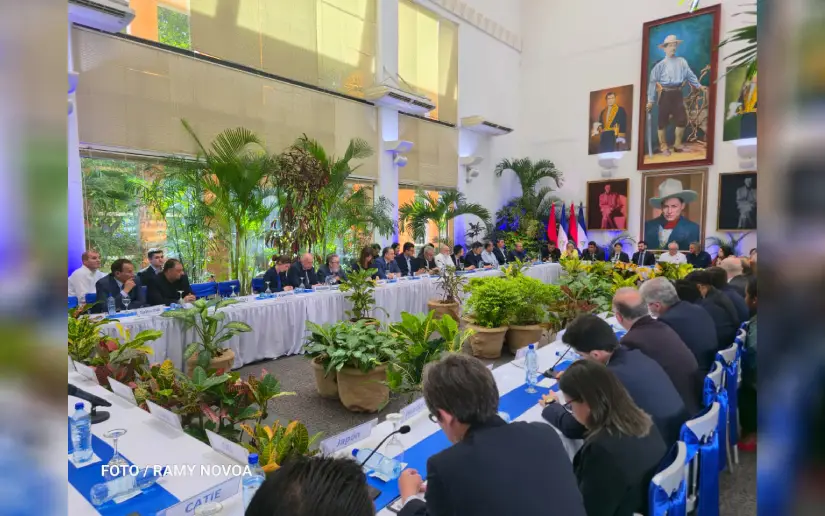
“ENCUENTRO Y CONVERSATORIO AMISTOSO ENTRE EL CUERPO DIPLOMÁTICO Y MISIONES ACREDITADAS EN NICARAGUA, Y NUESTRAS AUTORIDADES, SOBRE LA ORGANIZACIÓN DE NUESTROS PROCESOS ELECTORALES SOBERANOS”, EN CANCILLERÍA.
Lunes, 27 de Julio de 2026
Palabras del Compañero Valdrack Jaentschke
Co Canciller de Nicaragua
Agradecemos su presencia, agradecemos la respuesta que han dado a esta reunión. Tenemos bastante tiempo de no vernos en este formato. Y creo que es un formato bastante útil para que podamos tener la información.
Sin más, Doctor Porras, le paso la palabra.
Palabras del Doctor Gustavo Porras
Presidente de la Asamblea Nacional
Gracias. Buenas tardes a todos y todas. Buenas tardes a los Compañeros del Gobierno, a los Hermanos del Gobierno y a todos los Presentes.
Agradeciéndole la participación, la presencia que nos permita explicarles esta tarea que tenemos de una Reforma Constitucional para garantizar nuestros Principios de Democracia, de Soberanía y de Autodeterminación, y que nos permita garantizar las condiciones para continuar con esta Lucha contra la Pobreza que tenemos.
Les saludamos a todos y quiero expresarle, proba-blemente es una cosa repetitiva, reiterada, pero absolutamente indispensable. Porque, a partir del Discurso del CoPresidente, el Comandante Daniel Ortega, se generaron una cantidad de interpretaciones que es importante dejar claro que ese planteamiento vamos a cumplirlo fielmente y, además, de la mejor forma posible.
Entiendo que una Democracia está determinada por el respeto a las Leyes y el respeto a los procedimientos legales existentes, y que la Ley fundamental, la Ley que determina todo el orden de un País, en cada uno de sus Países, es la Constitución de la República. Y que lo que dicta la Constitución es lo que todos los ciudadanos debemos hacer.
En el Discurso del Comandante Daniel, hay una parte que dice: “Pero que se olviden, aquí no volverán a haber Elecciones, no volverán a haber Elecciones, para que por ahí intenten ellos atrapar el Gobierno, atrapar el Poder.
Y vamos a trabajar, con la Asamblea Nacional y con las Organizaciones correspondientes, las Leyes, porque hay que hacer las Leyes que les pongan un muro, un bloque a los golpistas, a los vendepatrias y que por mucha plata que les den los yanquis, ¡No Podrán! ¡No Podrán! ¡No Podrán!”.
Con este Mandato y además con nuestra Historia, con el Espíritu de nuestros Principios y el Espíritu Sandinista Nicaragüense, porque como pueden ver Ustedes aquí estamos de los diferentes Partidos, y el Espíritu Sandinista poco a poco va siendo el Espíritu nicaragüense. Porque Sandino hoy es la expresión, junto con Darío, la expresión más fuerte de los nicaragüenses.
De tal forma que vamos a trabajar una Reforma Constitucional donde debe quedar claro que sí van a haber Elecciones. Porque estoy claro de que esa es la preocupación. Sí van a haber Elecciones. Sí hay Elecciones. Los nicaragüenses, con nuestro Espíritu de Soberanía y Autodeterminación vamos a hacer las Elecciones del Pueblo nicaragüense, para el Pueblo nicaragüense y para la realidad y la historia del Pueblo nicaragüense. Y eso lo queremos dejar garantizado: ¡Van a haber Elecciones!
Claro, como en todos los Países, probablemente en los Países de ustedes existen determinadas condiciones para aquellos que participan en los Procesos Electorales, determinadas circunstancias para los que quieran participar en Procesos Electorales.
Y en nuestro País nosotros estamos estudiando, estamos viendo las Reformas Constitucionales que nos permitan garantizar Elecciones Libres, Democráticas, Transparentes, pero que tengan las condiciones para garantizar la Estabilidad, la Seguridad y la Paz, que son elementos esenciales para la Lucha contra la Pobreza.
Probablemente algo de lo que les voy a leer aquí no es ajeno para ustedes, porque probablemente en muchos Países debe existir; pero parte de la Reforma es algo como que no podrán ser candidatos a cargos de elección popular, ni podrán ejercer cargos públicos por designación electoral y de la Presidencia, quienes ejerzan o hayan ejercido la dirección, liderazgo, financiamiento, participación directa o indirecta, o cualquier tipo de vinculación con la planificación, preparación o ejecución de un intento de Golpe de Estado o de un Golpe de Estado consumado.
No sé si habrá algún País donde alguien intente un Golpe de Estado y después... Pero si no lo hay, no importa. Ahora, sí pretendemos en nuestra Constitución que quede establecido que no puede tener ese Derecho Político alguien que ha atentado contra el orden de la Revolución Nicaragüense, y, asimismo, a los que incurran o hayan incurrido en actos que menoscaben la Independencia, la Soberanía y la Autodeterminación de Nicaragua; que inciten o promuevan la injerencia extranjera; pidan
intervención militar; se organicen con financiamiento proveniente del extranjero; propongan, gestionen o respalden bloqueos económicos, comerciales o financieros y sanciones contra el Estado de Nicaragua, sus Instituciones y sus Ciudadanos. Eso está clarísimo, por eso les decía, probablemente no sea algo extraño.
Lo que sí va a tener la propuesta que tenemos, es elevar esto a un rango constitucional. Esa es la propuesta, darle fuerza, establecer ese muro constitucional para que alguien no pueda ser candidato, de algún cargo en Nicaragua, levantando la bandera de que nos intervengan militarmente. Eso no puede ser, eso es inaceptable.
Entonces, en esencia es eso, y la Reforma lo que lleva es, estos aspectos, naturalmente, como en todo País, el que viola la Constitución también no puede ser, porque ¿cómo vas a violar la Constitución de la República y va a ser candidato en el país?
Entonces, yo quiero transmitirles la tranquilidad de que este es el objetivo de nuestra Reforma. Por el contrario, es garantizar la Democracia, es garantizar las Elecciones Libres, sin injerencia extranjera; es garantizar las Elecciones donde no haya financiamiento externo; es garantizar las Elecciones absolutamente democráticas, para el Pueblo nicaragüense.
Ustedes que están haciendo su trabajo diplomático seguramente conocen muy bien la Historia de nuestro País. En nuestro País hubo, en algún momento, tropas de intervención que se erigieron en Consejo Supremo Electoral, y hubo tropas de intervención donde sus oficiales eran los Presidentes de las mesas de votación, allá por los años 1930. De esa historia tenemos que aprender. En nuestro país hubo Embajadores que anduvieron haciendo proselitismo político y entregando paquetes alimenticios, en una campaña electoral con un candidato a la par. De esa historia tenemos que aprender. Eso no es una Elección Libre, eso no es una Democracia Libre.
O el mejor ejemplo que tenemos es el del 90, donde los nicaragüenses teníamos, figuradamente y realmente diría yo, una pistola en la cabeza: “Si los Sandinistas ganan las Elecciones, la guerra va a continuar”. Y el Pueblo es inteligente, y nuestro Pueblo nos enseñó que había que buscar la Paz. Y lo entendimos. Y aún con esa imposición, el Comandante Daniel entregó el Gobierno. Porque lo entendimos, porque entendimos que lo más importante era la Paz.
Recuerdo que el Comandante Daniel dijo: “Y vamos a regresar al Gobierno por la vía de los votos”, tal y como lo hicimos en el 2006-2007.
Es decir, en Nicaragua los sectores políticos, el Frente Sandinista y los demás Partidos que nos acompañan en la Asamblea, hemos aprendido a jugar la Democracia, pero en el buen sentido. Y trabajamos y luchamos y caminamos hasta ir desarrollando este Modelo que poco a poco se va instaurando, que es el Modelo del Pueblo Presidente. Es un Modelo de Protagonismo del Pueblo.
Entonces, para no cansarles el cuento, la primera conclusión o el primer mensaje es: ¡Sí, van a haber Elecciones! ¡Sí, van a ser Elecciones Democráticas! Quizás, tal y como han sido las Elecciones, siempre dirigidas por Gobiernos Sandinistas o estando Gobiernos Sandinistas. No hay Elecciones más democráticas, la del 90, la del 2006-2007, ¡absolutamente democráticas! Y todas las posteriores. Y lo que estamos buscando es cómo garantizar que sean cada vez más claras, más transparentes, más democráticas, y con menos enredos de parte de personajes, construidos de la noche a la mañana, para enturbiar el Proceso Democrático nicaragüense. Eso es lo primero que tenemos que estar claros y que queremos transmitirles.
Y aquí están, es más, me atreví, no me atreví, leí algunas de las cosas que ahorita estamos discutiendo... Sí me atreví, pues, porque los Compañeros me pueden reclamar. Pero ese es el sentido. Estos son los muros de contención. O sea, si aquí alguien no es nicaragüense o, además, es Traidor a la Patria, ¿en algún País, un traidor a la Patria va a participar en un Proceso Electoral Democrático? Creo que no. Si alguien es un violador de la Constitución Política de su País, no participa, o de todas las cosas que mencioné aquí.
Por otro lado, en la Reforma Electoral también se toca, porque esto hay que garantizarlo, entonces el Consejo Supremo Electoral es el que tiene la función, la atribución de ejecutar estos aspectos electorales. Entonces, parte de la Reforma es, en un Artículo que corresponde a las atribuciones del Consejo Supremo Electoral, va a decir que una de las atribuciones tiene que ver con denegar Personalidad Jurídica en el caso de Partidos Políticos que quieran llevar candidatos que la Constitución no lo permite; o en el caso de cancelar la candidatura de personas que están dentro de esta cantidad de prohibiciones que están establecidas. Entonces se mandata al Consejo Supremo eso.
Hay otro punto que estamos discutiendo dentro de la Comisión, a duras penas, esta explicación a ustedes, es una explicación que se dispuso antes de comenzar el Proceso de Consultas que iniciaría mañana y que va a ser un Proceso que nos va a llevar todo el mes de Agosto, porque tenemos en nuestra mente, en nuestra idea, aprobar esto en el Mes de la Patria, a inicios del Mes de la Patria, que es el mes de Septiembre. Pero vamos a hacer un Proceso de Consultas amplísimo, diría yo, durante todo el mes.
Y ahí vamos a ver también otros aspectos. Por ejemplo, los aspectos que tienen que ver con los tiempos. Nosotros ahorita tenemos un tiempo determinado para las Elecciones, de seis años. Ahí tenemos que ver si se puede modificar o no se puede modificar, o se debe modificar. Nosotros pensamos que hay que establecer un tiempo que nos permita Estabilidad, Seguridad y Paz, porque nosotros tenemos un solo enemigo, es la Pobreza, y tenemos que garantizar tiempos electorales que permitan desarrollar trabajos, esfuerzos, proyectos, iniciativas, en esa Lucha contra la Pobreza. Pero todavía no tenemos tiempo definido, en el sentido de que estamos discutiendo.
Hay Países que tienen 10 años, hay otros Países que tienen 7. Hay bastantes Países que tienen 7. Hay otros Países que tienen 6 años. Hay otros Países de 5 años. Recientemente hubo Países que pasaron de 5 a 6 años. Nosotros habíamos pasado de 5 a 6, en una Reforma Constitucional del año pasado. Y hay países que tienen 4 años, que muchas veces se vuelven 8. Es como decir 8 pero que no sean 8, que sean de 4 en 4. Es decir, todo eso existe.
Vamos a discutir qué es lo que le conviene a Nicaragua. Esta es una discusión de los nicaragüenses para ver qué es lo que le conviene a Nicaragua de acuerdo a nuestra historia, de acuerdo a nuestras posibilidades, de acuerdo a nuestros proyectos, de acuerdo a nuestra visión, para el beneficio de nuestro Pueblo.
Sin embargo, sin duda, para nosotros es de gran importancia tenerlos a Ustedes aquí, porque cuando se establece un Representante Diplomático y cuando se establecen Organismos Internacionales con sus Delegados y sus Representantes estamos claros que hay una amistad, y nosotros somos respetuosos de todos nuestros amigos que son respetuosos con nosotros, y lo menos que podemos hacer es brindarles las informaciones que en este momento tenemos definidas.
¿Van a haber Elecciones? Sí. ¿Las Elecciones van a tener un nivel de intención tal y como lo mandató el Presidente? Sí, es decir, absolutamente justo, necesario, nada anormal. Vamos a estudiar los tiempos y también hay algunos artículos de la Constitución que debemos de modificar para la parte operativa de las decisiones, como es lo que les expliqué del Consejo Supremo Electoral o como sería la necesidad de ajustarse, en el caso que hubiera un cambio del tiempo, del periodo, hay que ajustar lo que existe en este momento.
Eso es en esencia, y más bien, aquí estamos todos, ya les presentaron a los miembros de la Comisión Especial Constitucional, si hay alguna duda, alguna inquietud, estamos a sus órdenes. Gracias.
Palabras del Compañero Valdrack Jaentschke
Muchas gracias, Doctor, por esa clara exposición.
Efectivamente es importante subrayar que los miembros presentes de la Asamblea Nacional, además de miembros de la Junta Directiva, son miembros de la Comisión Especial dictaminadora, para este tema. Por eso vemos miembros de distintas Fuerzas Políticas, miembros de distintos Partidos que conforman esa Comisión Especial.
Dejamos abierto el micrófono para ver quién quisiera comentar, preguntar, creo que más bien preguntar. Vamos a dejar circunscrito a la pregunta. Muchas gracias. Solo levantan la mano, tienen los micrófonos cerca, se los comparten.
Qué claridad, Doctor, absoluta claridad de las vías. Ni la mínima sombra de duda sobre su presentación. Ya se fueron las cámaras.
Compañera del Banco Interamericano de Desarrollo.
Palabras de la Señora Shirley Cañete Romero, Representante del Banco Interamericano de Desarrollo (BID)
Primero que nada, agradecer esta convocatoria. Creo que es importante para nosotros recibir información de primera mano de parte de Ustedes, y como bien informa Doctor Porras, van a empezar un Proceso de Consultas y ese Proceso tiene como varias aristas.
Entonces, talvez agradecer la oportunidad de que estas reuniones sean consecutivas y nosotros podamos tener esa información de primera mano y no información que estamos leyendo eventualmente en prensa, para poder informar con claridad a nuestros respectivos Organismos y Embajadas. Entonces, muchísimas gracias por toda esta información que nos acaba de suministrar y ojalá podamos ser parte de este Proceso, para poder entender cómo avanzan las Elecciones de Nicaragua.
Tampoco sabemos fecha, pero entendemos que, respectivamente, hacia el próximo año. Gracias.
Palabras del Compañero Valdrack:
Gracias, Representante.
Palabras del Señor Fernando Ponz
Embajador de la Unión Europea:
Bueno, buenas tardes y una vez más, gracias por este encuentro amistoso. En nombre de los Estados miembros de la Unión Europea y del mío propio, les agradezco profundamente esta presentación que entra dentro del espíritu de diálogo y que nos ayuda a comprender mejor.
Como parte de la Reforma que nos han presentado, me gustaría aprovechar esta oportunidad que nos dan y siempre desde el más absoluto respeto a la Soberanía Nacional de Nicaragua, para preguntarles si tienen Ustedes la intención de organizar algún tipo de Observación independiente de las próximas Elecciones. Y, por supuesto, reitero, esto es desde el más absoluto respeto a esta decisión que les pertenece a Ustedes.
Una vez más, gracias por este encuentro amistoso. Como ha dicho nuestra colega, es un formato que esperamos que continúe, se los agradecemos, y es un formato que nos permite tener un diálogo, incrementar la transparencia, conocer de primera mano sus puntos de vista y todo desde el respeto máximo, el respeto mutuo. Gracias.
Palabras del Compañero Valdrack Jaentschke:
Gracias, Embajador Ponz.
Vamos a hacer dos, tres, cuatro, cinco preguntas y después le pasamos la palabra al Doctor Porras.
¿Alguien más?
Palabras del Doctor Gustavo Porras
Bueno, debemos de reconocer la importancia de estos acercamientos, de estos espacios, nos toca a nosotros informarles, como una referencia y con el espíritu de amistad que los nicaragüenses tenemos con todos aquellos que nos respetan.
Ahorita estamos trabajando en lo que es la Reforma Constitucional, y les animo a Ustedes a transmitir la decisión, la tranquilidad, la decisión soberana, la explicación, podemos llamarla, de que en este País van a haber Elecciones como siempre han habido en los últimos años. Explicándoles un poco la historia de cómo eran y cómo no queremos que vuelvan a ser. Pero esa es la transmisión de la inquietud que tenemos y la discusión que tenemos los nicaragüenses para llevar adelante este proceso. Y lo que estamos haciendo son Reformas Constitucionales que nos garanticen eso. Ya leí la otra parte.
Ahora, nuestras Elecciones siempre han sido observadas, acompañadas, llamamos nosotros, porque realmente son acompañadas, y así lo haremos, porque son absolutamente democráticas.
Imagínense que la pregunta del Embajador Ponz yo se la agradezco, porque es una pregunta que nos tira más allá, es decir, ya la discusión no es que si hay o no hay Elecciones, que eran la que había hasta ahora; ahora la pregunta es si va a haber o no va a haber acompañamiento. Pero ya estamos, pues, en lo que estamos, claritos de que estamos en un proceso, estamos escuchando, hemos recogido las inquietudes y atendiendo la solicitud de los amigos. Vamos a irles informando cómo va este Proceso y poco a poco van a ser datos más concretos, obviamente, porque ahorita apenas vamos a comenzar el proceso. Vamos a transmitir eso.
Y tengan seguro que el Pueblo nicaragüense va a respaldar este Proceso y va a acompañar también las Elecciones de los nicaragüenses, para los nicaragüenses.
Palabras del Compañero Valdrack Jaentschke:
Muchísimas gracias, entonces, por haber participado en este esfuerzo, y creo que la presentación del Doctor Porras es meridianamente clara y absolutamente informativa. No voy a osar repetir, porque fue clara y fue informativa, y creo que incluso las dos intervenciones que hubo, de mucha calidad, en el sentido de que terminaron de dejar la foto; esperamos que esa sea la foto que se transmita, lo que dijo con contundencia el Doctor Porras.
Nicaragua, un País, lo voy a repetir, Doctor, un País democrático, donde hay Elecciones Democráticas, donde defendemos nuestro Proceso y nuestro Modelo y donde van a haber Elecciones. Y como hemos organizado este Proceso lo vamos a seguir organizando, con la calidad, pero fundamentalmente respondiendo a nuestro Pueblo nicaragüense, son los intereses nicaragüenses, la defensa del Modelo nicaragüense, la defensa de la Democracia nicaragüense, de la Paz y el Bienestar. Creo que me va a regañar el Doctor por andarlo parafraseando, pero creo que eso es con claridad lo que expuso el Doctor y para lo cual es esta reunión.
Si alguien, después de todas estas intervenciones, siente la necesidad urgente de hacer otra pregunta o hacer otra intervención, vamos a dejar los próximos segundos para que se decidan. En vista que solo sonrisas, vamos a dar por concluida esta reunión, nuevamente agradeciéndoles su presencia, agradeciéndoles su disposición a acompañar este Proceso, a estar permanentemente informados, y agradeciendo también que ustedes trasladen esta información como se la estamos brindando. Ya saben en lo que estamos, no necesitamos explicarles más, pero Ustedes también son portadores de una información que es vital. Muchísimas gracias. Buenas tardes.
------------------------------------------------------------------------------------------------------------------------
NICARAGUA TRIUMPHS IN PEACE AND UNITY
ALWAYS FURTHER ON
The Foreign Ministry reported "An amicable meeting and exchange between our authorities and the Diplomatic Corps and accredited Missions on the organization of our sovereign electoral processes”.
Monday, July 27th 2026
Introductory remarks by Compañero Valdrack Jaentschke
Co-Chancellor of Nicaragua
We appreciate your presence, we appreciate the response you have given to this meeting. It’s a long time since we have seen each other in this format. And I think it's quite a useful format for us to share information.
Without further ado, Doctor Porras, I give you the floor.
Address by Dr. Gustavo Porras
President of the National Assembly
Thank you. Good afternoon, everyone. Good afternoon to the Compañeras and Compañeros of the Government, to the Brothers and Sisters of the Government and to everyone present.
Thanking you for your participation, your presence which allows me to explain to you this task that we have set of a Constitutional Reform to guarantee our Principles of Democracy, Sovereignty and Self-Determination, and which allows us to guarantee the conditions to continue the fight against Poverty that we have undertaken.
We greet you all and I want to express to you, probably what is a reiterated, well-repeated, but absolutely indispensable matter. Because, based on the speech of Co-President Comandante Daniel Ortega, a number of interpretations were made such that it is important to clarify that we will comply with this approach faithfully and, moreover, in the best possible way.
I understand that a democracy is determined by respect for the laws and respect for existing legal procedures, and that the fundamental Law, the Law that determines the entire order of a country, in each of your countries, is the Constitution of the Republic. And that what the Constitution dictates is what all citizens should do.
In Comandante Daniel’s speech, there is a part that says: "But they can forget that, there will be no such elections here again, there will be no elections again for them to try and cheat their way to government, cheat their way to power in that way. And we are going to work, with the National Assembly and with the corresponding institutions, on the Law, because we have to make laws that put a wall, a barrier against the coup plotters, the sell-outs, such that no matter how much money the Yankees give them, they won't prevail! They Won't Prevail! They Won't Be Able To!”.
With this mandate and also given our History, with the Spirit of our Principles and the Nicaraguan Sandinista Spirit, although as you can see we are from the different political parties here, but the Sandinista Spirit is gradually becoming the Nicaraguan Spirit. Because Sandino today is the expression, along with Darío, Nicaraguans’ strongest expression.
Such that in this way we will work on a Constitutional Reform in relation to which it should be clear that there will be elections. Because I'm clear that this is the concern. There are going to be elections. Indeed, as there are elections. Nicaraguans, with our Spirit of Sovereignty and Self-Determination, we are going to make elections of the Nicaraguan People, for the Nicaraguan People and in accordance with the reality and history of the Nicaraguan People. And we want to guarantee: There will be elections!
Naturally, as in all countries, probably in your countries too, there are certain conditions for those who participate in electoral processes, certain requirements for those who want to participate in electoral processes.
And in our country we are studying, we are looking at Constitutional Reforms which allow us to ensure free, democratic, transparent Elections, but ones with the conditions to guarantee stability, security and Peace, which are essential elements for combating Poverty.
Probably some of what I am going to read here is not alien to you, because probably in many countries it may well exist; but part of the Reform is to do with those who exercise or have exercised the direction, leadership, financing, direct or indirect participation, or any type of connection with the planning, preparation or execution of an attempted coup d'état or a consummated coup d'état and will not be able to be candidates for positions of popular election, nor will they be able to hold public office by electoral appointment nor the Presidency.
I do not know if there may be some country where someone will attempt a coup and afterwards... But even if there is not, it doesn't matter. Now, we do intend to establish in our Constitution that someone who has attacked Nicaragua’s revolutionary order and also those who commit or have committed acts that undermine Nicaragua’s Independence, Sovereignty and Self-Determination; who incite or promote foreign interference; who seek the political right to military intervention; or organize with financing from abroad; or propose, manage or support economic, commercial or financial blockades and sanctions against the State of Nicaragua, its Institutions and its Citizens. That's very clear, that's why I said to you, it's probably not something unusual.
So the proposal we have or are going to have is to raise this to a Constitutional level. That is the proposal, to give it strength, to establish that Constitutional barrier so that someone cannot be a candidate for some office in Nicaragua, raising the banner of military intervention against us. That cannot be, that is unacceptable.
So, in essence that's it, and the leading Reform of these aspects, naturally, as in every country, is that anyone who violates the Constitution cannot stand, because how are you going to violate the Constitution of the Republic and stand as a candidate in the country?
So, I want to convey to you, in a considered way, that this is the objective of our Reform. Above all, it is to guarantee Democracy, it is to guarantee free elections, without foreign interference; it is to guarantee Elections where there is no external financing; it is to guarantee absolutely democratic elections for the Nicaraguan people.
As working diplomats you certainly know the history of our country very well. In our country there were, at one point, occupying troops who became the Supreme Electoral Council, and there were occupation troops whose officers were presidents of polling stations, back in the 1930s. We have to learn from that history. There were ambassadors to our country who went around doing political campaigning and delivering food packages, in an electoral campaign with a candidate by their side. We have to learn from that history. That is not a free election, that is not a free Democracy.
Or the best example we have is that of the 1990 election, when Nicaraguans had, both figuratively and I would say literally, a gun to their head: “If the Sandinistas win the elections, the war will continue.” And the People are intelligent, and our People taught us that we had to look for Peace. And we understood that. And even with imposed outcome, Comandante Daniel handed over the government. Because we realized, because we understood that the most important thing was Peace.
I remember that Comandante Daniel said, "And we are going to return to government by way of elections,” as in fact we did in 2006-2007.
That is to say, in Nicaragua the political sectors, the Sandinista Front and the other political parties that accompany us in the Assembly, have learned to deal with democracy, but in a good way. And we have worked and struggled and made our way so as to develop this Model that is gradually becoming established, which is the model of the People President. It is a model of the People's protagonism.
So, in order not to bore you with the story, the first conclusion or the first message is: Yes, there are going to be Elections! Yes, these are going to be Democratic elections! As elections under Sandinista Governments or being Sandinista Governments have always been, after all. Those elections could not have been more democratic, the one in 1990, the one in 2006-2007, absolutely democratic! And all the elections thereafter. And what we are looking for is how to ensure that they are increasingly clearer, more transparent, more democratic, and with fewer machinations from individuals, produced overnight, to confound Nicaragua’s democratic process. That's the first thing we have to be clear about and which we want to convey to you.
And so there you are, in fact, I might have dared, although I did not actually do so, to read out all of the things that we are discussing right now... I did read some and perhaps my Compañeros and Compañeras might call me to account. But that's the sense. These are the retaining walls. In other words, if someone here is not Nicaraguan or, moreover, is a traitor to our Patriotic Nation, is such a traitor to the Nation to participate in a Democratic Electoral Process in any Country? I think not. If someone violates the political Constitution of their country, or any of the things I have mentioned here, then they do not participate.
On the other hand, the Electoral Reform also touches on, because this must be guaranteed, that the Supreme Electoral Council is the entity that has the function, the attribution of executing these electoral elements. So, part of the Reform is, in an article relating to the powers of the Supreme Electoral Council, it will say that one of the powers has to do with denying legal personality in the case of political parties that want to present candidates that the Constitution does not allow; or in the case of canceling the candidacy of people who are within these various prohibitions that are established. Then the Supreme Council is to be empowered to do that.
There is another point that we are only just discussing within the Commission, this explanation to you is an explanation that was prepared before starting the Consultation Process that starts tomorrow and which is going to be a Process that is going to take us the whole month of August, because we have in our mind, our idea is to approve this in the month of the Patriotic Nation, at the beginning of the Month of the Patriotic Nation, which is the month of September. But we are going to carry out what I would say is a very extensive Consultation Process throughout the month.
And thus we are going to consider other aspects as well. For example, the aspects that have to do with duration. We have a certain duration for the elections, six years. Here we have to see if that can be modified or not, or if it should be modified. We think that it is necessary to establish a duration allowing us stability, security and Peace, because we have only one enemy, which is Poverty, and we have to guarantee electoral periods that allow us to develop work, efforts, projects, initiatives, in that fight against Poverty. But we still have no definite duration, in the sense that we are discussing.
Some countries have ten years, other Countries have seven. Quite a few countries have seven. Other countries have six years. There are other countries with five. Recently some countries went from five to six years. We had gone from five to six, in a Constitutional Reform last year. And there are countries that have four years, which often become eight. It's like saying we want eight but let’s not make it eight, but make it four plus four. I mean, all of that exists.
We are going to discuss what is in Nicaragua's interest. This is a discussion for Nicaraguans to see what is convenient for Nicaragua given our history, given our possibilities, given our projects, according to our vision, for the benefit of our People.
However, without a doubt, it is of great importance for us to have you here, because when diplomatic representation is established and when international organizations are established with their delegates and we are clear that there is friendship, and we respect all our friends who are respectful to us, then the least we can do is provide you with the information that we have defined at the moment.
Are there going to be elections? Yes. Are the elections going to have the kind of intention mandated by the President? Yes, that is to say, absolutely fair, necessary and nothing unusual. We are going to study the electoral periods and there are also some articles of the Constitution that we must modify for the operational part of decision making, such as what I explained to you about the Supreme Electoral Council or how there may be a need to change something, in the event that there was a change of duration, of the electoral period, meaning we have to change what exists at this moment.
That is it in essence, and rather, as we are all here, the members of the Special Constitutional Commission have already been presented to you, if there are any doubts, any concerns, we are at your disposal.
Thank you.
Compañero Valdrack Jaentschke
Thank you very much, Doctor, for that clear statement.
Indeed, it is important to emphasize that the members of the National Assembly present, as well as the members of the Board of Directors, are also members of the Special Advisory Commission on this issue. That is why we see members of different political movements, members of the different parties that make up this Special Commission.
We leave the microphone open to see who would like to comment, or ask questions, I think rather for question. Let's limit it to questions. Thank you very much. Do just raise your hands, you have microphones to hand, do share them.
What clarity, Doctor, absolute clarity in your presentation. Not the slightest shadow of doubt in your presentation. The cameras have gone now.
Compañera of the Inter-American Development Bank
Remarks by Mrs. Shirley Cañete Romero, Representative of the Inter-American Development Bank (IDB)
First of all, thank you for this meeting. I think it is important for us to receive first-hand information from you, and that as Doctor Porras has well informed us, that you are going to start a consultation process and that process has several points.
So, maybe we should be grateful for the opportunity to have these meetings back-to-back and we can have such first-hand information rather than the information we end up reading in the media, so that we can clearly inform our respective agencies and embassies. So, thank you very much for all this information that you have just provided us and hopefully we can be part of this process, so that we can understand how Nicaragua’s elections are progressing.
We also do not know the date, but we understand that it may be, in that regard, towards next year. Thank you.
Compañero Valdrack:
Thank you, Representative.
Mr. Fernando Ponz
Ambassador of the European Union:
Well, good afternoon and once again, thank you for this amicable meeting. On behalf of the Member States of the European Union and myself, I would like to thank you very much for this presentation, which is in the spirit of dialogue and helps us to understand things better.
As part of the Reform that you have presented to us, I would like to take this opportunity you are giving us, and always with the utmost respect for the Nicaragua’s national Sovereignty, to ask you if you intend to organize some kind of independent observation of the upcoming elections. And, of course, I reiterate, this is from the most absolute respect in relation to this decision that belongs to you.
Once again, thank you for this friendly meeting. As our colleague said, it is a format that we hope will continue, we thank you, since it is a format that allows us to have a dialogue, increase transparency, get to know your points of view first-hand and all out of the utmost respect, a mutual respect. Thank you.
Compañero Valdrack Jaentschke:
Thank you, Ambassador Ponz.
We are going to ask two, three, four, five questions and then we can give the floor to Dr. Porras.
Anyone else?
Dr. Gustavo Porras
Well, we must recognize the importance of these get togethers, of these spaces, it is up to us to inform you, as a point of reference and in the spirit of friendship Nicaraguans have with all those who respect us.
Right now we are working on what the Constitutional Reform will be, and I encourage you to convey the decision, the tranquility, the sovereign decision, the explanation, we might say, that in this country there are going to be elections as there have always been in recent years. Explaining a little the history of how they used to be and how we don't want them to be again. And this is to communicate the concern that we have and the discussion that Nicaraguans are having, to carry out this process. And what we are doing are constitutional reforms that guarantee this. I've already read the other relevant part.
Now, our elections have always been observed, accompanied, we call it, because they really are accompanied, and they will continue to be so, because the elections here are absolutely democratic.
You can be sure that I thank Ambassador Ponz for his question, because it is a question that takes us further on, that is to say, that the discussion is no longer about whether or not there are elections, which was the discussion that existed up until now; now the question is whether or not there will be accompaniment. But we are now where we are, clear that we are in a process, we are listening, we have collected concerns and are paying attention to friendly requests for information. We will continue to inform you how this process is going and little by little the data will be more concrete, obviously, because right now we are just going to start the process. Do let’s communicate that.
And be assured that the Nicaragua’s People will support this process and will also accompany the elections of Nicaraguans, for Nicaraguans.
Compañero Valdrack Jaentschke:
Thank you very much, then, for having participated in this effort, and I think that Dr. Porras' presentation has been crystal clear and absolutely informative. I'm not going to venture to repeat it, because it was clear and informative, and I think also that the two comments were of a very high quality, in the sense that they helped complete the snapshot; we hope that this will be the photograph that is transmitted of what Doctor Porras has said so forthrightly.
Nicaragua, a country, I'm going to repeat it, Doctor, a democratic country, with democratic elections, where we defend our process and our model and where there are going to continue to be elections. And as we have organized this process, we will continue organizing it, with quality, but fundamentally responding to our Nicaraguan People, to Nicaragua’s interests, to the defense of Nicaragua’s Model, the defense of Nicaragua’s Democracy of Peace and Well-being. I think the Doctor may well tell me off for paraphrasing him, but I think that's clearly what the Doctor explained and what the purpose of this meeting has been.
If someone, after all this exchange, feels an urgent need to ask another question or make another comment, we will leave the next few seconds for them to decide... Since there are only smiles, then we are going to conclude this meeting, thanking you again for your presence, thanking you for your willingness to accompany this process, to be kept up to date, and also thanking you for transmitting this information as we have provided it to you. You know what we are doing now, we don't need to explain more, and you also are communicators of this vital information.
Thank you very much. Good afternoon.